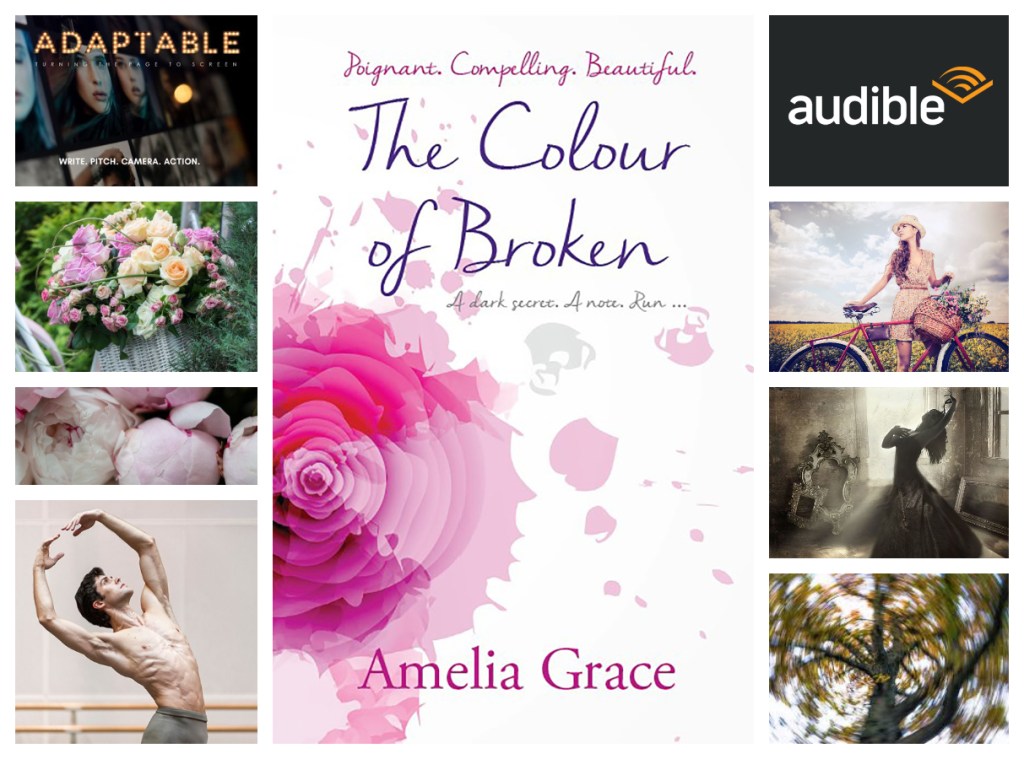
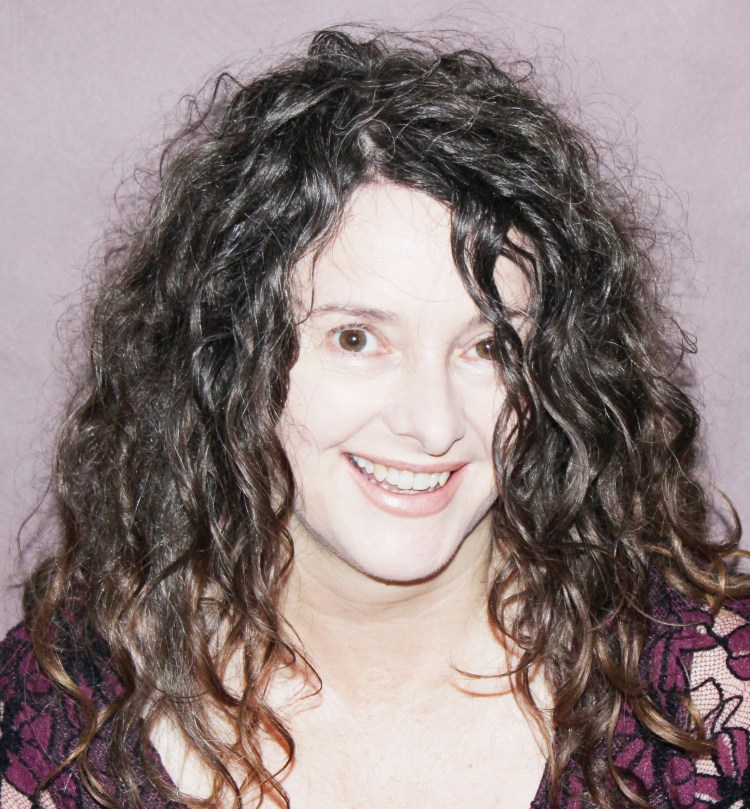
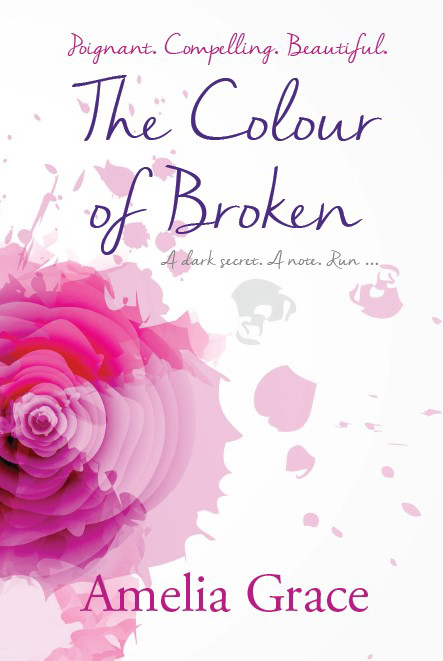
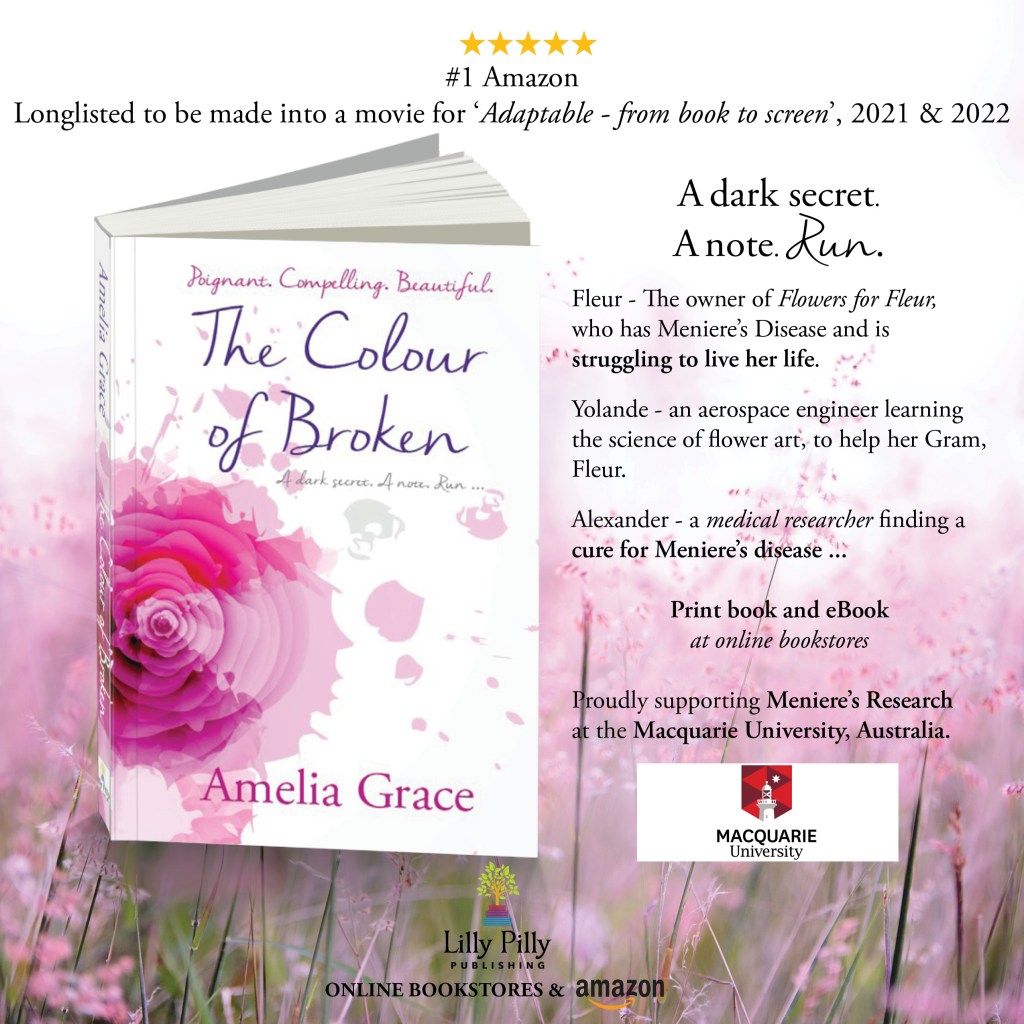
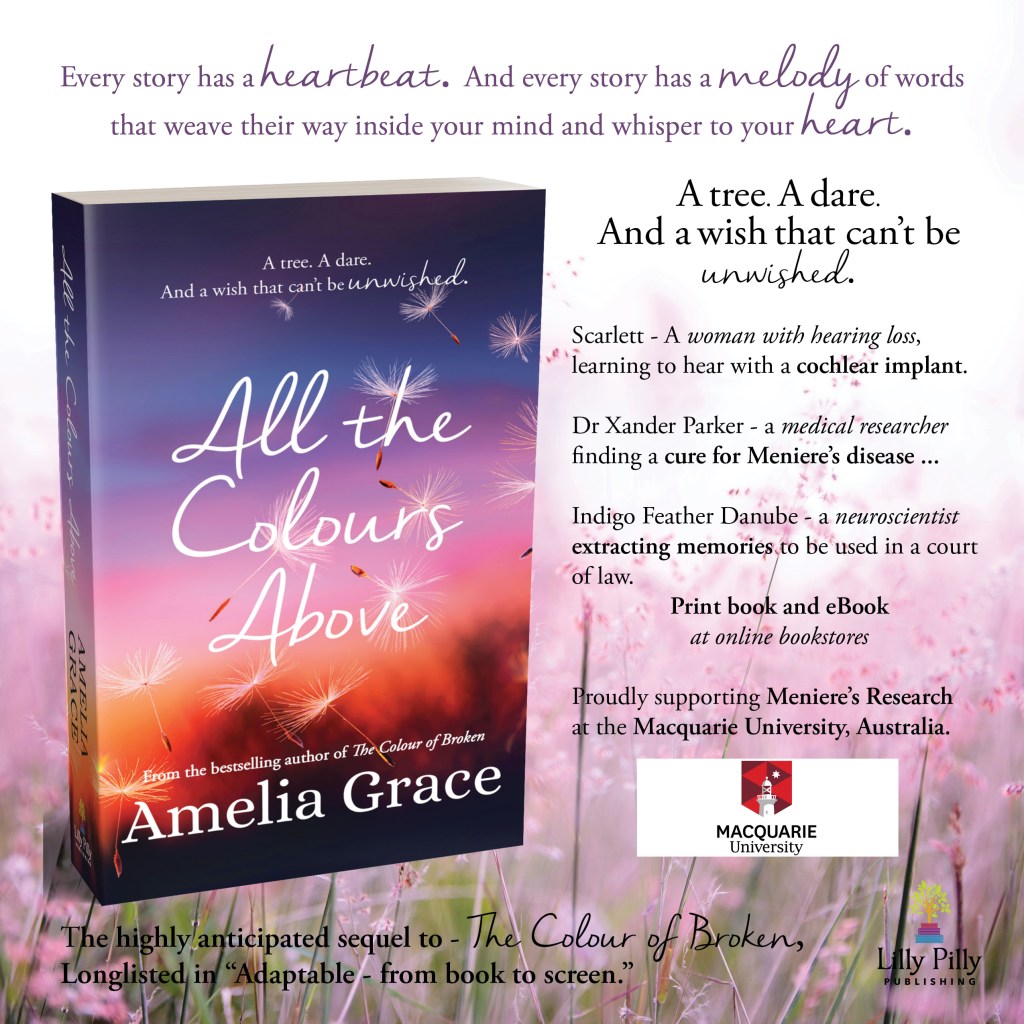
Julieann Wallace is a multi-published author and artist. When she is not disappearing into her imaginary worlds as Julieann Wallace – children’s author, or as Amelia Grace – fiction novelist, she is working as a secondary teacher. Julieann’s 7th novel with a main character with Meniere’s disease—‘The Colour of Broken’—written under her pen name of Amelia Grace, was #1 on Amazon in its category a number of times, and was longlisted in 2021 and 2022, to be made into a movie or TV series by Screen Queensland, Australia. She donates profits from her books to Macquarie University, Curtin University and University of Sydney, where they are researching Meniere’s disease to find a cure. Julieann is a self-confessed tea ninja and Cadbury chocoholic, has a passion for music and art, and tries not to scare her cat, Claude Monet, with her terrible cello playing.
It feels like there’s awareness days, weeks, and months for almost everything, connecting and educating people. Even odd and peculiar things. Like Popcorn Day, Nothing Day, Lost Sock Day, Punctuation Day, Handbag Day, Men Make Dinner Day, Fruitcake Toss Day, Nothing Day, Odd Socks Day, Put a Pillow on Your Fridge Day.
Except for Ménière’s disease.
Awareness Days for February 7, depending on what country you are in:
Rose Day
It’s Ice Cream For Breakfast Day
Yukon Quest
International Pisco Sour Day
National Black HIV/AIDS Awareness Day
Wave All Your Fingers At Your Neighbors Day
Send a Card to a Friend Day
National Ballet Day
National Fettuccine Day
National Periodic Table Day
e-Day by disconnecting from screens and embracing the world around you
Independence Day Grenada
Take Your Child to the Library Day
Safer Internet Day
My favourite is Ice Cream for Breakfast Day!
(Adobe Stock)
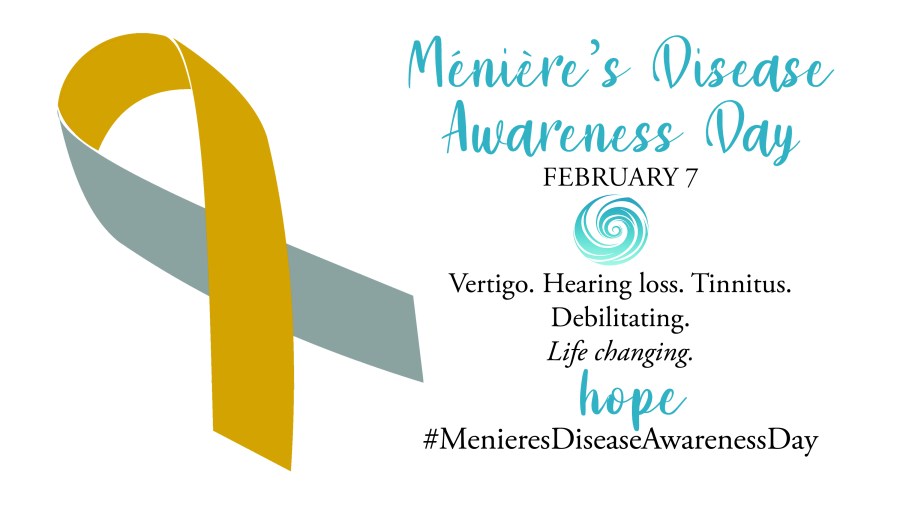
But now (drum roll please) there’s a new awareness day for February 7, on the US National Today Calendar – Ménière’s Disease Awareness Day.
A victory. For us. Recognition.
I would spin around in celebration, but you know, the vertigo of MD is a dizzy terror that no one wants to experience. But seriously, if you think it’s not that bad, please sit in an office chair, and let me spin you around as fast as I can for four hours, no stopping. Or, for some real fun, stay on that spinning ride at the fair for four continuous hours without getting off. And let’s not forget the loud tinnitus – often multiple sounds, ear fullness, hearing loss, loss of balance, anxiety plus more. It’s devastating, physically, emotionally, socially, psychologically, economically… My cochlear implant audiologist told me that Ménière’s is the disease that no doctor wants!
Backstory
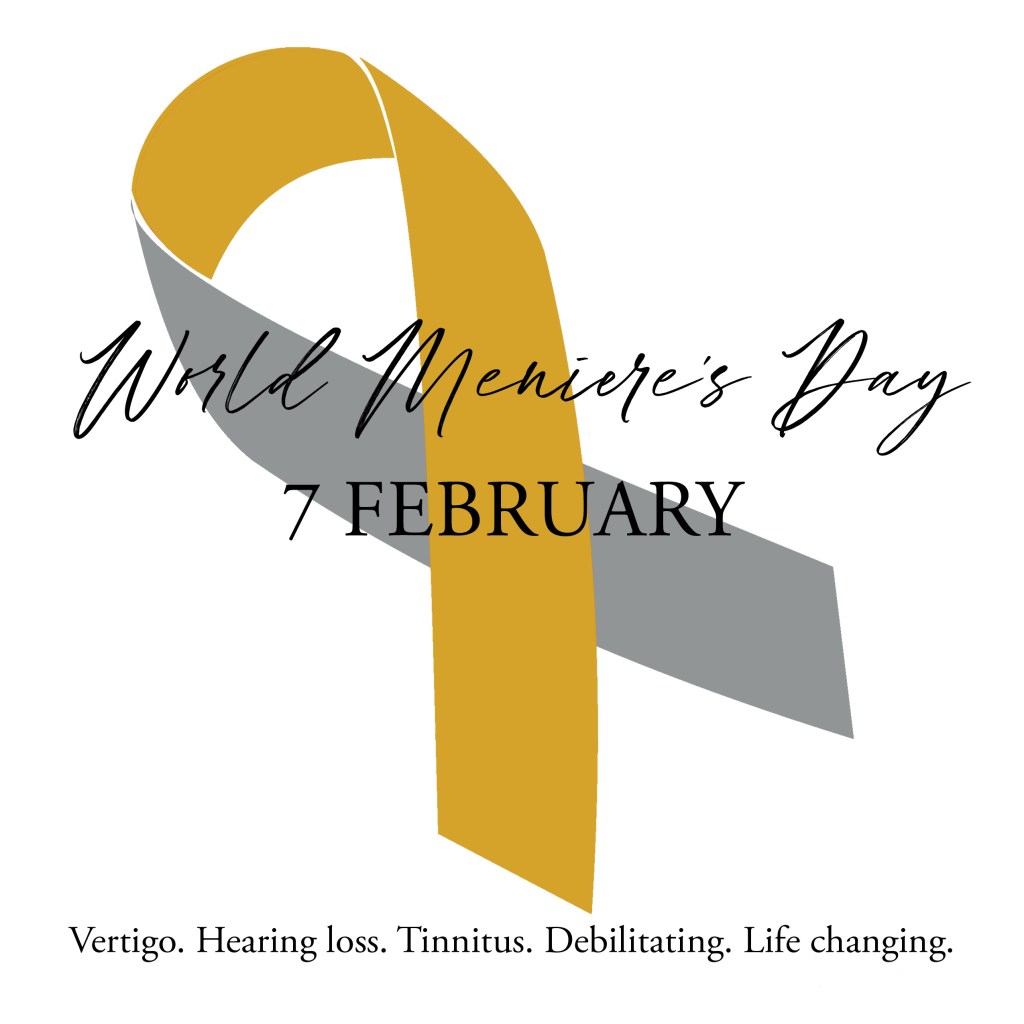
I was instrumental in having this day recognised, but I can’t take all the credit for 7 February, World Ménière’s Day. I just continued it on. I originally saw other people share this graphic in 2018, and thought it was an officially recognised day.
After I searched like a detective, I traced the graphic back to a group called Moms with Meniere’s Disease. It was first posted on February 8, 2017.
I loved that she had created this (unofficial) day for us. But when I looked at the graphic, I thought, no one understands what Ménière’s disease is. So I tried to contact the admin of Moms with Ménière’s Disease to chat with her, to find out her name, and to ask for permission to use her idea and date. No success. In fact, the last post there was November 5, 2018.
So I decided to build on what she had created.
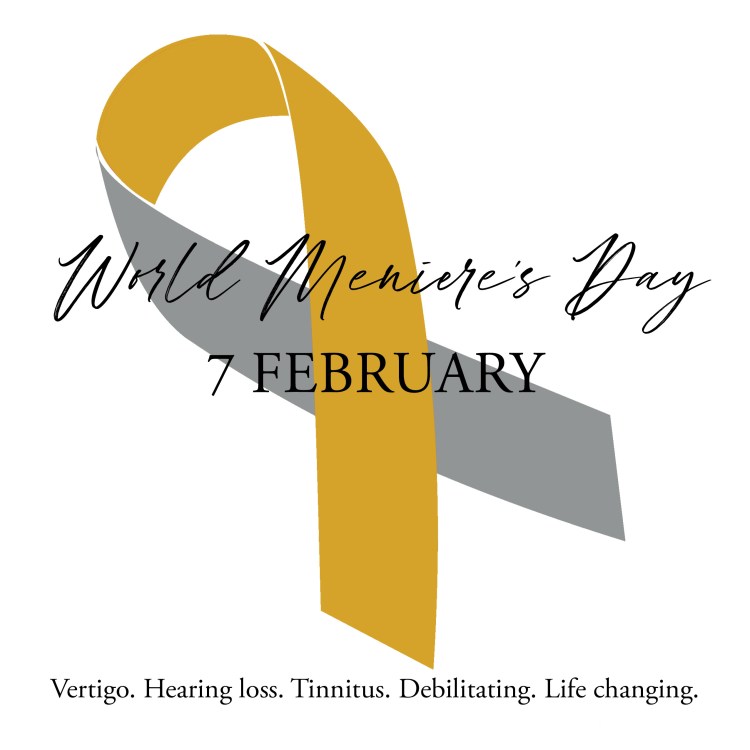
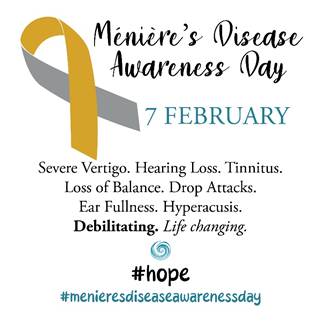
I updated the graphic, and added symptoms, so people could at least see what we were going through.
On February 7, 2024, after I posted the World Ménière’s Day graphic in the Ménière’s Disease Support Group, someone told me it wasn’t an official day. It was true, and it really annoyed me. So I decided to do something about it.
In January, 2025, I spent days on the internet researching international and national days organisations to try to get Ménière’s disease acknowledged as a day of recognition ready for February 7, 2025. I sent off emails that included detailed stats on Ménière’s s, lists of symptoms, famous celebrities, and the history of Prosper Meniere, the doctor whom the disease is named after. Many official awareness calendars required a doctor to apply for the day, but I still emailed them anyway.
No success.
The biggest organisation I emailed was the United Nations List of International Days and Weeks, with hope that Ménière’s would be recognised as an International Day, but I didn’t get a reply.
People were suffering. No one had heard of Ménière’s disease. I hated that we were invisible. And why should basketball get an official international day but not an incurable disease that destroys lives?
On February 7th, 2025, I posted these graphics to the Meniere’s Disease Support Group, founded by Glenn Schweitzer (Mind Over Meniere’s)
with the words…
“It’s World Meniere’s Day today.
It’s not an official day, but was started by someone a very long time ago. Last year I applied for it to be identified as a day of recognition, but it was rejected 🙁
Have a spin free day on this day of our acknowledgement ❤
And you have permission to use my Meniere’s designs if you like x”
Many people replied in support, but it was this reply by Jeannine that made my heart skip a beat.
Jeannine
“Hello Julieann Wallace. I saw your post and contacted the head of National Today who confirmed by email he would recognize it. I hope it happens – I’ll share it when I see it:) I believe this is a debilitating disease that more people need to know about bc it affects so many 🥺”
Thank you Jeannine! It is done. Meniere’s Disease Awareness Day 7th February. (I wanted a different picture to be used on the site, so it was inclusive of men and women – but we’ll take this as a win)
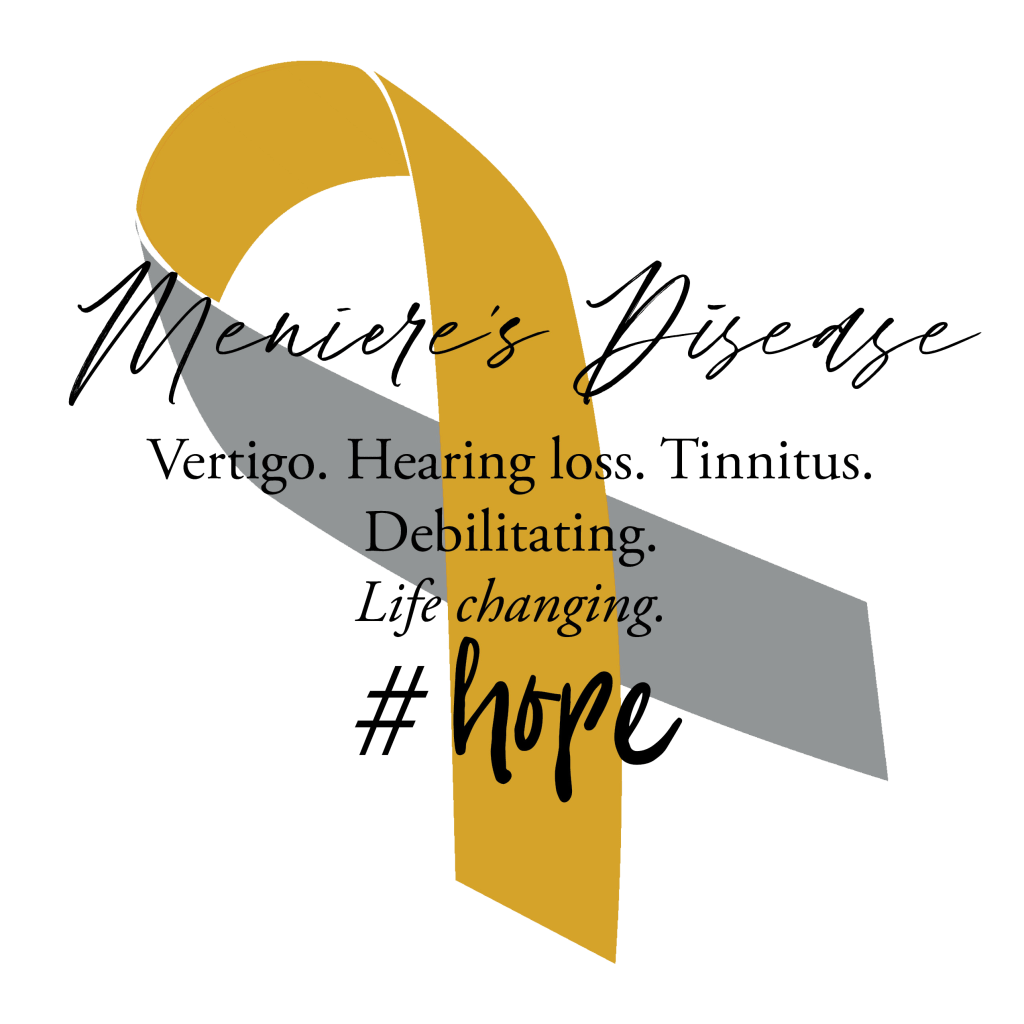
And my newest graphic for our awareness day – no AI was used to create it, to care for our earth.
Why the 7th February?
Dr. Prosper Meniere’s life dates: 18 June 1799 – 7 February 1862.
But the Ménière’s Disease Awareness Day is not finished.
We’re not finished.
Let’s aim for an officialInternational Ménière’s Disease Day, listed on calendars globally.
Can anyone help?
Julieann Wallace is an Australian multi-published author and artist. When she is not disappearing into her imaginary worlds as Julieann Wallace – children’s author, or as Amelia Grace – fiction novelist, she is working as a secondary teacher. Julieann’s 7th novel with a main character with Meniere’s disease—‘The Colour of Broken’—written under her pen name of Amelia Grace, was #1 on Amazon in its category a number of times, and was longlisted in 2021 and 2022, to be made into a movie or TV series by Screen Queensland, Australia. She donates profits from her books to Meniere’s Research, to help find a cure or successful treatment for everyone. Julieann is a self-confessed tea ninja and Cadbury chocoholic, has a passion for music and art, and tries not to scare her cat, Claude Monet, or her dog, Pablo Picasso with her terrible cello playing.
Here we are, unbelievably at the end of another lap around the sun. And I’m quietly filled with hope as Meniere’s research, globally, is uncovering pieces to the puzzle to stop the ‘dizzy terror’.
We’re not quite there yet for a cure, or successful treatments that don’t involve choosing invasive procedures to kill off balance cells to stop the vertigo etc, but after having Meniere’s disease since 1995, and seeing the increase in treatment options over the 30 years, and the new research coming out, I am quietly expectant.
New research led by Professor Jose Antonio Lopez Escamez at the University of Sydney and the Kolling Institute shows that Meniere’s is not a single condition – the symptoms may all be similar but the causes are varied, and identifiable. His painstaking work has uncovered that up to 40% of patients may have a genetic origin for their Meniere’s whilst the other 60% have some kind of immune system problem. Amongst the immune subgroup, there are 3 additional distinct categories, all identifiable via blood tests – auto-immune, allergic inflammation or auto-inflammation.
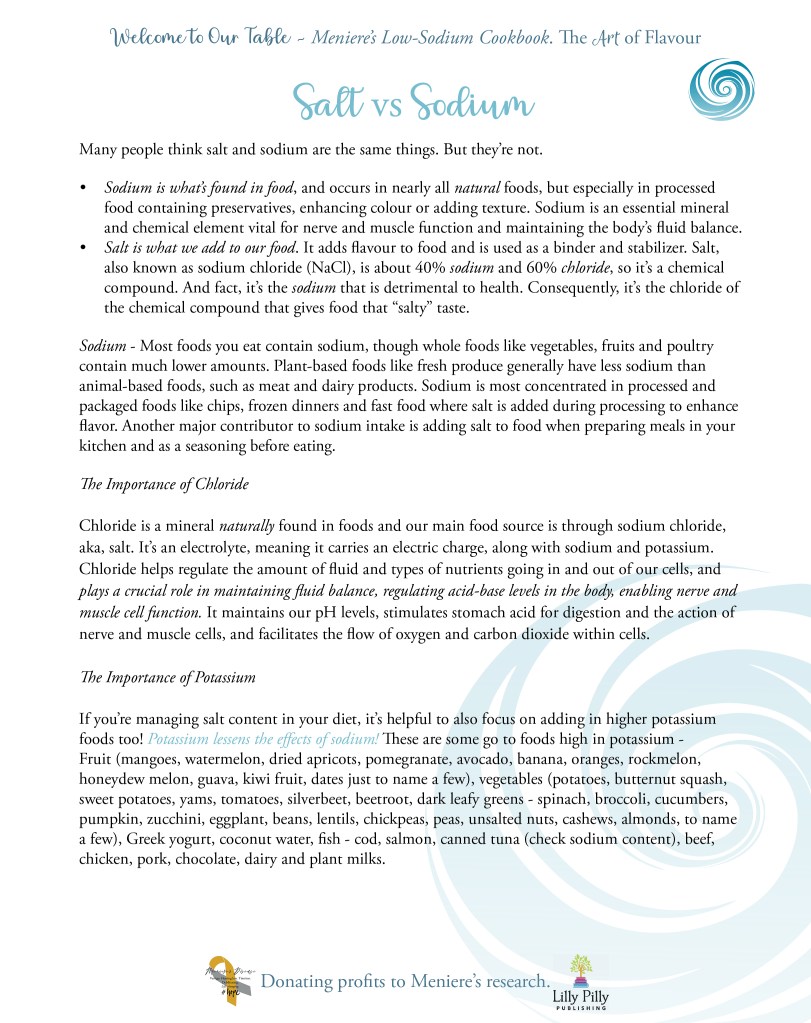
But while we patiently wait for our individualised treatments, we still need to try to control factors that may set off our vertigo, tinnitus, hearing loss, brain fog, etc. And one way to do that is with a low-sodium diet. That is, if salt is a trigger for you. And it is for me. Usually, if I have a food with high sodium content, the very next day my tinnitus has ramped up it’s volume telling me that it is still here. If I did still get vertigo (an injection of gentamicin into my middle ear stopped that in 2004) I would have a vertigo attack.
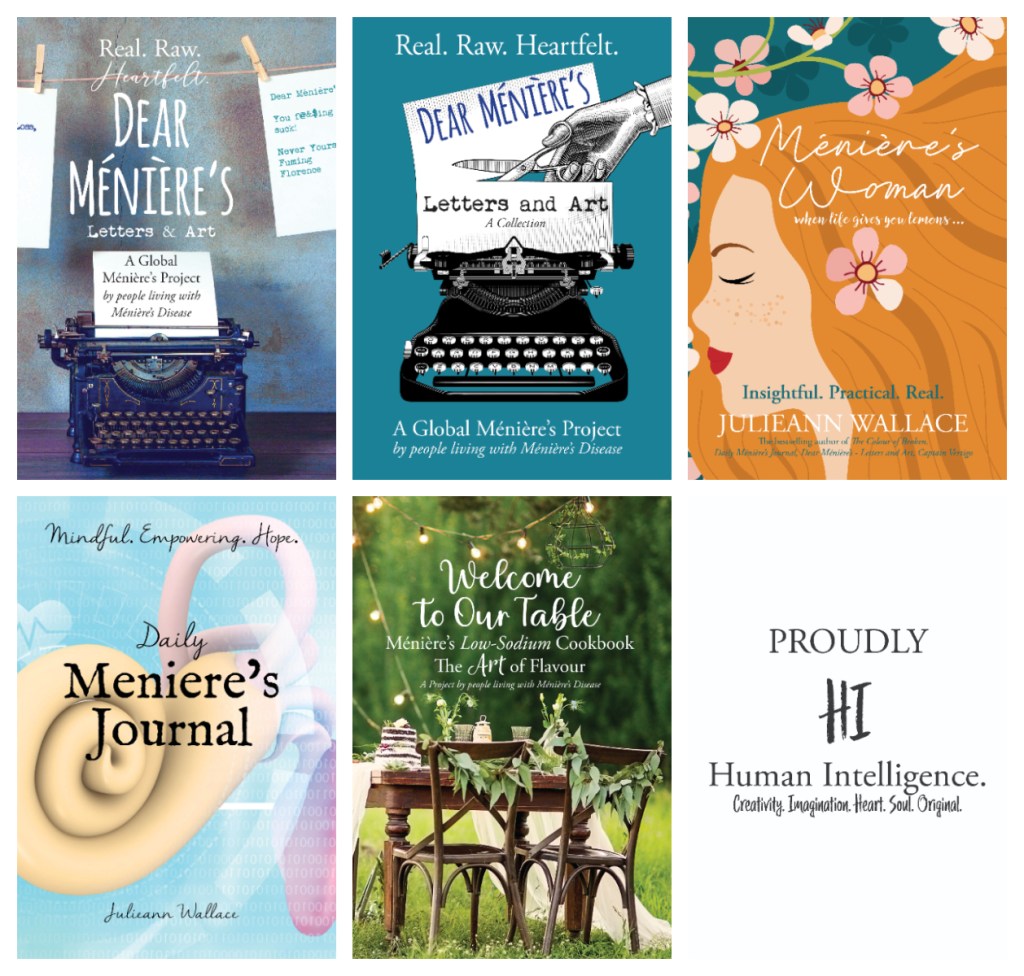
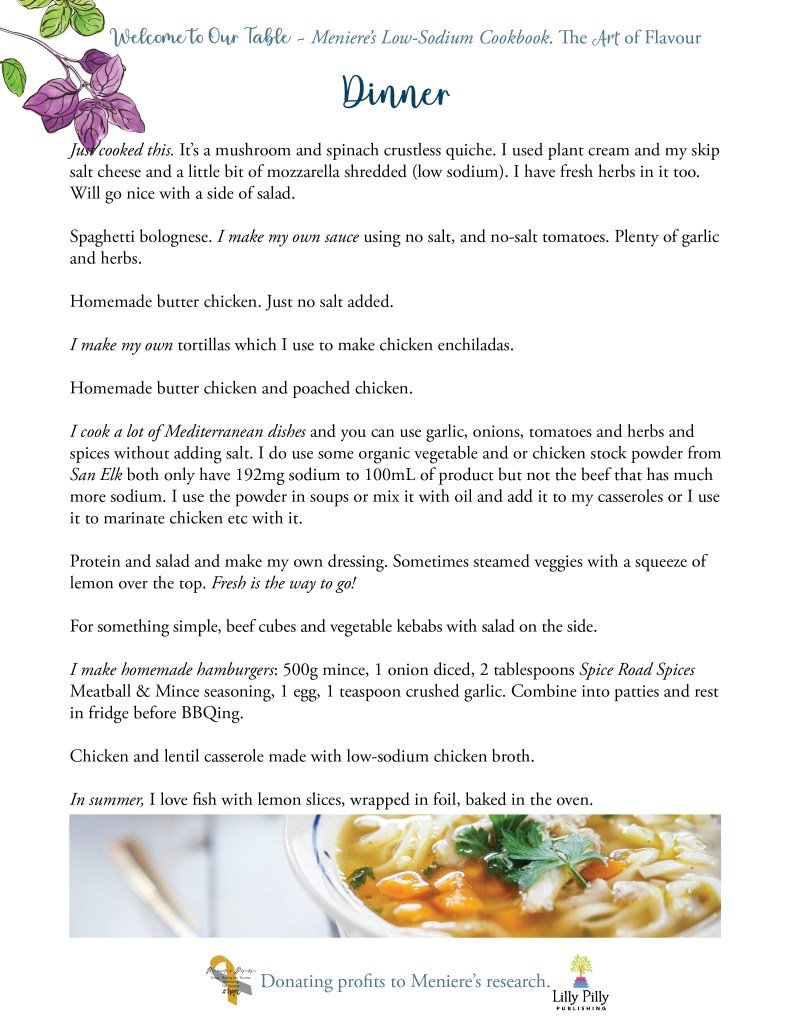
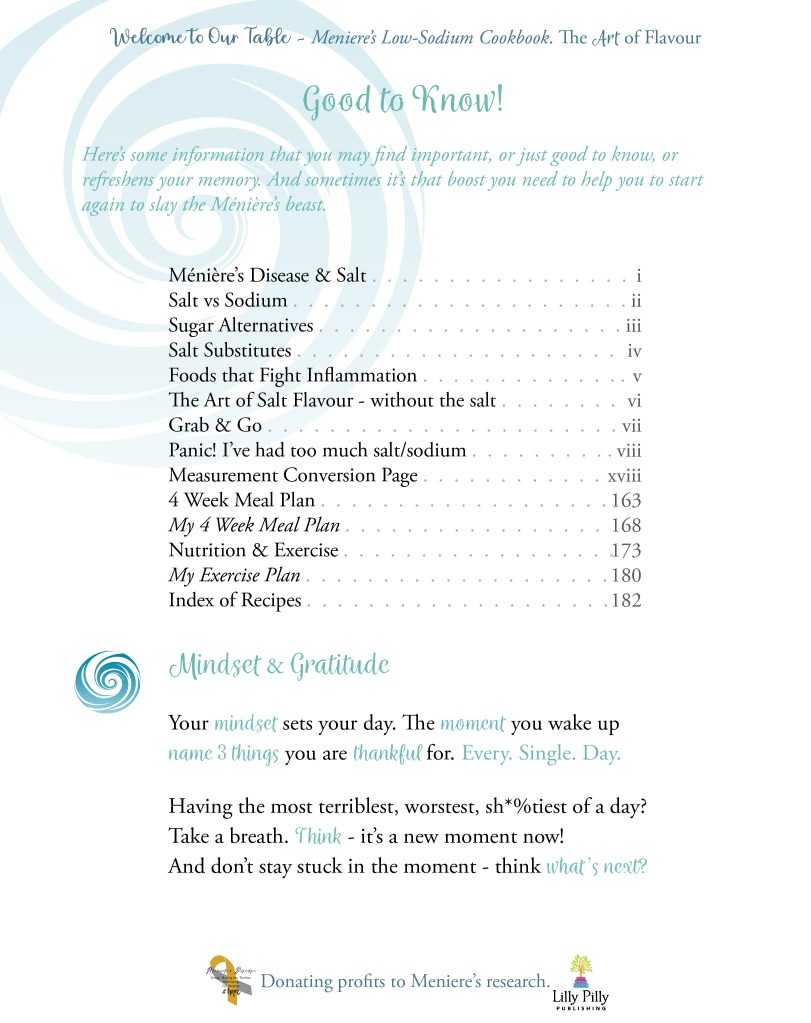
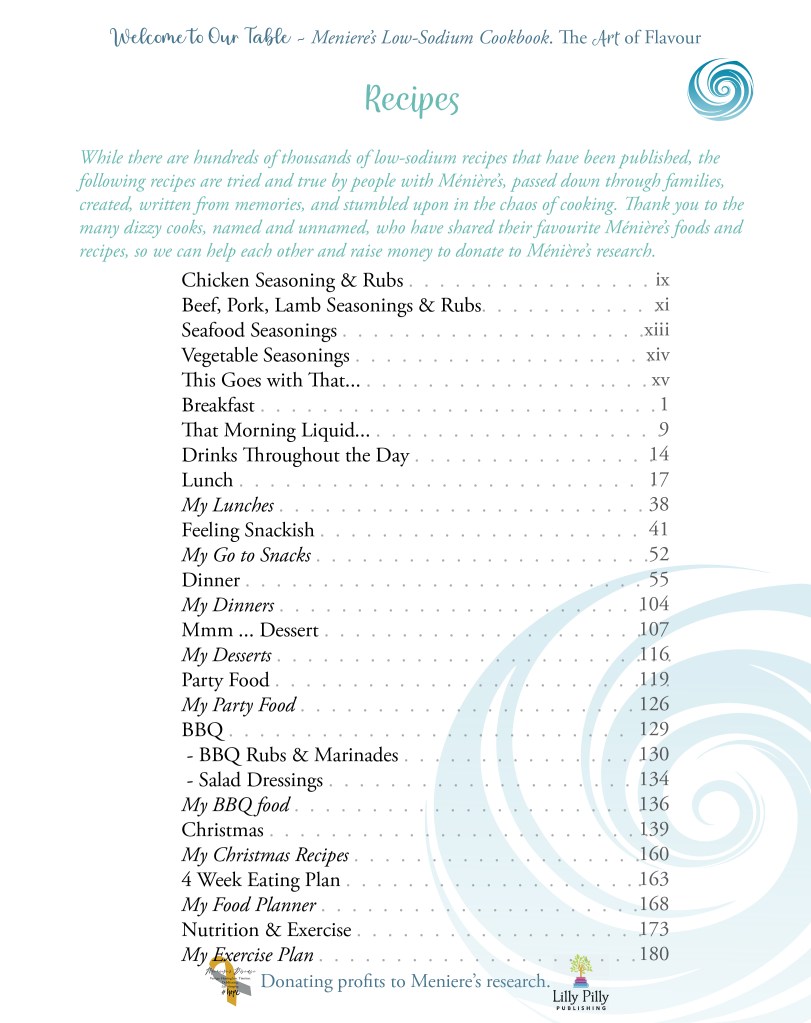
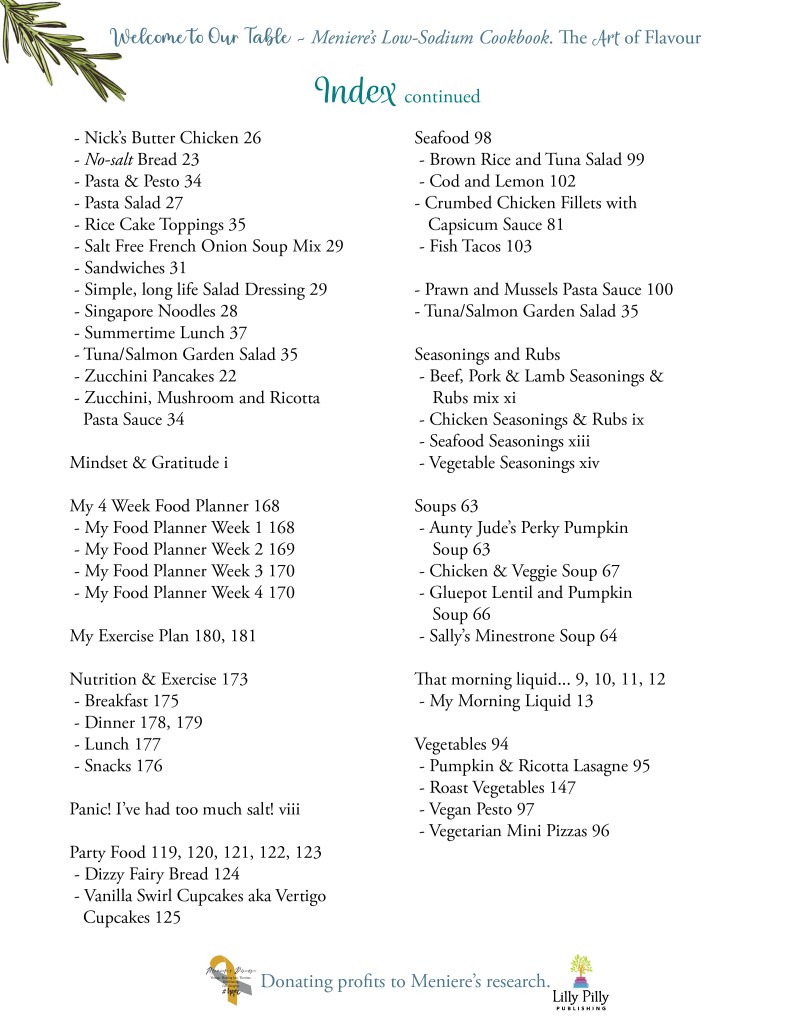
And so this to help. Hot off the press – a low-sodium cookbook. Collated by me (Meniere’s since 1995), Sally Edsall (Meniere’s since 2016), Kim Dean (Meniere’s since 2010), Phillip Stephanou (Meniere’s), Anne Elias (Meniere’s since 2015), and Low Sodium Foods Australia, and the Meniere’s community, for people with Meniere’s, with profits donated to research. Published by Lilly Pilly Publishing.
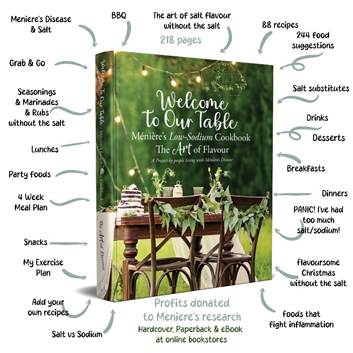
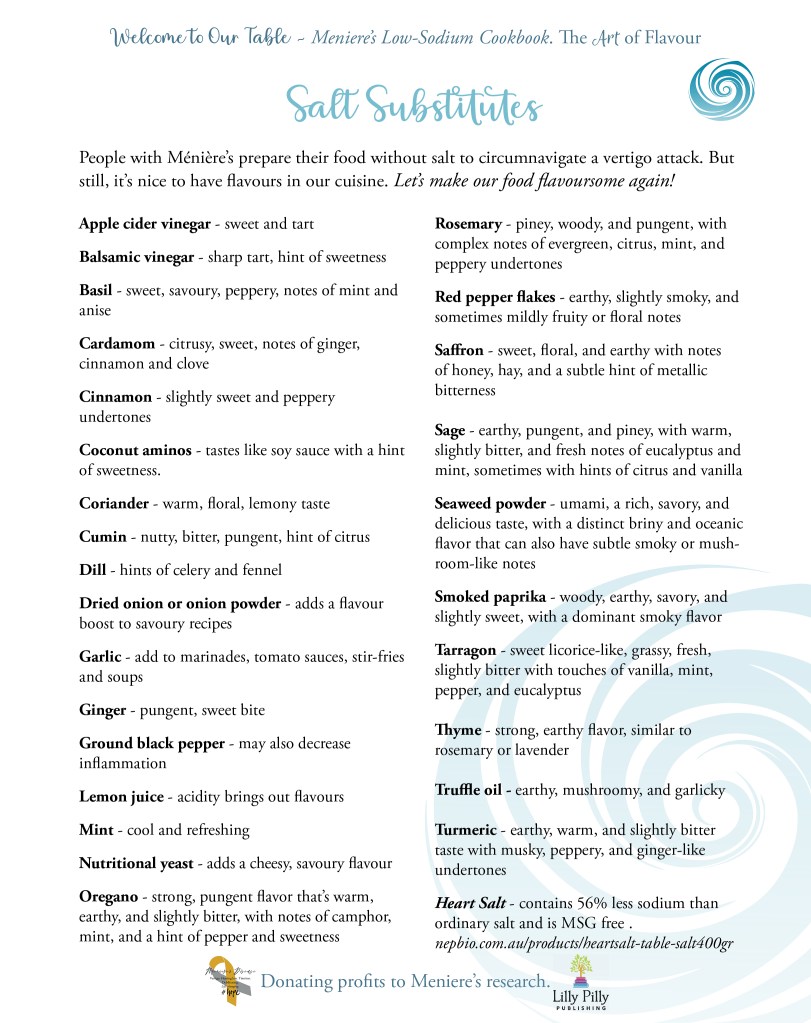
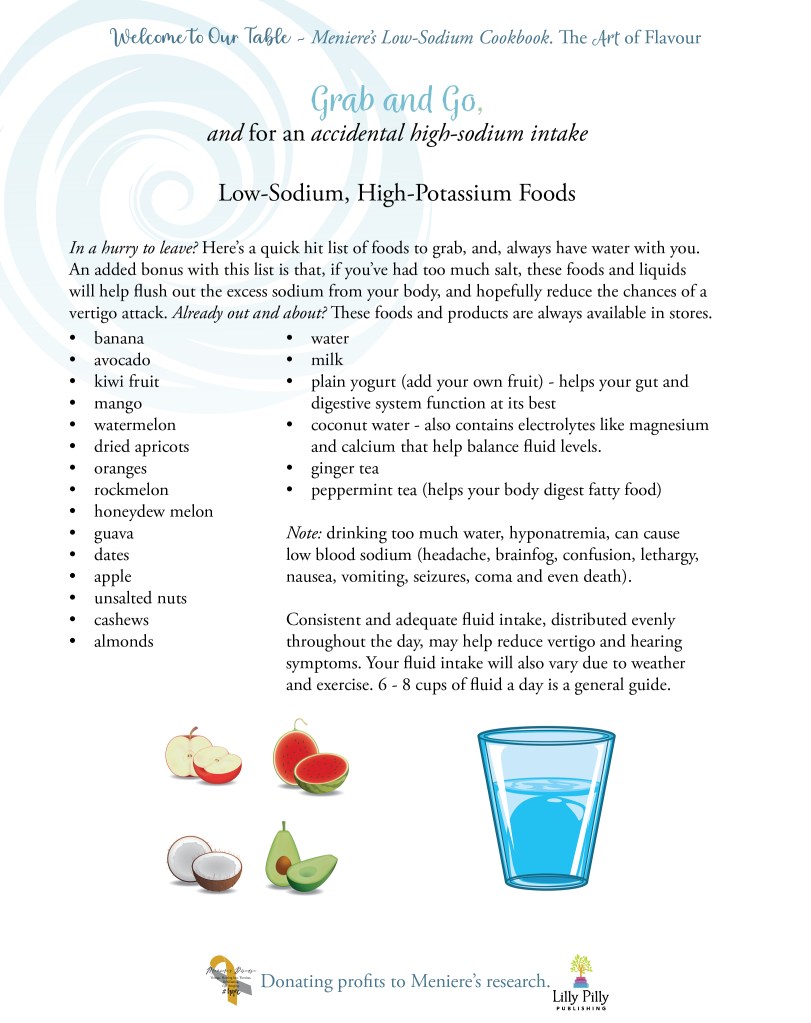
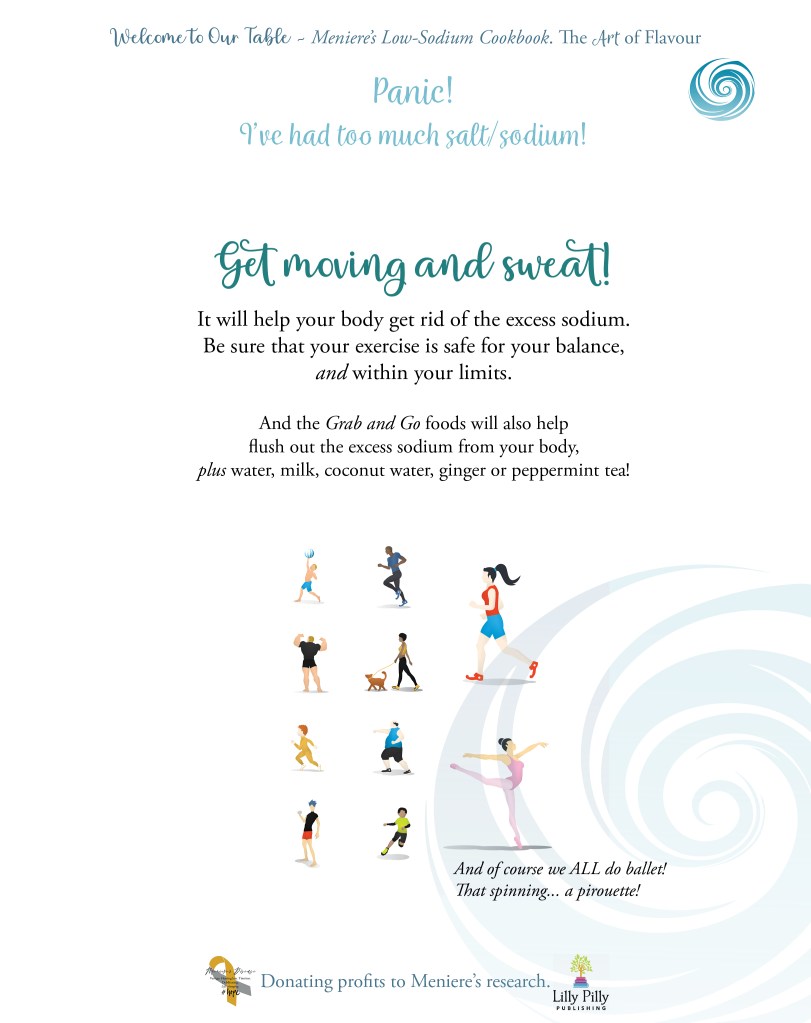
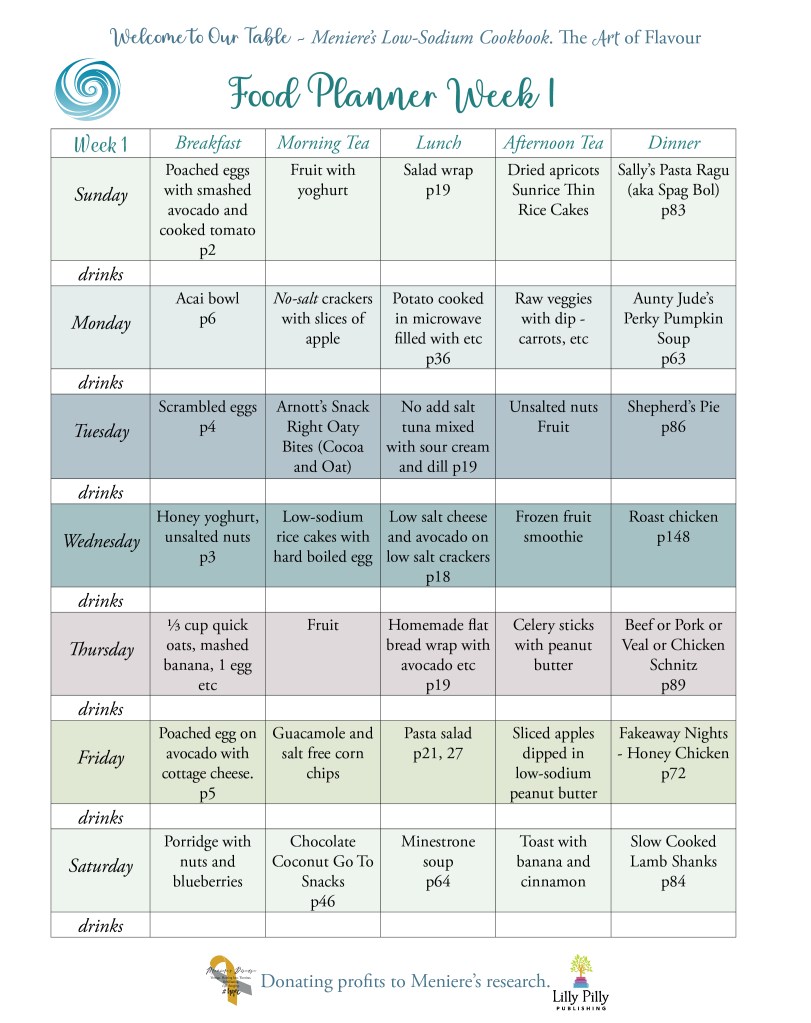
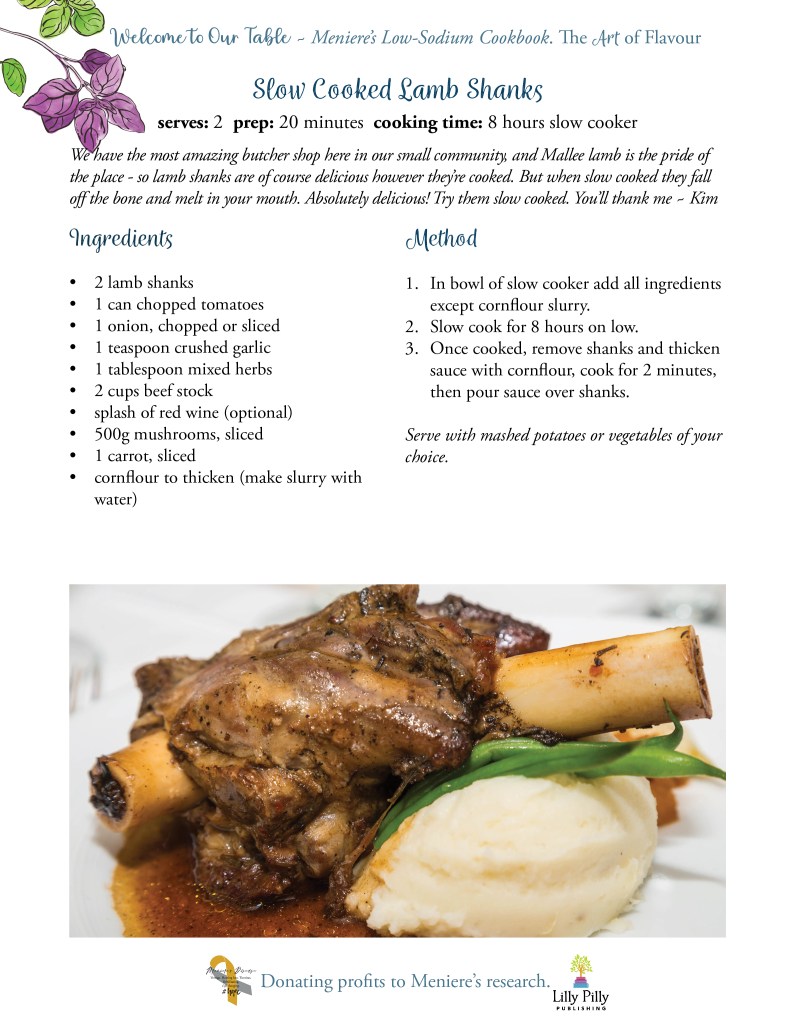
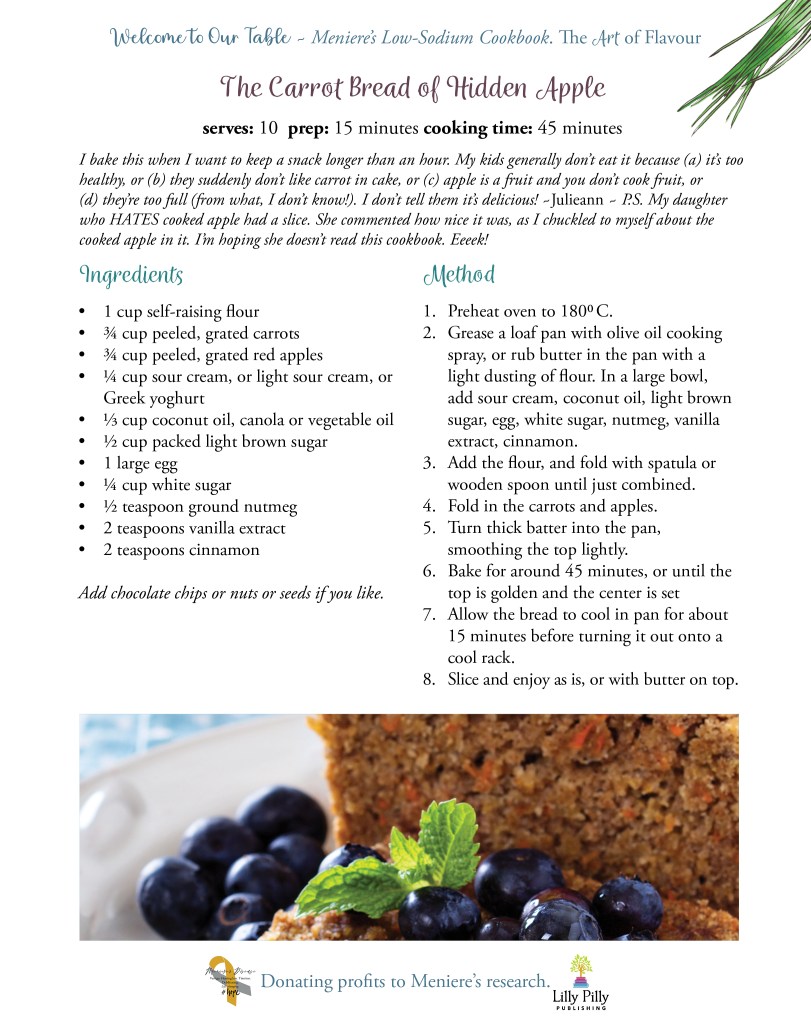
It’s a most comprehensive and valuable low-sodium cookbook. 218 pages. 88 recipes. 244 food suggestions that feel like you are sitting around a table with Menierians causally chatting about food.
Let’s have a look at it.
Welcome to Our Table ~ A Meniere’s Low-Sodium Cookbook. The Art of Flavour.
Here’s a sneak peek:
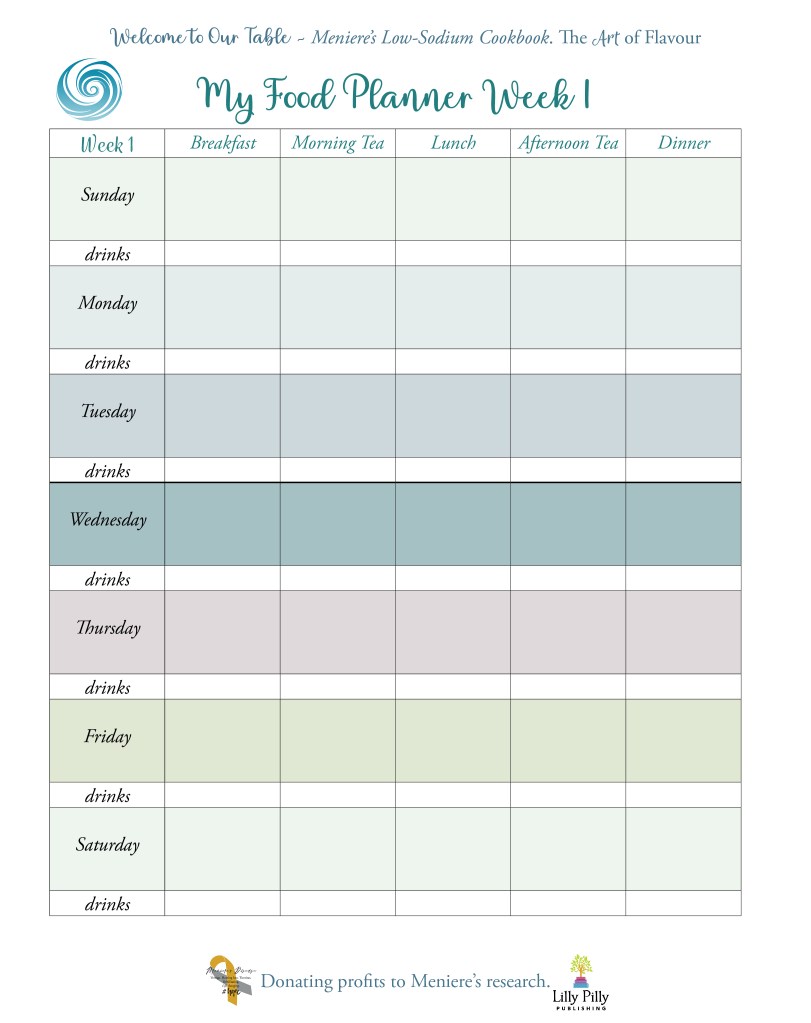
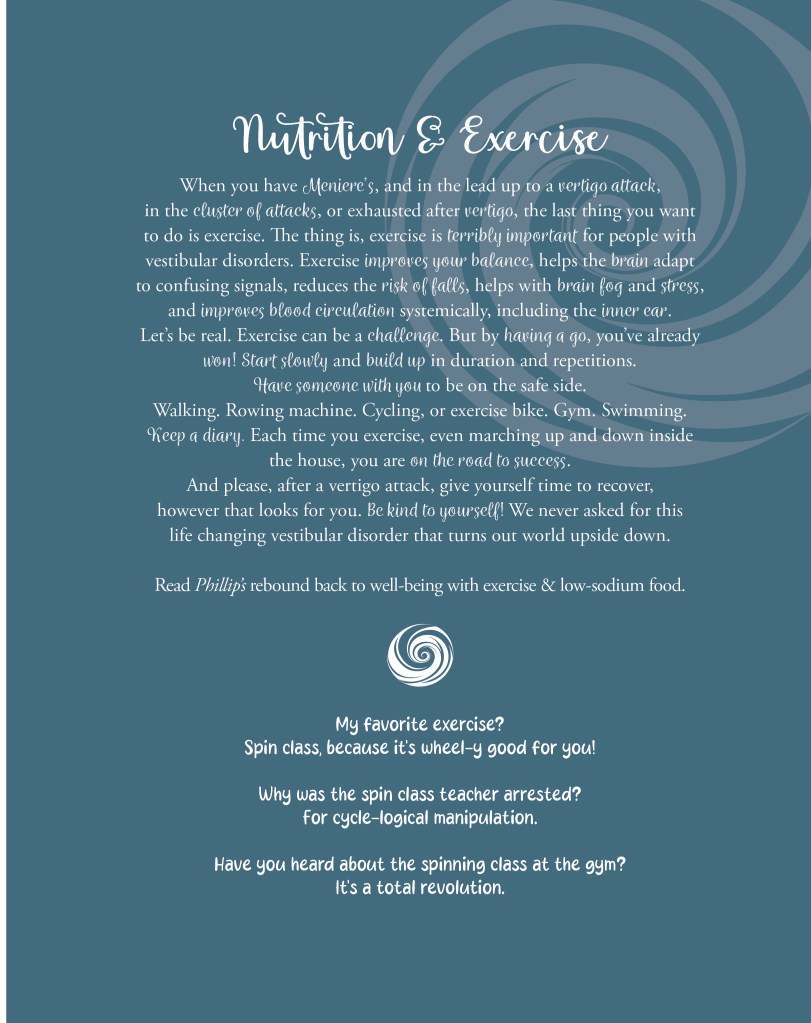
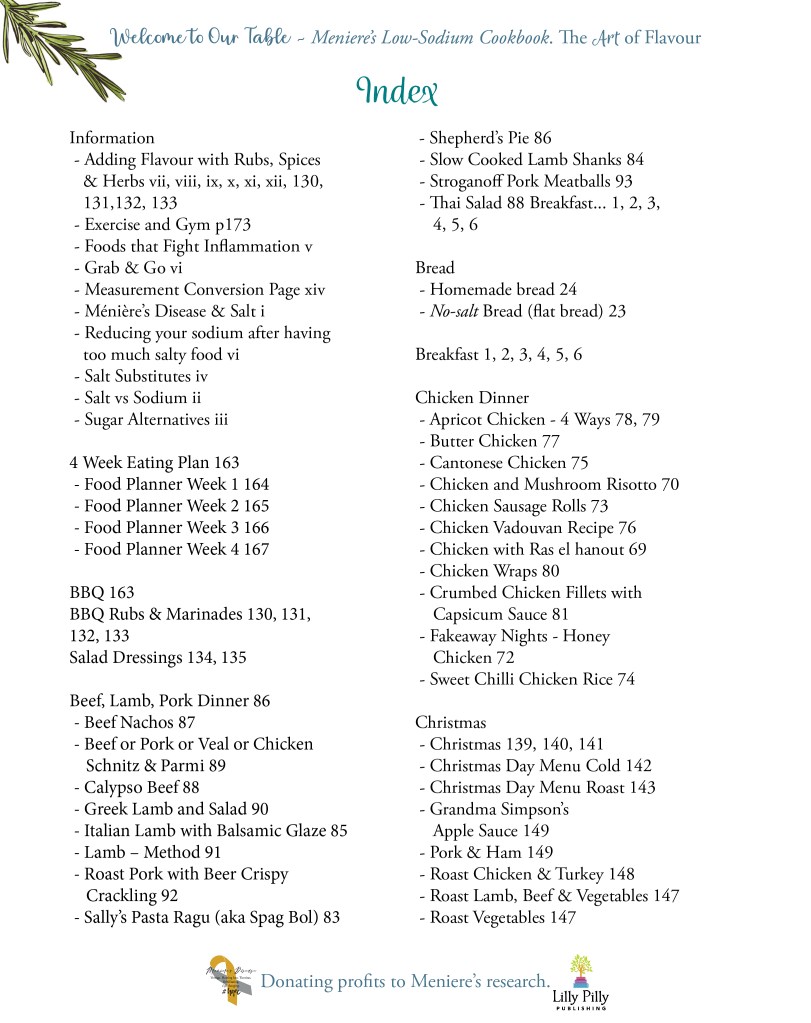
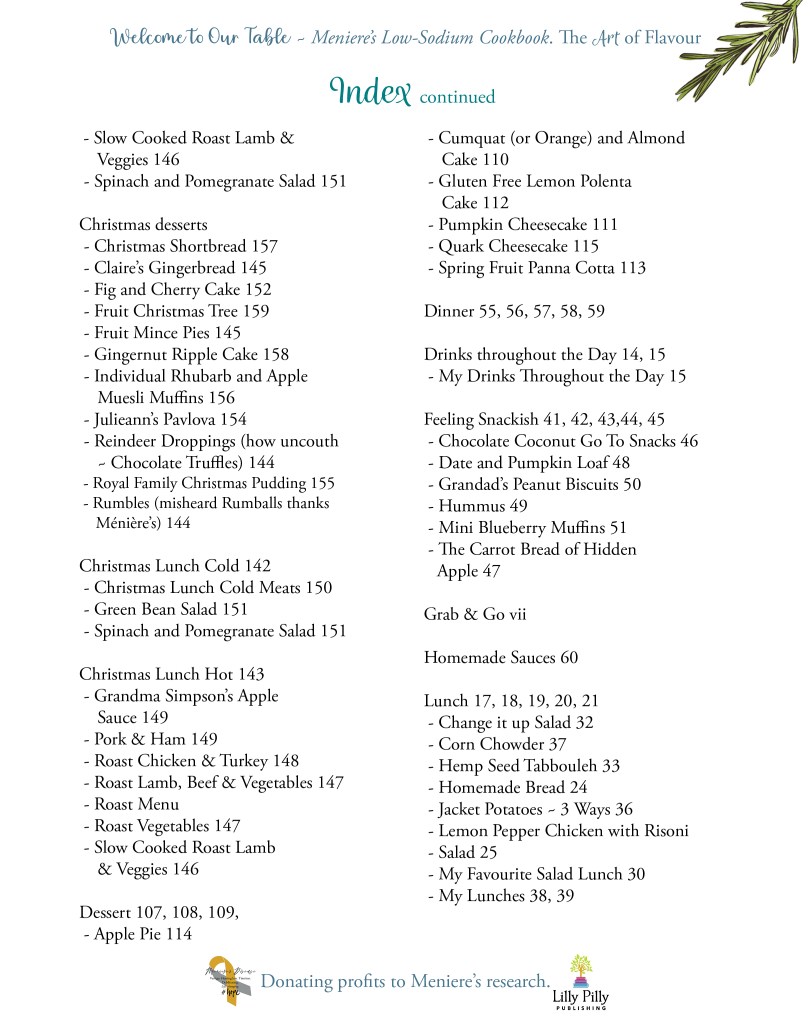
It’s packed with Meniere’s information, research, and lifestyle suggestions besides recipes. That makes it different to your usual cookbook. And while there is an endless amount of low-sodium recipes available online today, the recipes in this cookbook come from members of the Ménière’s community, in the hope that they help you.
What I love about this book, is the fact that, if you are unable to care for yourself, a friend or family or partner can pick it up, and look up foods that will be okay for you to eat!
There’s nothing better than that.
Here’s some reviews that are coming in:
“Thank you all for your hard work. I am a qualified chef and adjusting to NOT using salt has been an interesting journey. Thanks for fresh ideas and new inspiration.”
“The book has arrived and I just want to congratulate all involved , it’s fabulous!”
“It’s arrived! Sending out a massive thank you to Julieann and the team for creating this excellent resource which I know I’ll use regularly! Only being diagnosed in 2024, it has been a challenging journey to navigate my new ‘normal’. ‘Welcome to Our Table’ has cut down the hard work of the many diet/lifestyle changes we need to make. With so many beautiful, yummy recipes and food ideas, I’m definitely feeling inspired and less stuck. Go get it – you won’t regret it! It’s so beautifully presented too.”
“Sooooo excited to get this in the mail today. As soon as I got home from work I read it from cover to cover non-stop. What a beautiful book. I just love it.”
Grab a copy at online bookstores – hardcover, paperback or eBook.
Happy cooking,
Julieann
Julieann Wallace is a multi-published author and artist. When she is not disappearing into her imaginary worlds as Julieann Wallace – children’s author, or as Amelia Grace – fiction novelist, she is working as a secondary teacher. Julieann’s 7th novel with a main character with Meniere’s disease—‘The Colour of Broken’—written under her pen name of Amelia Grace, was #1 on Amazon in its category a number of times, and was longlisted in 2021 and 2022, to be made into a movie or TV series by Screen Queensland, Australia. She donates profits from her books to Meniere’s Research, to help find a cure or successful treatment for everyone. Julieann is a self-confessed tea ninja and Cadbury chocoholic, has a passion for music and art, and tries not to scare her cat, Claude Monet, with her terrible cello playing.
Julieann is also an Meniere’s Research Australia Ambassador for Meniere’s Research Australia and a Cochlear Implant Buddy for Cochlear Australia.
They say when life gives you lemons, make lemonade.
“They” obviously don’t have Ménière’s disease, or any other incurable, debilitating, life changing disease for that matter. If they did, they would say, ‘I’m sorry about your diagnosis. I hope a cure comes soon. Let me know if you ever need help with anything.’
I want to say that I am sorry that you have Ménière’s disease.
I wouldn’t wish it on my worst enemy. I have had it since I was twenty-nine.
I woke at 5am one morning in early January, 2024, with the words Ménière’s Man stuck in my head. It’s a book written about Ménière’s disease, by a man. I’ve never read it. But I know that people are thankful for the information inside it.
Then I thought, where are the Ménière’s books written by women? There aren’t many.
How about WOMénière’s? WOménière’s? woMénière’s?
Sure, you may be able to glean lots of interesting information from books written by men, but let’s face it, they don’t deal with holding the responsibility of keeping the household going like women do (mostly) – groceries, cooking, cleaning, childcare (if you do have a partner who helps you with that, you are truly blessed!).
Men don’t deal with menstruation and everything that entails.
Men don’t have babies.
Men don’t go through perimenopause and menopause.
Men don’t have the fluctuations with hormones like women do.
We women have the rough end of the stick when it comes to Ménière’s !
Researchers have uncovered countless ways in which women’s and men’s bodies react differently to the same diseases, due to our hormones. There is A LOT that female bodies go through during a hormonal cycle, a stark contrast to the experience of the male body.
And so it began.
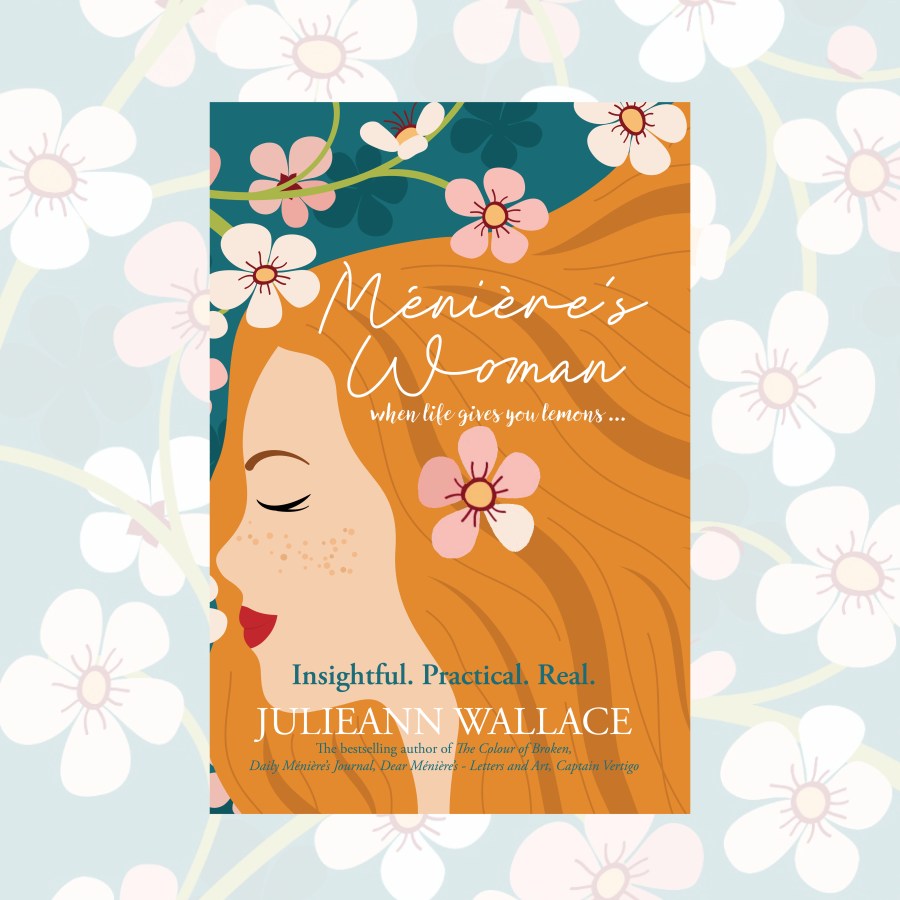
I accepted my own challenge to write a book about Ménière’s disease for women, and started on it. I figured that I was more than qualified enough to write it, Ménière’s being with me for 29 years at the time of writing this book. Exactly half of my lifetime.
Mum of three. My Ménière’s started the year before my first was born.
Wife.
Teacher.
Ménière’s Research subject at the University of Queensland’s Mind and Brain Institute.
Gentamicin to destroy the vertigo after 9 years of trying prescription medicines, herbal medicines and other alternative treatments.
It was my honour to pen this book to help others. To describe the road travelled before others going through the same things.
To encourage.
To understand.
To give insight.
To give tips on surviving the Meniere’s jungle.
To say it’s okay. We’re in this together. You’re going to make it through.
To give hope.
I have put countless hours of medical research into Meniere’s Woman, and reading anecdotal stories by women and questions they ask on social media.
Plus my own experience.
It’s time to honor us. Women with Ménière’s .
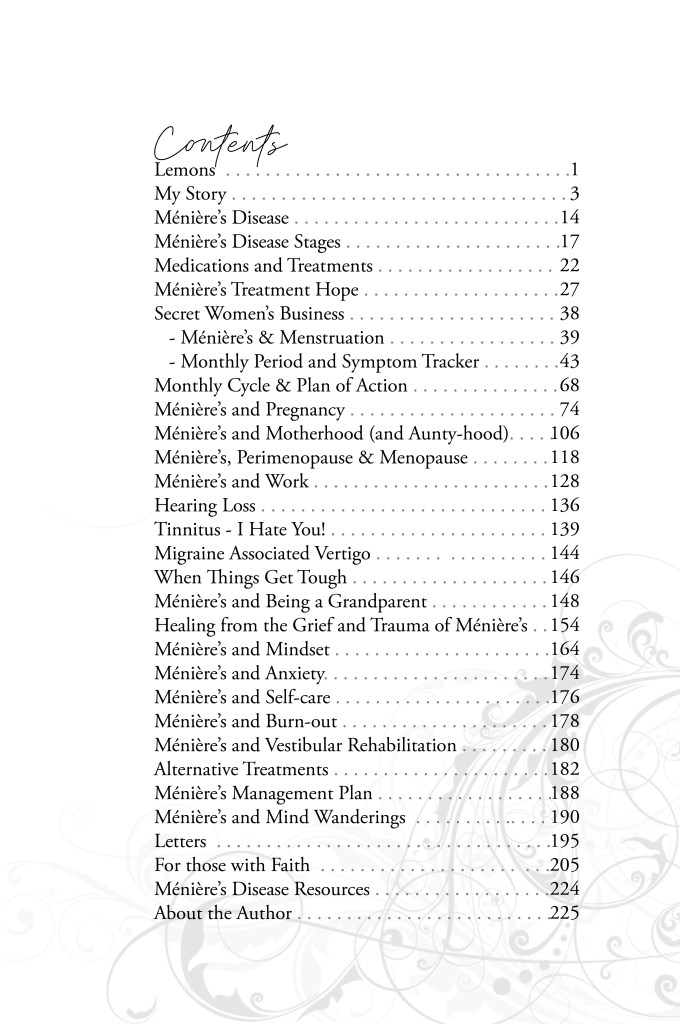
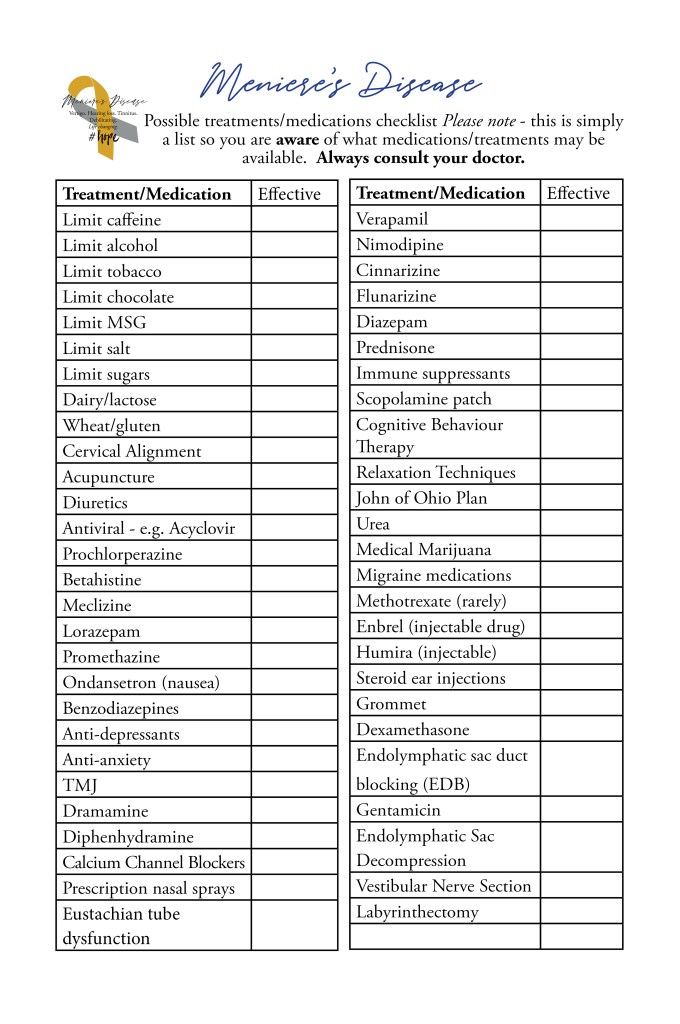
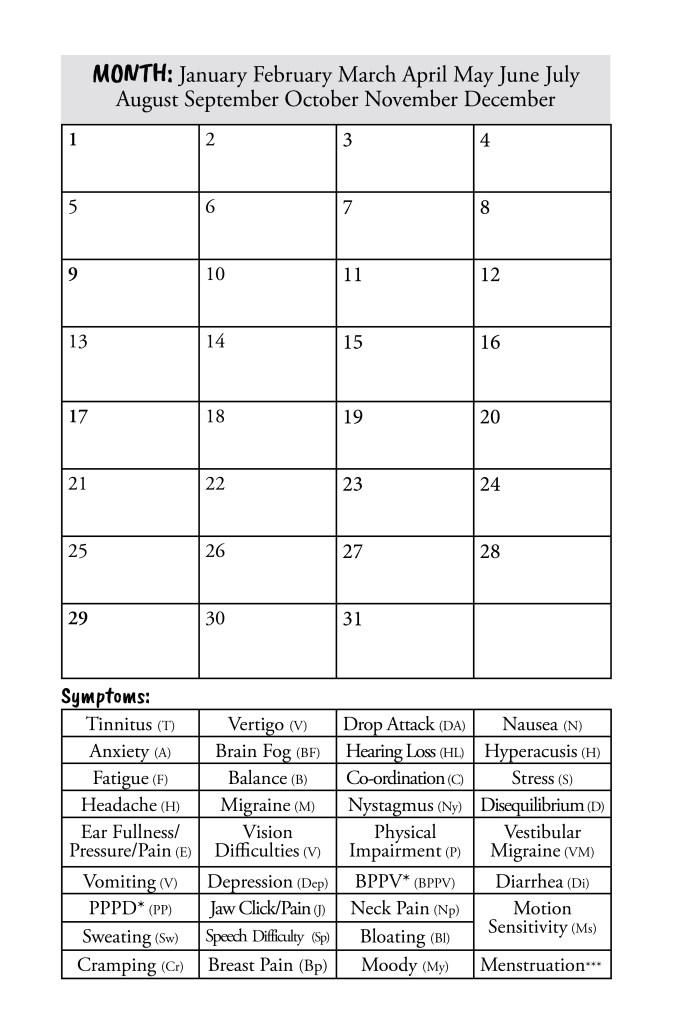
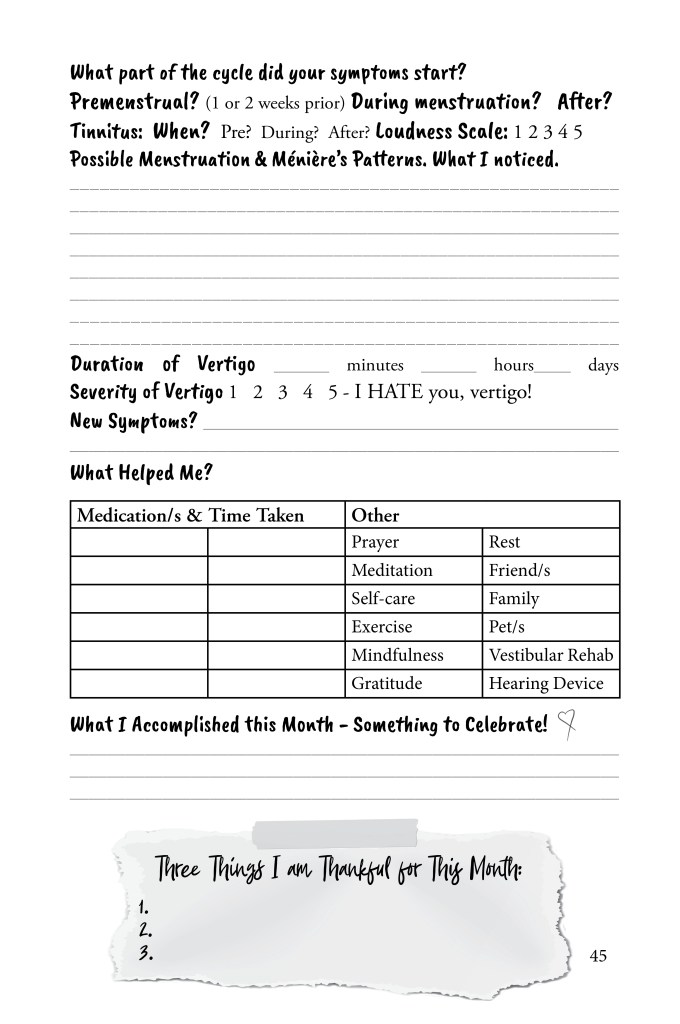
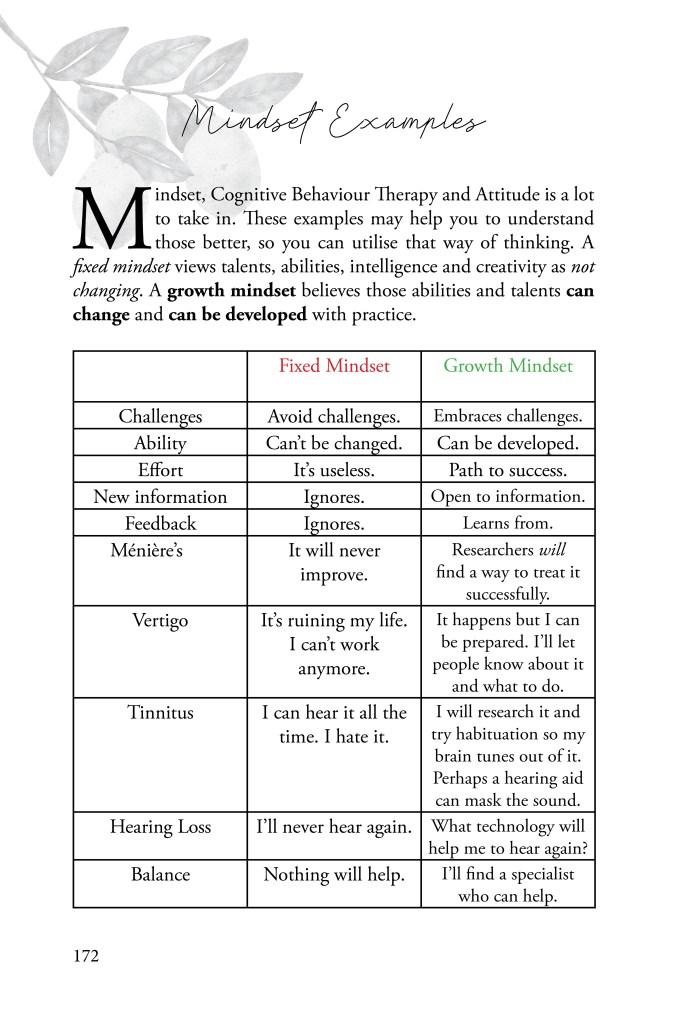
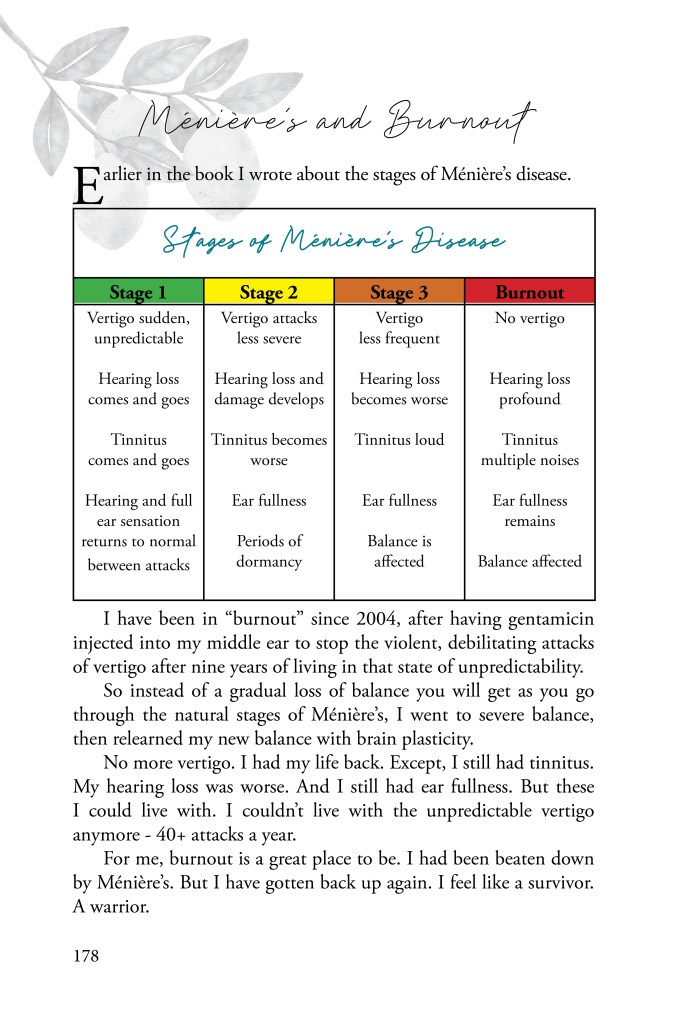
On the pages you’ll find tips, hints, research, personal anecdotes, secret women’s business, pregnancy, motherhood, grand-motherhood, understanding, inspiration and mindset, self-care, a period and Meniere’s symptoms tracker and a Ménière’s Management Plan, plus lots more.
And because this is your book, add your own stamp and style. I have left blank pages for your to glue/tape in clippings, inspirational verses or images that speak to you in some way, or write them in. Be creative. Be you.
Here’s a peek at inside the book. Ménière’s Woman. Honoring you. xx
Profits from the eBook and Print book will be donated to Ménière’s research, as all of my Ménière’s books are. I don’t publish Ménière’s books for personal gain, but to help others.
Let me know what you think of the book if you purchase a copy. And, I hope that it helps you beyond what you thought it could. xx
Julieann Wallace is a multi-published author and artist. When she is not disappearing into her imaginary worlds as Julieann Wallace – children’s author, or as Amelia Grace – fiction novelist, she is working as a secondary teacher. Julieann’s 7th novel with a main character with Meniere’s disease—‘The Colour of Broken’—written under her pen name of Amelia Grace, was #1 on Amazon in its category a number of times, and was longlisted in 2021 and 2022, to be made into a movie or TV series by Screen Queensland, Australia. She donates profits from her books to Meniere’s Research, to help find a cure or successful treatment for everyone. Julieann is a self-confessed tea ninja and Cadbury chocoholic, has a passion for music and art, and tries not to scare her cat, Claude Monet, with her terrible cello playing.
I see you wince at sounds that you say are too loud.
I see you, lying on your bed, staring at the wall, as still as a statue for a very long time. Why can’t you move?
And when you are as still as a statue, I hear you vomiting loudly. It scares me. When will you get better?
I see you walking and nearly falling over.
I hear you crying in the shower.
I hear daddy crying, too.
It makes me sad.
I want to hold your hand.
Here, Mama. Have my magic wand. It will cure you. And then we can play together like we use to … before you got sick with many ears.
From your favouritest-est daughter,
Lucy-Lou
P.S. I love you Mama, to the furtherest-est sparkliest star and back. P.P.S. Please get better.
Do you ever try to hide your tears from your child?
Your crying?
Your sounds of frustration or anger?
Do you think you have hidden those emotions well enough from your children, because you don’t want them to know how you truly feel?
What if your child caught a glimpse of you at your time of vulnerability?
How would your child react? How would you react?
I have to admit. I cried in the shower. I cried in the middle of the night.
I wiped my tears the moment I heard the footfall of my children as they came near.
And when I was bed-bound due to violent vertigo from my Ménière’s disease, my husband or my parents would take care of my kids, keeping them busy to reduce the impact of my incurable disease upon them.
And sometimes, just sometimes, one of my three kids would quietly stand beside my bed and hold my hand for a moment in time. A moment in time that meant the world to me.
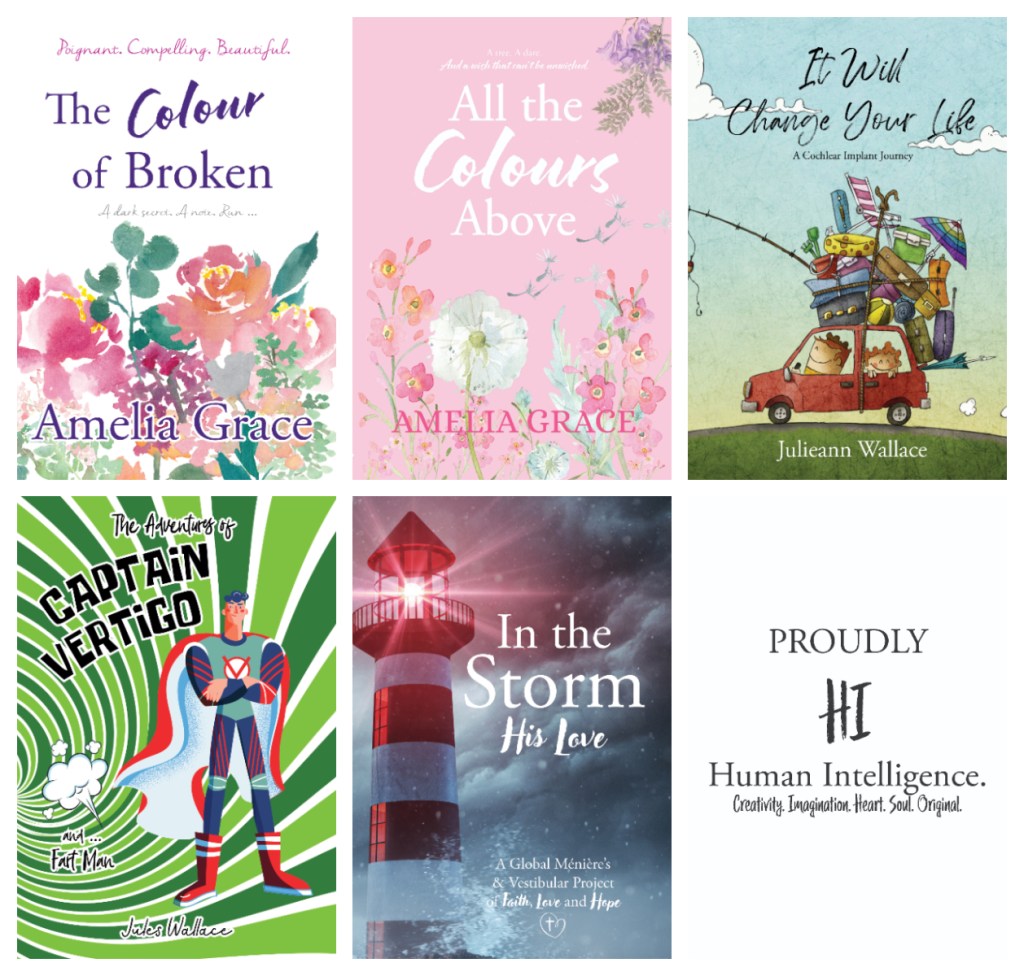
There’s a new book out. An important book. Not just for people who suffer from Ménière’s disease, but for anyone who has or has had vertigo, hearing loss or tinnitus.
The global Meniere’s community has a goal – to stop that vertigo, that tinnitus, that hearing loss, not just for people with Meniere’s, but for all people from all walks of life.
Money raised from book sales will be donated to research.
Imagine not having vertigo anymore.
Imagine not having tinnitus anymore.
Image hearing loss being a thing of the past.
Can you dare to imagine being you again …
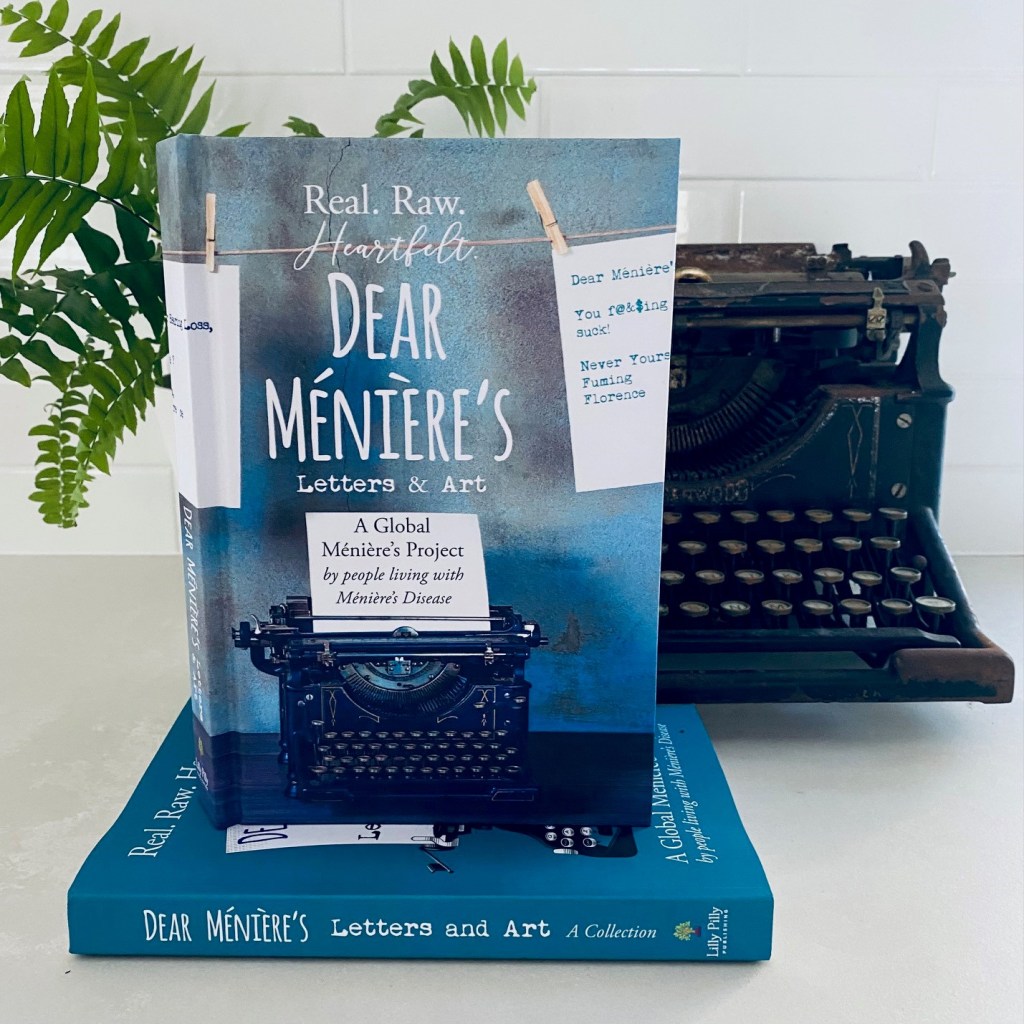
Dear Ménière’s has been labelled as extraordinary, a life changer and a much needed book by early readers. It’s available at online bookstores as a print book and eBook
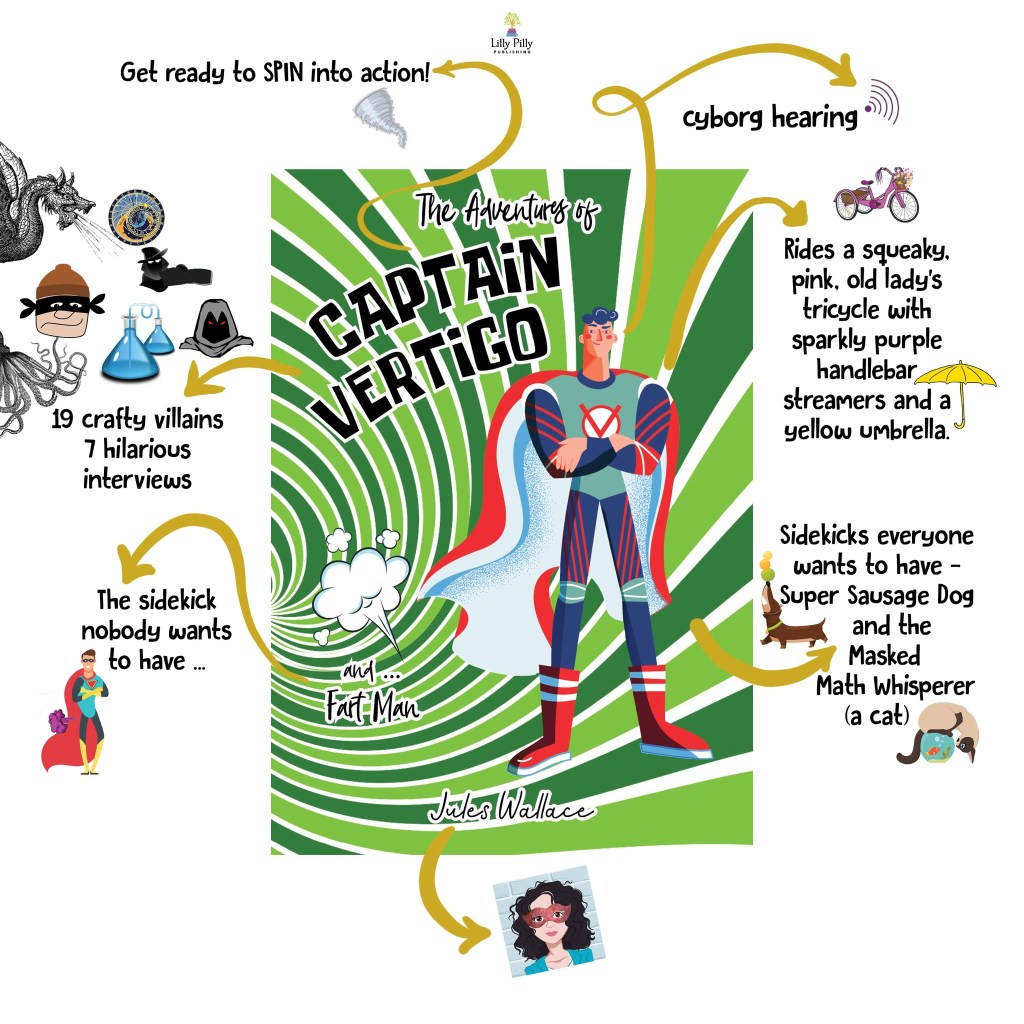
And now to inject some humour for our kids – Captain Vertigo.
Finally, enjoy some letters to Ménière’s …
Dear Ménière’s,
I wish I could stand at the ends of the earth, where the winds blow swiftest, and feel the gentle sway caused by the blowing, not by my lack of balance, and have the winds blow away the tinnitus and the brain fog.
To have, for just one moment again in time, the silence of sound.
The clarity of mind.
To feel energised by life and not drained by it.
I imagine standing on a windswept shore. The noise I hear is the rustle of seagrass, the blowing of the southerly wind, the heave and heft of the ocean. Sea salt and sand pepper my skin. The incessant ring in my ears is quiet, drowned out by the oceans song or swept away, I neither know nor care, I cannot hear it.
The salty air fills my lungs, its brusqueness blows away the ever present fog in my brain. Thoughts, swirling vaguely in my brain, come to the forefront. They take shape, as clear and sharp as the broken shells beneath my feet. I’m not moving through a miasma, I’m as clear as the sun shining through the water that rolls onto the sand and back out again.
Each deep breath clears more fog from my head and returns more of me to myself, as if the real me lives out there in the ocean, waiting to be breathed in on the winds.
I miss who I was.
Kelly
Ménière’s disease since 1998
Without Warning
Here it comes.
Deep breaths. Find your focus.
Radiating tremors. Vision blurred.
For a brief moment, numbness.
Knowing the dark wave is about to consume you.
Deep breaths. Screaming inside,
“NO! Please God, not again. Not here. Not now.”
White knuckles desperately trying to hold steady.
Sweat pours. Heart racing.
Every line bends. Every curve vibrates.
Close your eyes and it will find you.
Even in darkness you twist and turn.
Gut is writhing in distress.
So violent yet completely invisible for others to see.
Empathy is shared with whispers of doubt.
Solace too far to reach.
Independence lost.
Dignity robbed.
A bright future shadowed in fear.
In time, tremors dissipate and vision clears.
Th e agony is rewarded with short lived joy.
Without haste, the crippling fear of the next one looms.
Micaela Grady
Written 9/8/2021
Ménière’s disease since 2007, Vestibular Migraine: 2021
Dear monster,
You are …
AKIN TO SHIT on a shoe trodden through a carpeted home,
A 6 HOUR LONG podcast with a voice so monotone.
Like riding a bike with a constantly falling off chain,
A summer garden party that is RUINED BY THE RAIN.
The spilt glass of water that calculatedly covers one’s crotch,
Like paying for Netflix then discovering there’s barely anything good to watch.
The SOGGY WET SOCK and also the HOLE IN THE BOOT,
Like discovering HALF A WORM after biting into some fruit.
A SALT AND VINEGAR CHIP on a fresh paper cut thumb,
The APPROACHING BEAST IN THOSE NIGHTMARES where we are unable to run.
Truth is, you are SO MUCH WORSE than all these examples by a mile,
This is me keeping it light, and trying my damn hardest to CREATE A SMILE.
Julieann Wallace is a multi-published author and artist. When she is not disappearing into her imaginary worlds as Julieann Wallace – children’s author, or as Amelia Grace – fiction novelist, she is working as a secondary teacher. Julieann’s 7th novel with a main character with Meniere’s disease—‘The Colour of Broken’—written under her pen name of Amelia Grace, was #1 on Amazon in its category a number of times, and was longlisted in 2021 and 2022, to be made into a movie or TV series by Screen Queensland, Australia. She donates profits from her books to Meniere’s Research Australia, where they are researching Meniere’s disease to find a cure. Julieann is a self-confessed tea ninja and Cadbury chocoholic, has a passion for music and art, and tries not to scare her cat, Claude Monet, with her terrible cello playing.
That’s the quality of life for a person with Meniere’s disease during an active vertigo attack. It’s been compared to someone who is 6 days from death by authors of this study – Meniere’s Quality of Life.
The study revealed the following:
— QWB scores: Meniere’s patients achieved a mean score of .505 on days of acute episodes and .620 on days without acute episodes. This compares with scores of normal adults (.810), very ill adults with life-threatening illness (cancer, AIDS (.616), non-institutionalized Alzheimer’s patients (.506), and AIDS & cancer patients, six days before death (.427)
Earlier in my Meniere’s journey, I had read online that a doctor claimed it was 3 days from death …
My husband flinched when I quoted him those words. 40 + violent vertigo attacks year, each one lasting around 4 hours. Unable to move. Staring at one spot on the wall for the entire time. He was the spectator to my sad life with Meniere’s that pulled me into the darkest pit.
Nausea. Puking. Unbearable. Feeling like I am close to death. And doing that 40 + times a year.
6 days from death. Let that sink in.
Do you ever read something that hits you in the gut? Something so well written it describes your invisible symptoms so that others might understand it better.
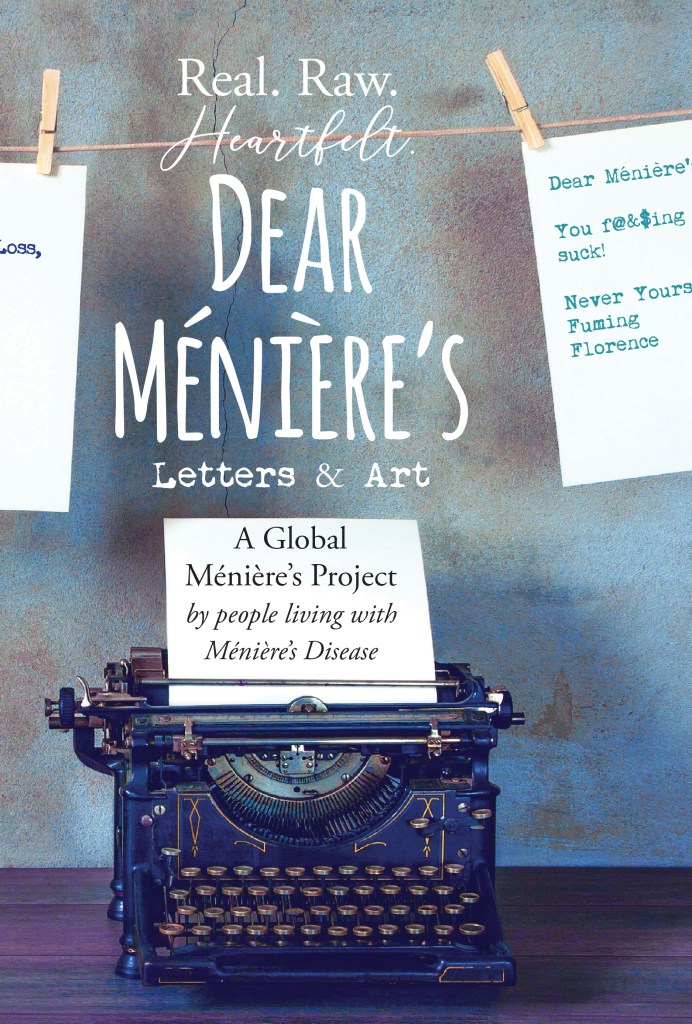
Dear MONSTER, written by Colin (The Monster Meniere’s) does that. It’s from a book about to be released on June 1st 2023 Dear Meniere’s – letters and art – a collection.
Dear MONSTER,
You are …
AKIN TO SHIT on a shoe trodden through a carpeted home,
A 6 HOUR LONG podcast with a voice so monotone.
Like riding a bike with a constantly falling off chain,
A summer garden party that is RUINED BY THE RAIN.
The spilt glass of water that calculatedly covers one’s crotch,
Like paying for Netflix then discovering there’s barely anything good to watch.
The SOGGY WET SOCK and also the HOLE IN THE BOOT,
Like discovering HALF A WORM after biting into some fruit.
A SALT AND VINEGAR CHIP on a fresh paper cut thumb,
The APPROACHING BEAST IN THOSE NIGHTMARES where we are unable to run.
Truth is, you are SO MUCH WORSE than all these examples by a mile,
This is me keeping it light, and trying my damn hardest to CREATE A SMILE.
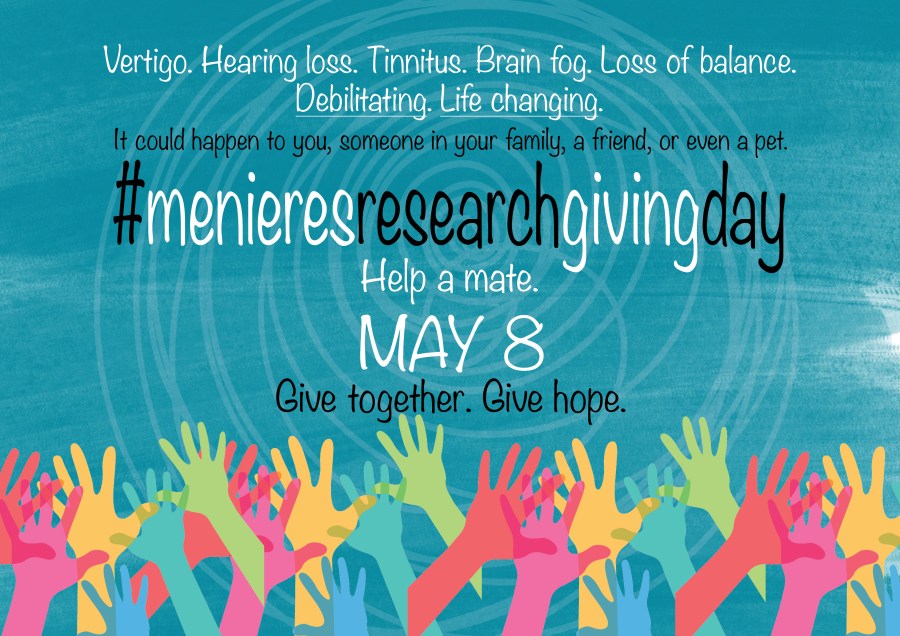
This is Meniere’s disease. Vertigo. Hearing loss. Tinnitus. Brain fog. Debilitating. Life changing.
Meniere’s disease is said to be about the same prevalence as Multiple Sclerosis in the community, and yet, there is no funding for research, nor fundraising days in the community to bring awareness. Our medications (if they work) are costly and are not subsidised. Many people with Meniere’s cannot work due to unpredictable, long, violent vertigo episodes that leave them exhausted, causing them to lose their livelihoods, their confidence, their sense of self-worth.
6 days from death.Let that sink in.
It has been said that Meniere’s disease is the most livable disease with the highest suicide rate. If you’ve ever been in Meniere’s FB groups, you will read posts about people wanting to end their suffering. You will see others reaching out to them to help. Just one more day ….
I’ve had MD for 28 years now. How can I sit back and hope for the best for my MD family without doing anything?
It’s like wondering why nothing good ever happens to me.
It’s like waiting for others to act, and then nobody does, because they are all waiting for others to step up for them.
Here’s the thing. You have to go out and grab opportunities.
You have to make things happen.
It’s active. Not passive.
SO here’s my active for my Meniere’s brothers and sisters, uncles and aunts, kids, friends, and that person down the street.
Julieann Wallace is a multi-published author and artist. When she is not disappearing into her imaginary worlds as Julieann Wallace – children’s author, or as Amelia Grace – fiction novelist, she is working as a secondary teacher. Julieann’s 7th novel with a main character with Meniere’s disease—‘The Colour of Broken’—written under her pen name of Amelia Grace, was #1 on Amazon in its category a number of times, and was longlisted in 2021 and 2022, to be made into a movie or TV series by Screen Queensland, Australia. She donates profits from her books to Meniere’s Research Australia, where they are researching Meniere’s disease to find a cure. Julieann is a self-confessed tea ninja and Cadbury chocoholic, has a passion for music and art, and tries not to scare her cat, Claude Monet, with her terrible cello playing.
Julieann is mindful of those who also have incurable diseases or are walking on the path of a diagnosis that is life changing. She never aims to undermine the severity of anyone else’s illness, disability or journey. We all deal with life with different tolerances, attitudes and thresholds.
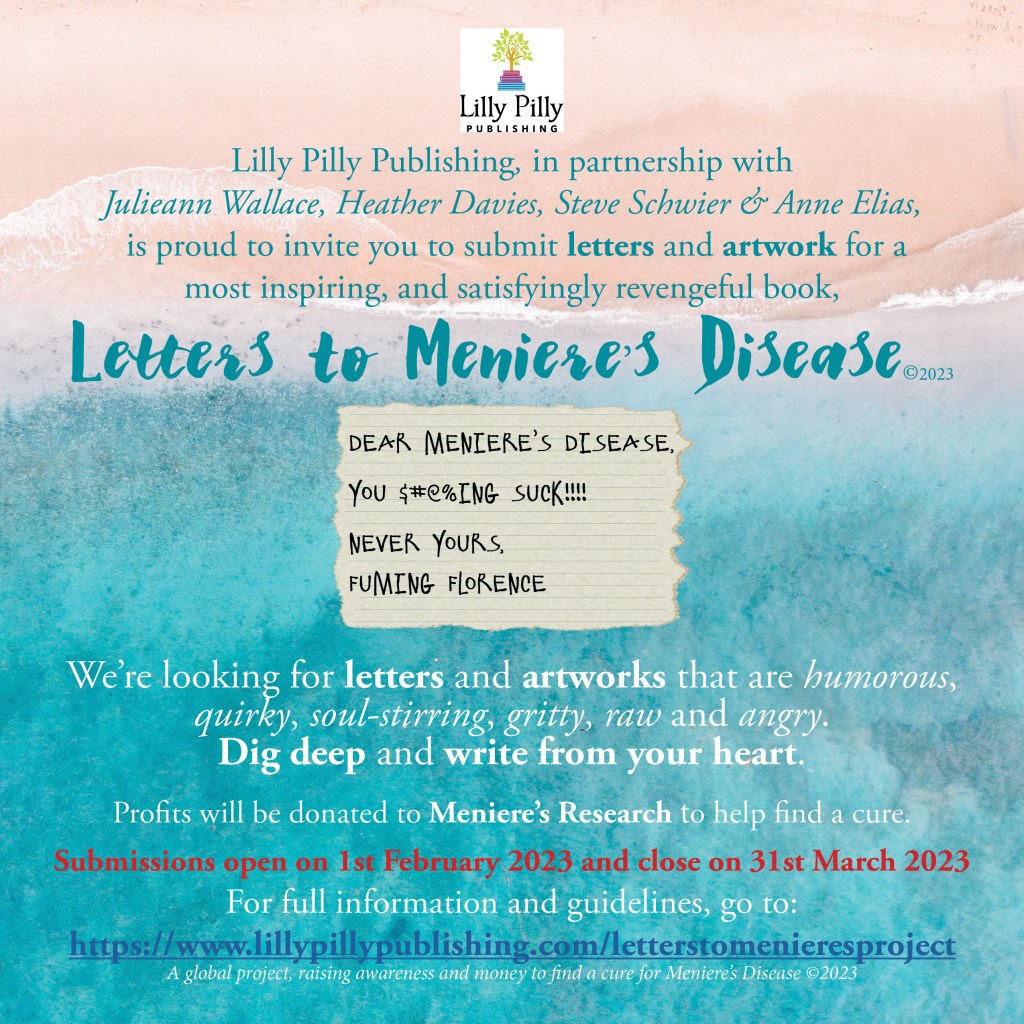
That’s you, Ménière’s. There’s a call out for submission for letters and art about you.
Apparently you’re the focus of a new book, a collection of writing and creativity.
Surely you don’t deserve such attention in this way?
What do you think they will say about you?
How kind you are?
How popular and well-liked you are?
Do you think you’ll be thanked?
We’ll see …
And the art?
What on earth would you look like on the canvas? In a photograph? Or other creative art mediums? Ha, a sculpture of you would be interesting!
Do you think you’ll be beautiful and lavished with love in each of those carefully placed paint strokes?
Will you be depicted up on a pedestal all high and mighty?
Will the capturing of your existence in visual form be so exceptional that an entire gallery will be dedicated to you?
Or will you look like the monster you are?
We’ll see …
Ménière’s, you’re finally being called out for the atrocious bully that you are.
Fingers are being pointed at you for torturing people with vile, violent vertigo, insanely loud tinnitus, nausea, hyperacusis, deafness and loss of balance. So debilitating are your attacks that some cannot find the strength to live with the symptoms anymore. How dare you?
Are you proud of the quality of life rating of 6 days from death with your repulsive, incrediblly fast room spinning vertigo that lasts for hours, sometimes days?
Fists are being shaken at you for your devious ways, hiding in the inner ear that is hard to get to.
Voices are being shouted, louder than our unremitting, loud tinnitus, to call you out from the cowardly darkness and into the light so you can be seen in all of your ugliness.
You thief. Stealing happiness, livelihoods, passions, friends, confidence, hearing, balance, joy, money, a normal quality of life, bringing us to our knees to search for the missing pieces of us.
Ménière’s disease. Debilitating. Life changing. Do you really think there is no cause, no cure?
We’ll see …
Ménière’s, research is discovering your mischievous ways. Research is planning an attack to take you down. How joyous that day will be when the doctor will say, ‘You’ve got Ménière’s disease. We can fix that!’
Never yours,
Julieann Wallace
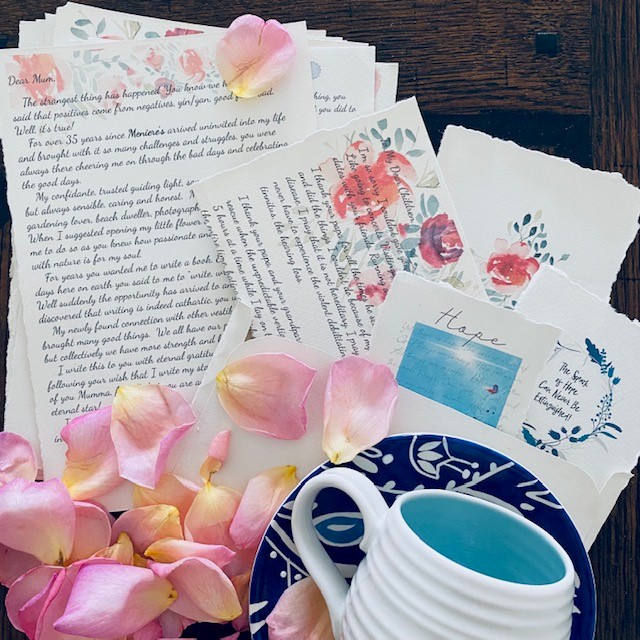
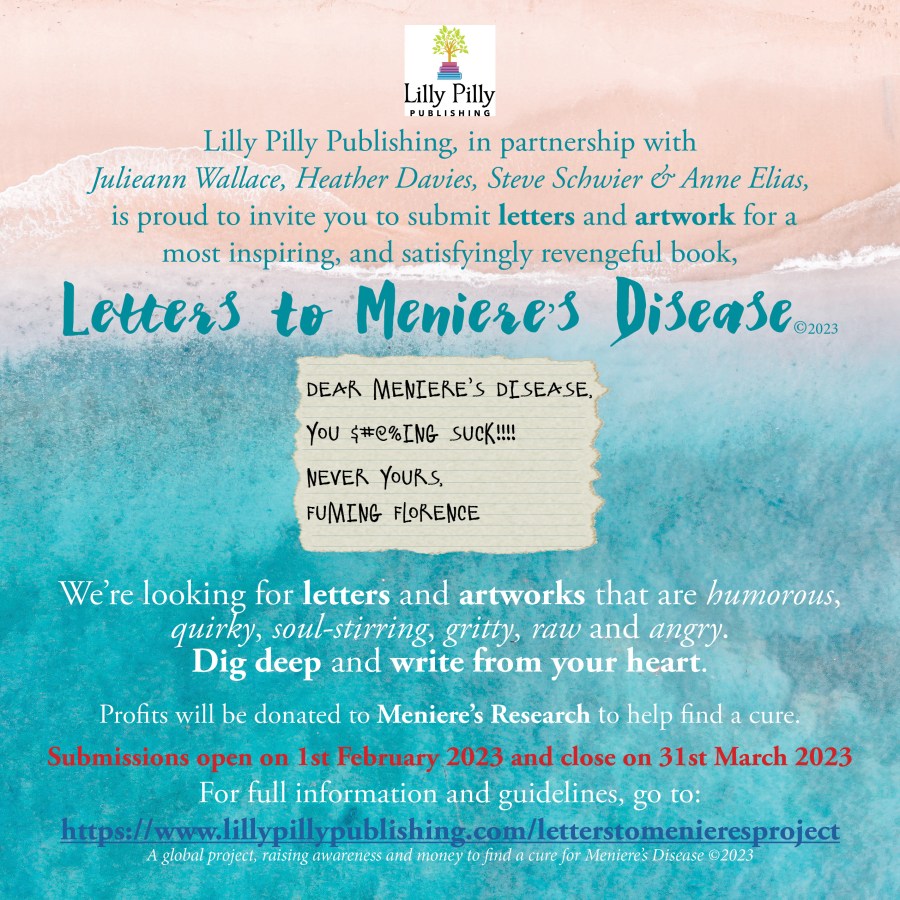
Your turn. Here’s your invitation to write a letter or create some art to be published in the Lilly Pilly Publishing Letters to Ménière’s Global Project to raise awareness, proceeds being donated to Meniere’s research.
Julieann Wallace is a multi-published author and artist. When she is not disappearing into her imaginary worlds as Julieann Wallace – children’s author, or as Amelia Grace – fiction novelist, she is working as a secondary teacher. Julieann’s 7th novel with a main character with Meniere’s disease—‘The Colour of Broken’—written under her pen name of Amelia Grace, was #1 on Amazon in its category a number of times, and was longlisted in 2021 and 2022, to be made into a movie or TV series by Screen Queensland, Australia. She donates profits from her books to Meniere’s Research in Australia to find a cure. Julieann is a self-confessed tea ninja and Cadbury chocoholic, has a passion for music and art, and tries not to scare her cat, Claude Monet, with her terrible cello playing.
Just writing to let you know that your time is limited. A cure is coming. You stole pieces of us, and we want it all back.
Never yours,
Julieann
1am.
Hello world. Not sleeping!!! Tossing and turning.
My mind is stuck on writing letters. My mind is obsessing with writing a letter to Meniere’s disease to tell it what I think …
Dear Meniere’s,
Dear Vertigo,
Dear Left Ear,
Dear Hearing Loss,
Dear Brain Fog … wait … is that brain fog (shakes head), what was I thinking again?
Dear Ear Fullness,
Dear TINNITUSSSSSSSSSSSSSSSSSSSSSSSSSSSSSSSSSSSS!
Dear Me Before Meniere’s Disease,
To My Dear Children, I’m sorry …
Dear, Dear Meniere’s Disease, we have to talk …
I feel like going to the window, opening it and yelling out to the neighbourhood, ‘I’m awake, everyone! I think I’m going crazy!’
We need a cure. We need a cure.
Except, we need money to fund the researchers …
Could we create a book of letters to Meniere’s and donate the money to research?
Could we use the book to show doctors and ENTs and disbelieving friends and family what we go through?
Could the book be used when applying for disability support so they can truly understand?
And then I’m scrolling through Meniere’s social media groups.
Symptoms.
Frustrations.
Hopelessness.
Despair.
HELP!!!!!!!!!!!!!!!!!!!!!
Misery dripping from every word of a life lived with Meniere’s.
I feel like crying.
I have to get off Facebook for a while before it pulls me back to the dark abyss of Meniere’s.
I close my eyes and take a deep, calming breath.
It’s time to create the Letters to Meniere’s book. I’m stepping up awareness for Meniere’s disease, and seeking revenge by creating a satisfying book of Letters to Meniere’s, written by the people who live with the condition.
Yep. Let’s do this!
Gather a team of inspiring Meniere’s Ninjas to help bring the book to fruition. CHECK
Steve Schwier, who rode an e-bike 1,400 miles from Denver, Colorado to Columbus, Ohio to bring awareness to Meniere’s Disease. His difficult and gruelling ride is chronicled in his memoir, “On the Vertigo: One Sick Man’s Journey to Make a Difference”.
Anne Elias, mover and skaker of the Sydney Meniere’s Support Group, and instigator of our amazing Webinars with Meniere’s professionals.
Please join the Meniere’s community as we write letters to Meniere’s disease. We’d love for you to share your story, or, a story, through a letter. Sign your letter off with your first name, or a fictional name. Go to https://www.lillypillypublishing.com/letterstomenieresproject for more information and guidelines. Profits will be donated to Meniere’s research.
Let’s laugh together, cry together, and … understand. That’s what our letters and artwork will do. That’s what we can do. It takes a village.
We’re on a mission. A terribly important mission.
Dear Meniere’s,
Imagine a world where Meniere’s disease, that’s you, has been eradicated …
Julieann Wallace is a multi-published author and artist. When she is not disappearing into her imaginary worlds as Julieann Wallace – children’s author, or as Amelia Grace – fiction novelist, she is working as a secondary teacher. Julieann’s 7th novel with a main character with Meniere’s disease—‘The Colour of Broken’—written under her pen name of Amelia Grace, was #1 on Amazon in its category a number of times, and was longlisted in 2021 and 2022, to be made into a movie or TV series by Screen Queensland, Australia. She donates profits from her books to Macquarie University, where they are researching Meniere’s disease to find a cure. Julieann is a self-confessed tea ninja and Cadbury chocoholic, has a passion for music and art, and tries not to scare her cat, Claude Monet, with her terrible cello playing.
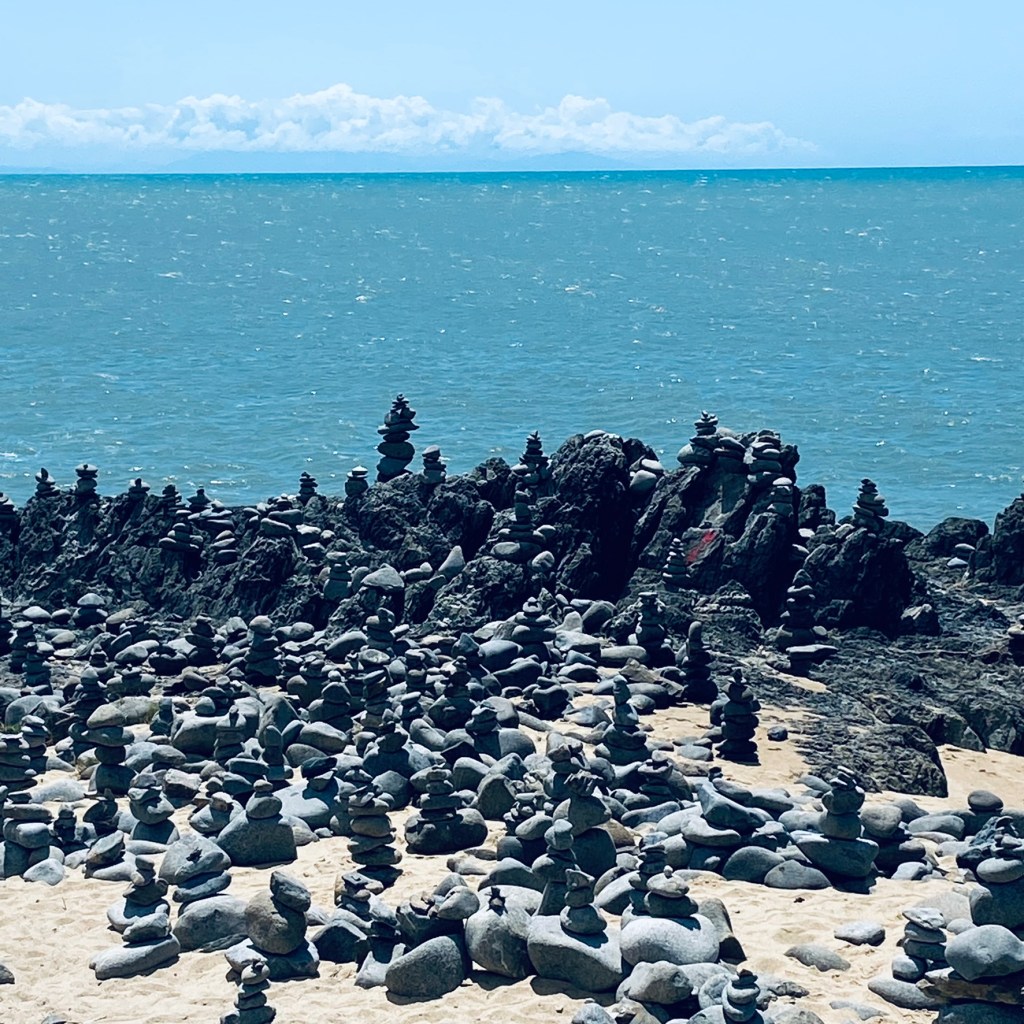
I’m sitting on a small rock beach at Wangetti, between Cairns and Port Douglas in Australia.
There’s balancing rocks everywhere. Allowed by the council. The insta-famous Gatz balancing rocks.
There’s a foreboding, for me.
Others would see it differently. I can see how it might be considered fun, and the challenge of creating your own rock stack exciting. There’s a family to my left busy creating rock stacks. Smiles litter their faces. Fingers point. Hands rest on hips once they have accomplished their mission.
But to me, the rocks are all shades of darkness, mirroring my Meniere’s journey and the destruction of my balance cells. My Meniere’s journey that has scarred my heart and mind. And my inner ear. My journey that I pray that nobody ever has to travel. Cure for Meniere’s disease, please come soon.
I study the balancing rocks with more focus.
Rocks of black.
Rocks of brown.
Grey rocks. So many grey rocks with an “e” like the rain clouds – melancholy, but an enjoyable melancholy that builds up until it releases, like petrichor, the smell of the rain after warm, dry weather. Satisfying. The grey with an “e” of deep thought, philosophy and ponderings. The grey with an “e” that helps you to discover parts of yourself that you never knew existed, and can vanish without leaving a bitter aftertaste.
Gray rocks. So many gray rocks with an “a”. Never enjoyable. A very dark gray. It’s self-judgement, doom and gloom, forever hanging around and within. It wants to drag you into the dark abyss of the colour black, that absorbs all colours … the colour of self-condemnation, the colour of depression.
The rocks first caught my gaze as my husband and I travelled to Port Douglas to catch the Quicksilver boat out to the Great Barrier Reef the day before.
‘I want to go back to the rocks tomorrow,’ I had said to him.
Memories of my journey with Meniere’s disease flood my mind and my throat tightens. Vertigo. I so hate vertigo! I could cope with the ear fullness, hearing loss and tinnitus. But not the abhorrent, unpredictable vertigo.
Balance. I chose to have my balance cells destroyed in 2004 to stop the violent, horrendous, soul-destroying vertigo that would last up to 4 hours at a time. I would be hit with episodes of vertigo at least 40 times a year. I was totally debilitated, unable to move. I would stare at one spot of the wall for the entire time trying to gain some sort of control over the vertigo. I never could. My husband would selflessly empty my vomit bucket numerous times, and take me to emergency at the hospital for an injection of Stemetil and a bag of IV fluids. I was exhausted for days afterward.
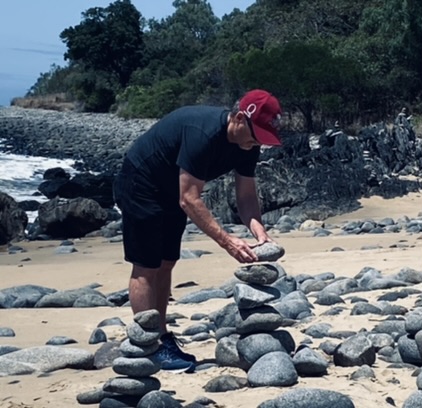
I looked to my right. And there was my husband creating his own rock stack.
Tears pooled in my eyes. I felt like he was making the balancing rocks for me, for the journey I have been through, relearning my new balance using my eyesight. Successfully.
In reality, I know that he is creating a rock stack because it is fun.
I wipe the tears from my eyes and place the final rock on top of my husband’s rock stack. Joy fills me and I smile.
And there it is. We have created a rock stack for my Meniere’s family, and for others who have vertigo caused by diseases and traumas.
I lift my gaze to the ocean and inhale deeply. What a journey I have been on. What an awesome family I have where I receive support, always, and who deal with my lack of balance with humour to make me laugh.
I am beyond thankful that I no longer have vertigo. An answered prayer.
I walk to my left and move amongst the balancing rocks with care. The ground is uneven and … rocky. Any normal person could easily lose their balance here. But I’d hate to be the reason some rock stacks are knocked over due to me losing my balance.
I laugh to myself at the irony.
I take one final gaze at the works of rock art. Ephemeral art. I know that researchers are working on devices and gene therapies to cure vertigo.
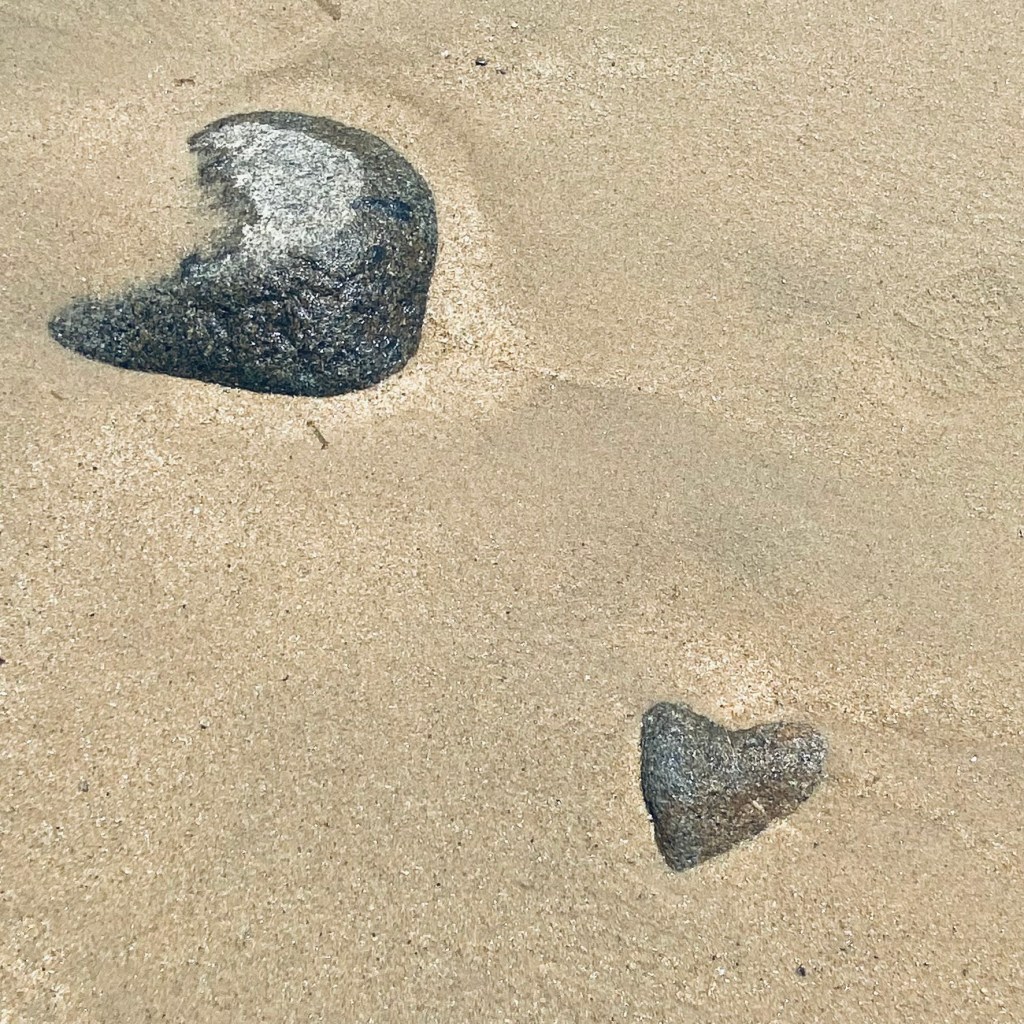
I look down and find a heart shaped rock. Good things are coming.
Julieann Wallace is a multi-published author and artist. When she is not disappearing into her imaginary worlds as Julieann Wallace – children’s author, or as Amelia Grace – fiction novelist, she is working as a secondary teacher. Julieann’s 7th novel with a main character with Meniere’s disease—‘The Colour of Broken’—written under her pen name of Amelia Grace, was #1 on Amazon in its category a number of times, and was longlisted in 2021 and 2022, to be made into a movie or TV series by Screen Queensland, Australia. She donates profits from her books to Macquarie University, where they are researching Meniere’s disease to find a cure. Julieann is a self-confessed tea ninja and Cadbury chocoholic, has a passion for music and art, and tries not to scare her cat, Claude Monet, with her terrible cello playing.
1. an even distribution of weight enabling someone or something to remain upright and steady.
‘I fell,’ I said. I wanted to sob. Loudly. Aftershock from my fall. I caught the sob in my throat. ‘I fell and I couldn’t stop it.’
My husband’s eyes filled with tears, but they didn’t leak down his cheek like mine. I always hate seeing his eyes that way. He was following me as we walked, to catch me if I fell. He always does that for me. My protector. And when it happened, there was no way he could stop it. I remember the panic in his voice as he leaned over me, asking if I was okay, looking over me, again and again. ‘Did you hurt yourself?’ he had asked.
All I could say was, ‘My phone is under the bush, over there.’ I had no idea how I saw it slide under the bush. When I fall (which is rare), I have no idea where to put my hands to stop me, or protect me – inside my head as I’m falling, I see myself as a body but no arms or legs. That’s what destroying my balance cells did to me. I just have to wait for impact and suffer the consequences.
‘I don’t care about your phone. Are you okay?’ he said.
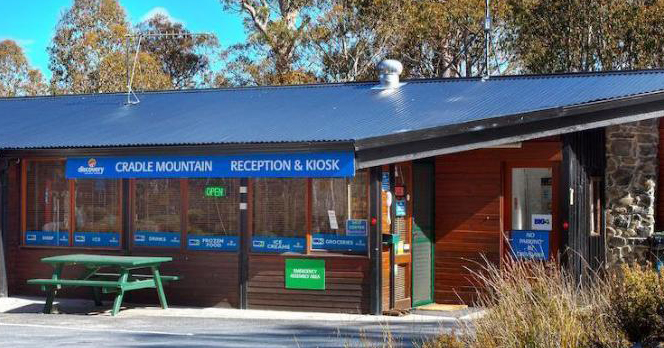
‘Yes,’ I said. It was a lie. I was hurt. But I wanted to get up to save face. There were many people on the walking track at Dove Lake, Cradle Mountain, Tasmania. 5.7kn. 3 hours.
I HATE YOU MENIERE’S!
My husband pulled me up off the ground. My daughter picked up my phone. She was too quiet. How many times had she witnessed Meniere’s bring me to my knees with vertigo, deafness, depression? And now falling, this first time, only because I tripped over a step.
I blew out a long breath between my lips. Then set a rock in my sights to sit on for a moment to assess my injuries, then walked there, my husband holding onto my arm to support me. I wanted to yell at him, “LET GO OF ME. I’M NOT AN INVALID!” But I didn’t. He was trying to help.
I sat on the rock, looked over the lake and focussed on where I hurt – my wrist, my arm, my ankle and my back. Hold yourself together, I thought, people fall all the time. Put on your “I’m okay mask”.
‘Are you alright, Ma?’ my daughter asked.
Hold yourself together. The emotion of “I want to fall to pieces” rolled through me. Hold it together. Breathe.
‘It could be worse,’ I said, ‘I could have broken something.’ I was hoping that I didn’t break anything. My wrist, arm and ankle were throbbing. Not to mention my back spasms. ‘Thanks for picking up my phone,’ I added.
She nodded, looking at me with concern in my eyes.
‘I’m sorry for falling,’ I say to her. I don’t want her to be embarrassed by me.
I HATE YOU MENIERE’S!
And of course, she’s not. She never is. She’s always one of the first to help. It is my own self-judgement that betrays me.
I stand. In pain. But I can walk to finish the last hour of the 3 hour track.
My daughter is in front of me, glancing back at me every once and a while, and my husband behind me. I’m glad. He can’t see me wriggling my fingers to check my wrist, and feeling where my right arm hurts, nor the wince on my face when my ankle hurts more than I want it to, or my back spasms. All I can think of is when my son would roll his ankle at elite triathlon training, and his coach would tell him to walk normally on it. So that is what I do, despite the pain.
After the walk we entered a cafeteria for a drink.
Without warning, tears filled my eyes. In public. ‘I could have died if I fell in a different part of the walk,’ I say. It was true. Parts of the track were on a boardwalk above the ground that fell steeply, scattered with rocks and trees below. No rails to stop a tumble.
‘I know,’ my husband whispered. I watch his watery eyes and see him swallow harder than usual. ‘What do you want to drink? Do you want an ice-cream?’ He was using the distraction method. He knows me well.
Claire and I find a table away from most of the people. My wrist and arm throb. My back was spasming and my ankle twinging. Swelling was setting in. I ate my ice-cream, flicking tears from my eyes when they dropped. At least I don’t have vertigo, I thought. It was a good day, after all. Any day without vertigo is a good day. Suck it up, I tell myself, it could be worse.
In 2004, nine years after my Meniere’s started, I made a conscious decision to have my balance cells destroyed. I couldn’t do the horrendous, unpredictable, debilitating, violent, torturous, four-five hours of insane vertiginous spinning and nausea and vomiting and staring at one focus spot on the wall for the entire four-five hours anymore. I was more than done. I didn’t want to be here anymore. So when my ENT offered to inject gentamicin into my middle ear to kill off the balance cells, halting the vertigo, I didn’t think twice.
Imagine for one moment, having to make the choice about destroying your balance cells. Balance. Yeah – that thing. Something you never even think about. Your body just does it for you.
The vertigo of Meniere’s disease for me, was the most abhorrent, violent, room spinning.
Totally debilitating.
It was “hold on to the floor or the bed even though you are already on lying on the floor or bed”. I had to stare at one spot on the wall for four or five hours until the spinning subsided. And whatever you do, DON’T move your head. It will make the spinning one hundred times worse.
Beyond exhausting. Soul destroying.
And let’s not forget the relentless, vicious puking that feels like you’re about to turn inside-out, dehydrating the body so much you need to be transported to emergency at the hospital.
If you ever want to know how vertigo of Meniere’s feels, sit on an office swivel chair and get someone to spin you around and around and around as fast as they can.
Now, imagine not being able to stop it. Not being able to get off that office chair for hours and hours and hours.
Then imagine, never being able to predict when vertigo will hit – and when it does, you are stuck wherever you are, and you absolutely cannot move as it will make the spinning impossibly worse. This is the vertigo of Meniere’s. Hell.
Was the gentamicin my first port of call? Absolutely not. I had already had Meniere’s disease for nine years and tried:
* Low salt diet
* Diet elimination
* Stemetil
* Diuretic
* Serc
* Sound therapy
* Acupuncture
* Prednisone
* Grommet
Gentamicin was next. If that didn’t work, I was going to have a Vestibular Nerve Section where the balance nerve to your ear is severed.
The gentamicin worked – an answered prayer. One full strength shot injected in through my grommet with some bicarbonate of soda and sterile water mixed with it to make it penetrate better.
Image: Polyclinique Centre-Ville
The procedure took place at my ENT’s procedure room in the city. I lied on my right side while he injected the concoction in through my grommet in my left ear.
‘Isn’t that hurting?’ he had asked me as he infused the mixture into my middle ear.
‘Yes,’ I had said, ‘but I am envisaging it destroying the Meniere’s in my middle ear. It’s a mind visualisation technique I taught myself when I was young, when I had growing pains in my knees.’
I remained on my right side, left ear facing the ceiling for 20 minutes after the procedure, then went home, where I went to bed and rolled onto my right side to keep my left ear up. I slept for two hours.
The next day I had bouncy vision when I walked. It has a term – oscillopsia. Oscillopsia is a vision problem in which objects seem to jump, jiggle, or vibrate when they’re actually still. It stems from a problem with the alignment of your eyes, or with the systems in your brain and inner ears that control your body alignment and balance. It was a side effect of having my balance cells destroyed. It was a good sign that the gentamicin was working, my ENT had said.
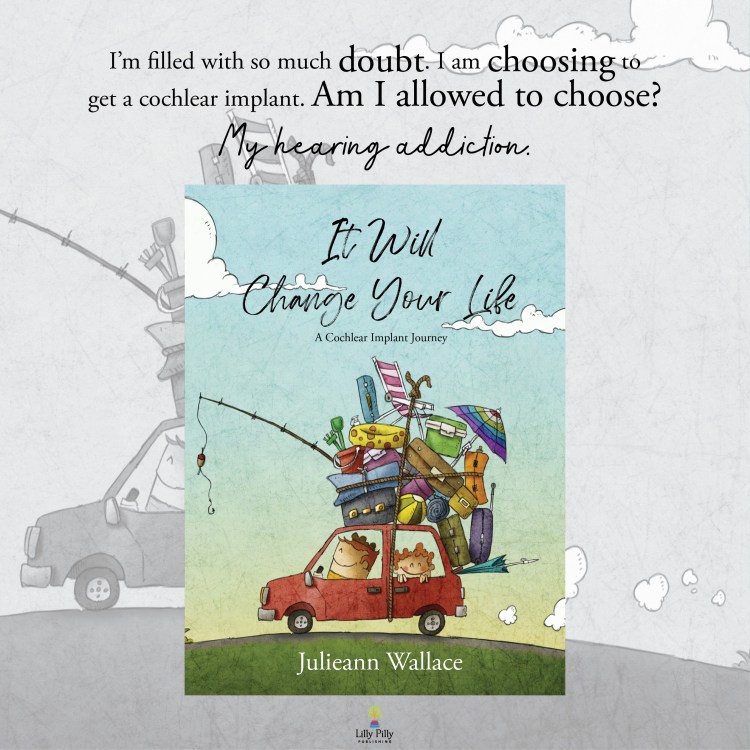
Three weeks later I was back teaching full-time, learning to trust that I wouldn’t have any more vertigo attacks. I relearned to walk using my eyesight. The neuroplasticity of the brain is beyond words. Since 2004, I have been vertigo free. So thankful for God’s mercy and grace.
15 year later, before I had my cochlear implant, I had balance rehabilitation. Finally. I wish I had discovered it earlier in my journey. My balance improved far beyond what I every thought it would. My life is pretty normal balance-wise now. I do have limitations, like climbing ladders and fences. I just make sure that I hold on for stability.
It’s Balance Awareness Week. Many people do not know that your inner ear plays a significant roll in your balance. The inner ear is home to the cochlea and the main parts of the vestibular system. The vestibular system is one of the sensory systems that provides your brain with information about balance, motion, and the location of your head and body in relation to your surroundings. There are three loops in your inner ear, called semicircular canals. The first canal senses up-and-down movement. The second canal senses side-to-side movement. The third canal senses tilting movement. Each canal has hair cells and fluid inside, which move when your head or body moves. The hair cells send messages to your brain through the acoustic nerve. These messages tell your brain about how you are moving. Are you moving straight, like in a car, or up and down, like in an elevator? Or maybe you are not moving at all. This information (along with what you see, hear, and sense with your body) helps you keep your balance. A problem in your inner ear is just one of many factors that can lead to balance difficulties, dizziness, and vertigo.
Signs and Symptoms
Balance disorders come with different symptoms. Symptoms may happen all the time or just occasionally. They may come about suddenly or may be triggered by something (e.g., position change, head movement, visual or sound stimulation). Symptoms of balance problems include:
difficulty walking and moving around
dizziness
falling
headaches
light-headedness
motion sickness
nausea
unsteadiness
vertigo (e.g., a feeling that the room is spinning) and
A balance problem may cause you to feel nervous or afraid. You may change the way you walk and move around. For example, you may walk more slowly or move your head less.
Causes
It is important to find out the cause of your dizziness and balance problems. A variety of underlying conditions or issues may cause balance problems and dizziness, including:
I learned to use my vision to help with balance, and balance rehabilitation did wonders.
Life is good.
Julieann Wallace is a multi-published author and artist. When she is not disappearing into her imaginary worlds as Julieann Wallace – children’s author, or as Amelia Grace – fiction novelist, she is working as a secondary teacher. Julieann’s 7th novel with a main character with Meniere’s disease—‘The Colour of Broken’—written under her pen name of Amelia Grace, was #1 on Amazon in its category a number of times, and was longlisted to be made into a movie or TV series by Screen Queensland, Australia, twice. She donates profits from her books to Macquarie University, where they are researching Meniere’s disease to find a cure. Julieann is a self-confessed tea ninja and Cadbury chocoholic, has a passion for music and art, and tries not to scare her cat, Claude Monet, with her terrible cello playing.
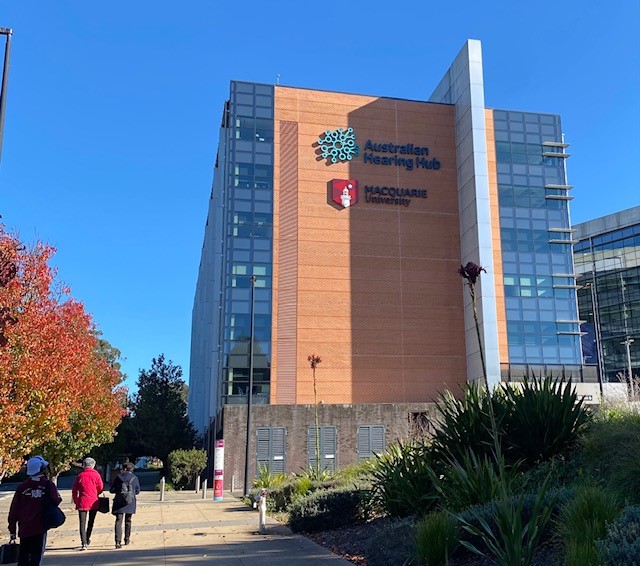
It’s early in the morning and I’m buzzing with excess energy. I’m restless, and failing at trying to focus on getting ready to go to work to teach secondary students. My thoughts are all over the place and I’m filled with an ocean of hope for the future of Meniere’s disease. It’s also the day after I flew to Sydney to attend the Macquarie University for a tour of the School of Engineering and Hearing Hub. Yes, I wagged school to fly interstate. It’s for a Cochlear appointment, I told my employer, leaving out the fact that the appointment was a 1hr 35min flight to Sydney.
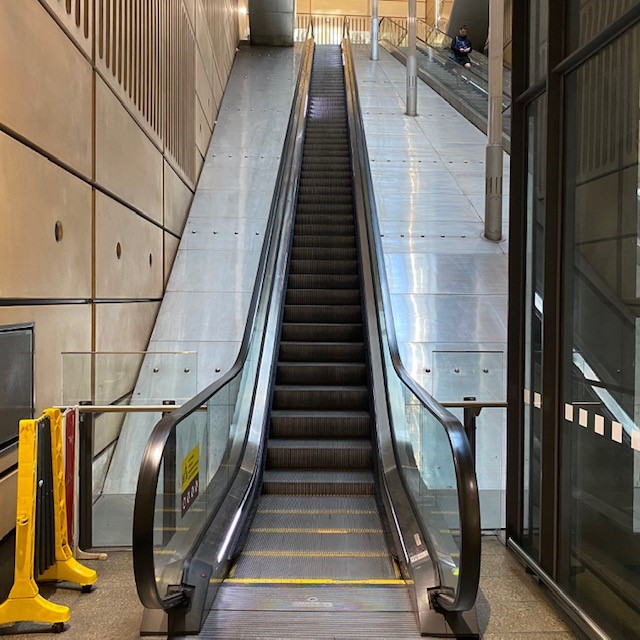
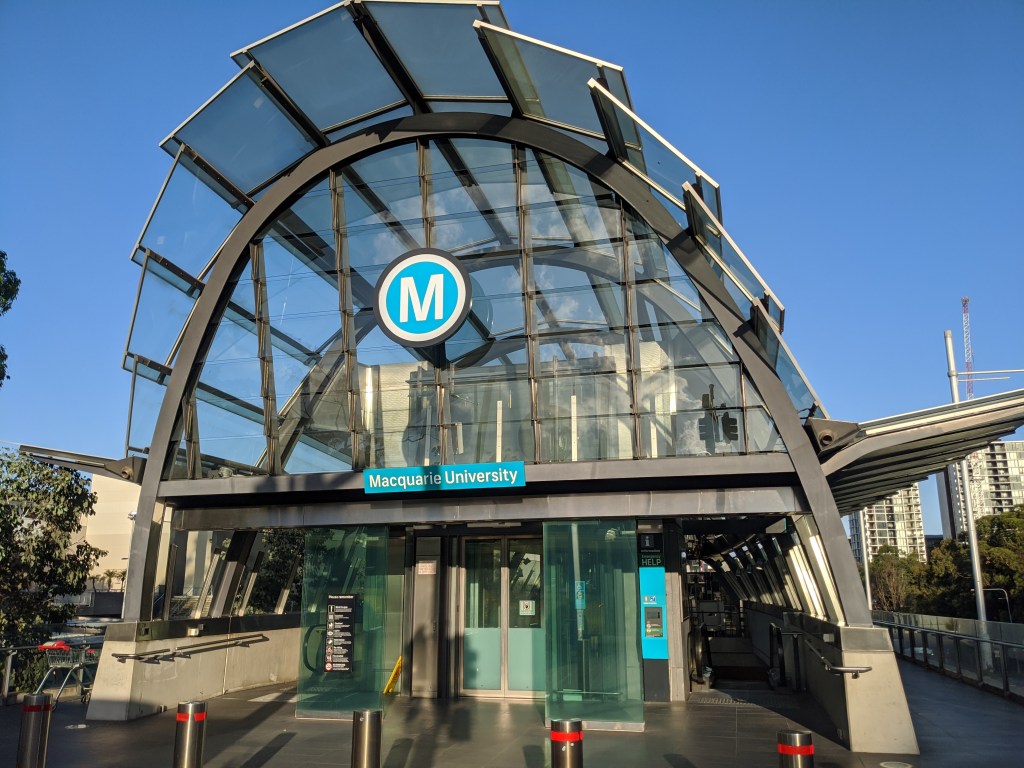
Yesterday, I was up at 4:30am to start my day. After the flight to Sydney I caught three trains to Macquarie University Station. Anne said she would meet us here. I looked around. No Anne. Maybe she meant not right here, but at the entrance of the station. I looked up at the exit. Two massive escalators, around 100 steps each. How far underground were we?
I reached the top of the stations and stepped out into the daylight and looked up. It was such a beautiful day in Sydney.
‘Julieann?’ I shifted my gaze, expecting to see Anne. But it wasn’t her. ‘Yes,’ I said, assuming it was one of the thirteen Meniere’s people who were gathering at the Macquarie University today. ‘I’m Eleanor*. I recognise you from the Zoom sessions.’ I smiled then remembered I was a Meniere’s guest speaker at one of Sydney Meniere’s Group Zoom sessions. Technology connects us globally. ‘Hi, Eleanor.’
And then our conversation started. Eleanor told me her Meniere’s story and I asked her questions. At once her Meniere’s traits appeared, those traits that people with Meniere’s know so well. That turn of the head to the better hearing ear. The ‘Can you say that again?’ request. The stop in the conversation when the traffic noise became too loud. What a terrible place to share stories. I watched once again as she turned her good ear toward me to hear what I was saying. My heart cracked. That was me once, trying to listen, trying to lip read, trying to fill in the missing or misheard words to make sense of what was being said. The nodding and smiling when I should have been answering a question. Eleanor needs a Cochlear Implant. Like me. It would make her life so much easier. Dear, dear Eleanor. I wanted to hug her so tightly that all her broken bits from Meniere’s would be pushed back together. Her life story … I took a deep breath, what a strong woman she is. I was in awe of her.
And then another person arrived. ‘Julieann,’ she said. ‘I’m Amy*.’ She knew my name before I could say anything. She told me her Meniere’s story. It was her neck that was out, and once she had it worked on, she hadn’t had vertigo since, but she still has the other symptoms.
Then Anne appeared. The shaker and mover, Dizzy Anne. The Anne who started the Sydney Meniere’s Support Group . Anne who organises regular Zoom meetings with guest speakers to educate, support and help people with Meniere’s disease: Meniere’s Support Group – Dizzy Anne – YouTube. Legendary Anne with a heart of gold.
More people appeared as if from nowhere. A head count. Two people were missing. They couldn’t make it. We all understood perfectly. That horrid beast of Meniere’s disease. You can make plans, but it is the Meniere’s Monster that destroys them for you. My heart sank for them and I started to slip into that dark, dark place of long ago when that was me. When Meniere’s had taken so much away from my life and I was on my hands and knees trying to find the missing pieces of me. I lifted my face to the sunshine, thankful for my Meniere’s journey, thankful that I was able to be a voice for sufferers, and thankful that I was here today to meet the researchers working to find a cure for us. It must be coming soon. Hope.
After finding our bearings we were on the move, headed toward the Macquarie University Hearing Hub Café where our day of insight would begin.
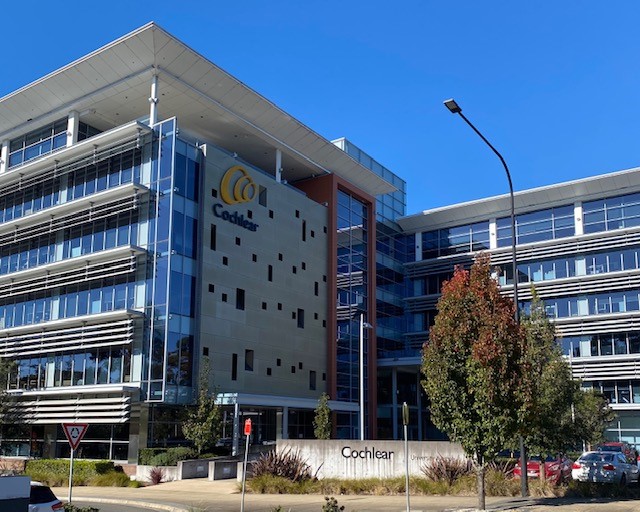
Cochlear Australia’s global headquartersMacquarie University Hearing Hub
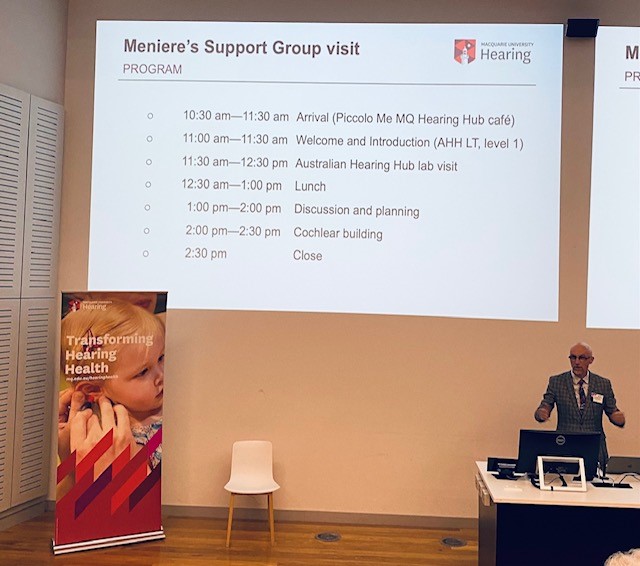
10:30 – 11:00
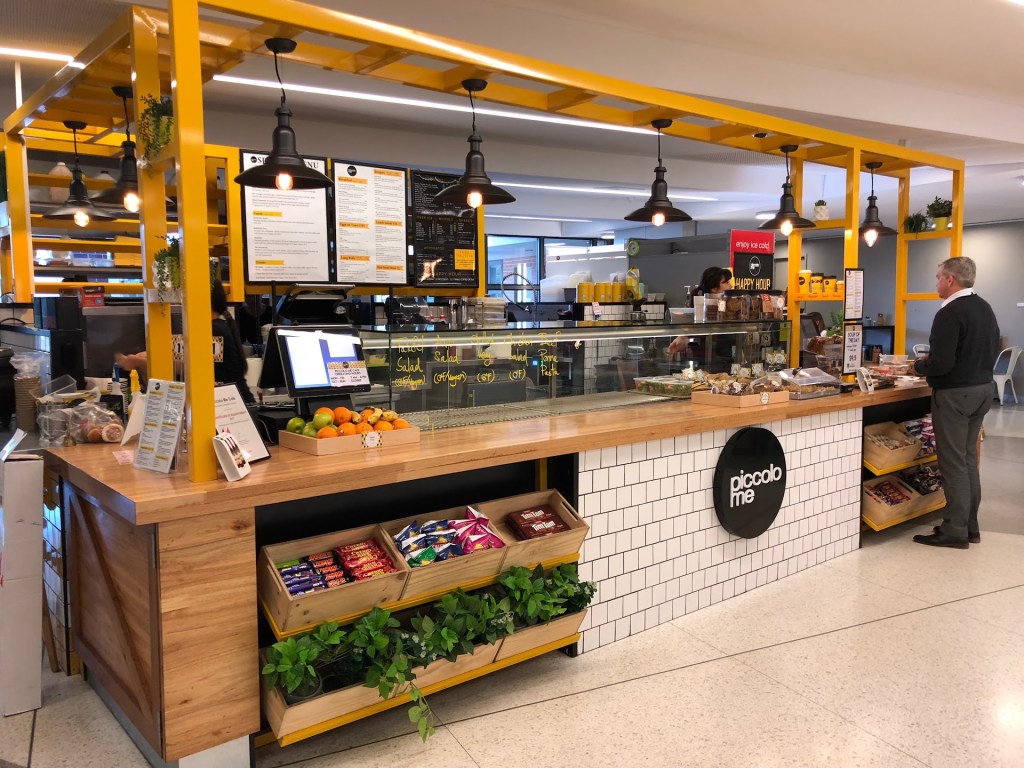
Piccolo Me MQ Hearing Hub Café
We entered the café I looked for our people. Our Meniere’s researchers. They belonged to us. A noble type of HumanKIND filled with a passion to help others, or perhaps because they loved the academic challenge to find missing pieces to solve medical problems, maybe a mix of both. What is their story? What is their motivation? These were the bravest of brave researchers, tackling a terribly difficult disease to find solutions for, with the ultimate goal of finding a cure. They are my Meniere’s Superheroes.
They stood together with an easy confidence. Smiling. Their Clark Kent personas hid their superhero status. In my curious and imaginative mind I gave them each a superhero cape. Then I joined the line to order a chai latte.
I turned to see who was behind me. ‘Julieann. I recognise you from our Meniere’s Facebook group. I’m Mark*.’ I smiled. ‘Hi, Mark. How are you?’ And then we fell into an easy conversation. He told me he had a small spin while driving to the university. He shared his Meniere’s story with me. I understood completely. He also told me how he had lost his hearing in his right ear when he was young, most probably due to the measles. I knew he needed a Cochlear Implant. It would change his life.
I discovered how at ease I was in the group of Menierian’s. I’ve only met two very small groups of people with Meniere’s twice in my 26 years of this awful disease. We all suffered the same symptoms. We had been through the same journey. We were friends, instantly. No judgement. Only sincere compassion and empathy…
The Meniere’s researchers approached us and mingled while we sipped on our barista made tea, coffees, chai lattes, cappuccinos and hot chocolates, gifted to us, all paid for like we were the superheroes, and they were visiting us. I was taken back by their kindness.
11:00 – 11:30am
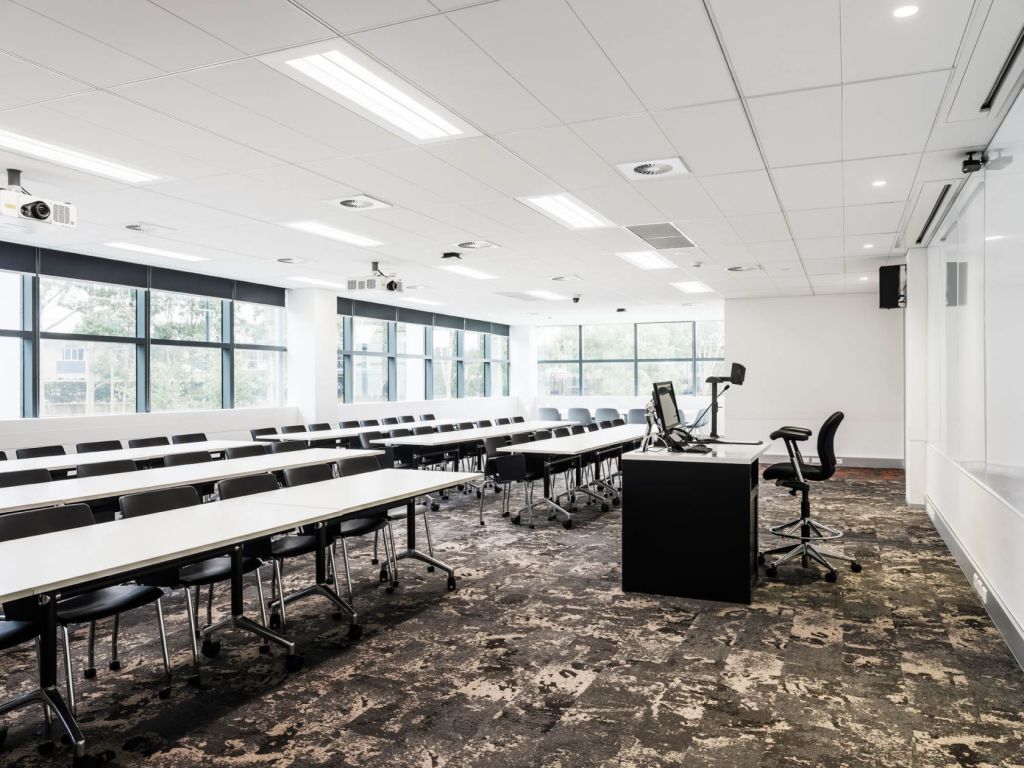
We walked to the Lecture Theatre on Level 1. The door opened to the impressive lecture room. I gazed up at the pitched floor with rows and rows of seats. It took me back to my own university days, and indeed of a teaching room at the school where I taught. I eased myself into the seat with a quiet confidence, keen to hear about their research.
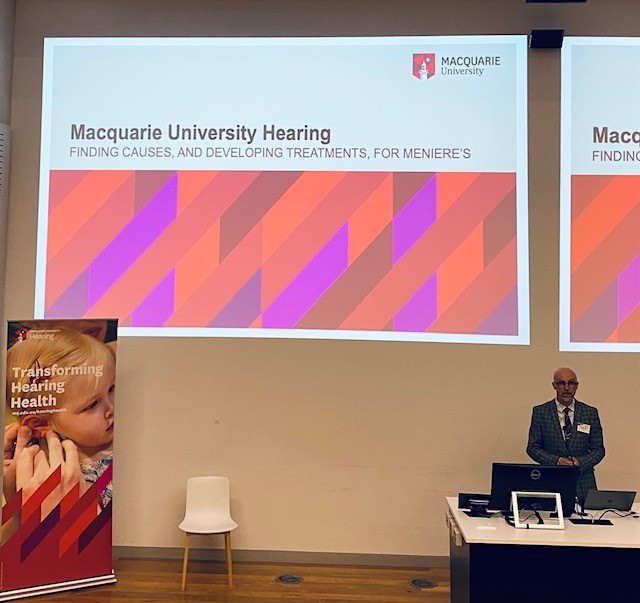
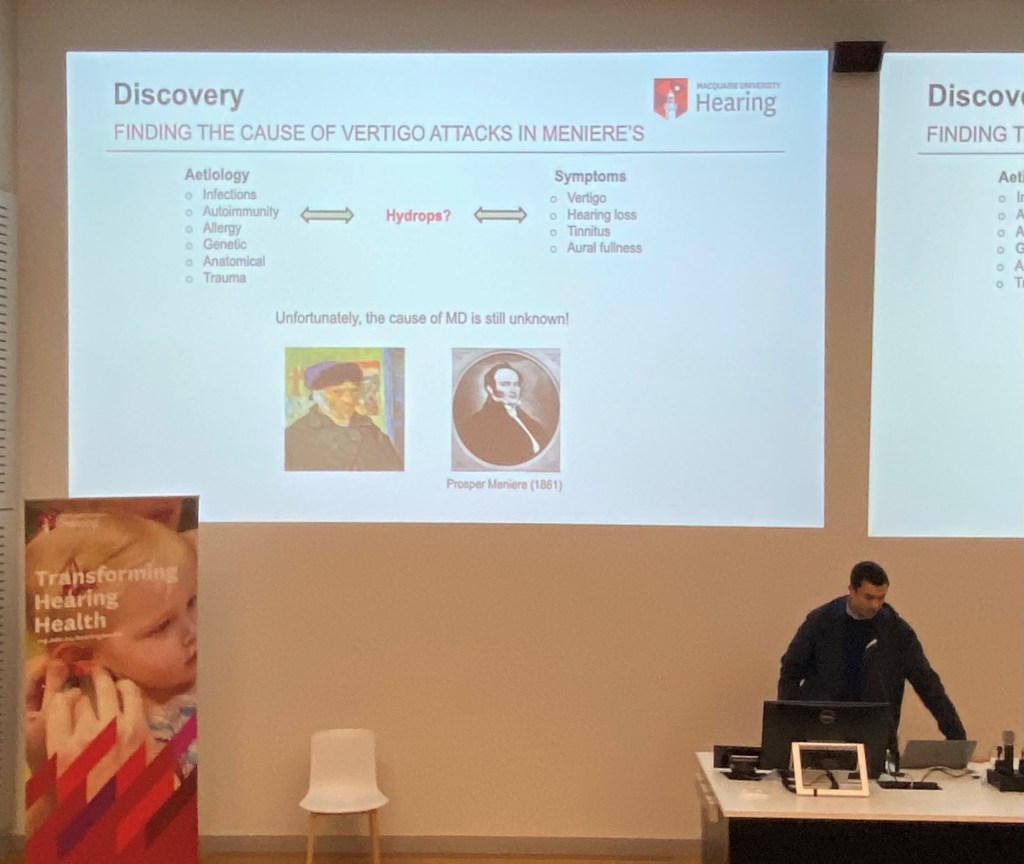
Professor David McAlpine, Academic Director of Macquarie University Hearing at the Macquarie University Australian Hearing Hub, awardee of the prestigious Einstein Fellowship, welcomed us to the Macquarie University and walked us through our program today.
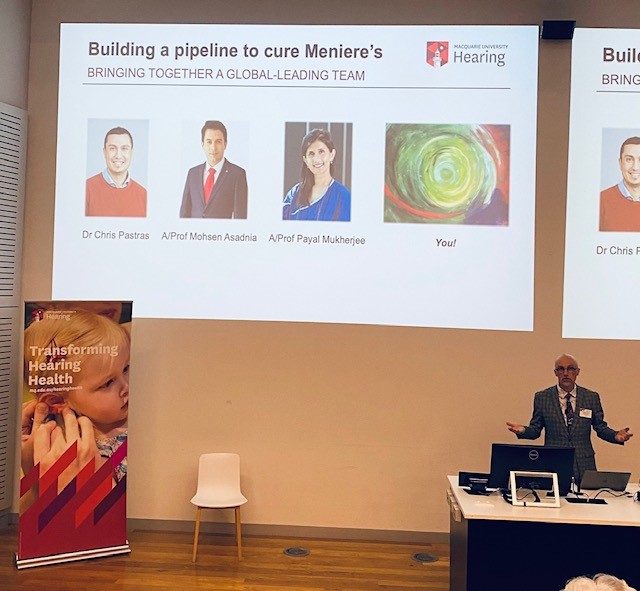
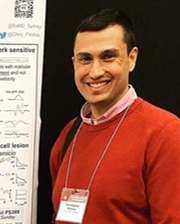
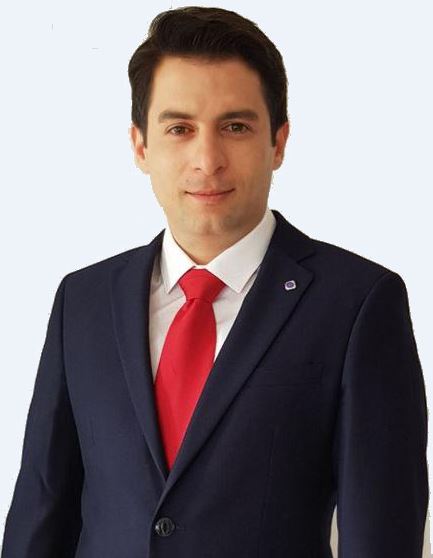
Then he introduced us to the Meniere’s research team, who are building a pipeline to cure Meniere’s, bringing together a global-leading team: Dr Chris Pastras (Director of Meniere’s Disease Research), Associate Professor Mohsen Asadnia, Associate Professor Payal Mukherjee ENT (who was unable to attend today), and then he added … you.
He spoke of the importance of listening to people with Meniere’s disease. They want to help us, and they can’t do it without our involvement. Future tours and information sharing will continue with open invitations, as today’s was.
I sat there in awe as he drew us into his world of research, our world of Meniere’s. My memory cells are bursting with Meniere’s information, soaking in every single word, enraptured by the Professors McAlpine’s passion for research and trying to cure, or at the very least, find solutions to symptoms so Meniere’s people can live a quality life again.
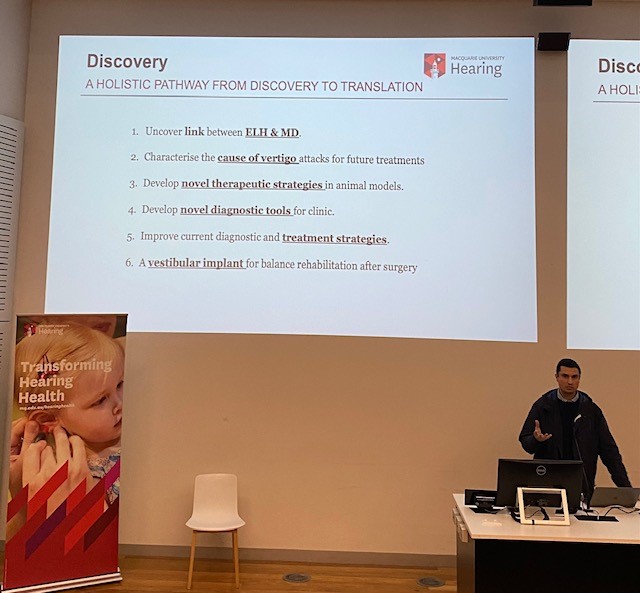
And then came the words that had me in a spin. He told us about an implantable device that will allow us to turn off the vertigo and restore our balance. I couldn’t stop myself from mouthing “WOW!” I held my breath and shifted in my seat as my eyes pooled with tears. Then I inhaled deeply to calm myself. This … is what we have been waiting for: to be able to control our vertigo without the destructive intervention, without sac decompression, without the use of gentamicin, without having a vestibular nerve section, but to just have an implantable device that acts like a switch to turn off the vertigo … mind officially blown. An answered prayer. This is a life changer. This is a life giver. This means finding our self again, the one before the physical, social, emotional and psychological broken pieces of us, after Meniere’ Disease entered our lives uninvited, shattering our sense of self – who we were, our self-worth, taking our happiness, our confidence, our friends, our social lives, our enjoyment of being able to eat whatever we wanted, our ability to take part in any physical activity offered to us.
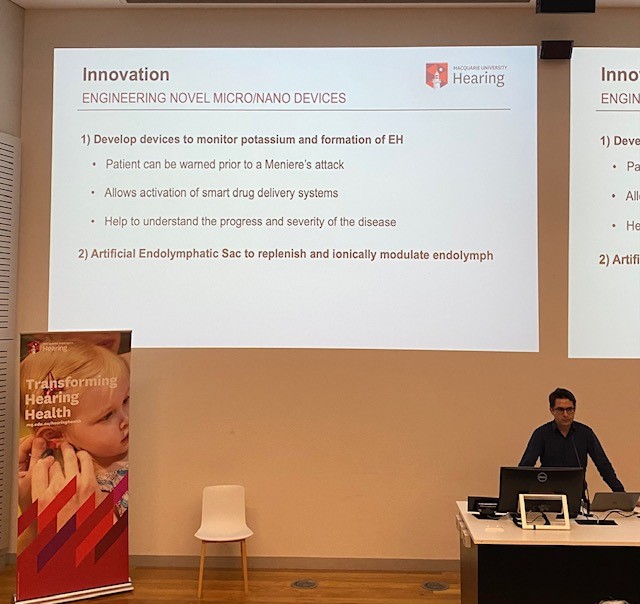
Develop devices to monitor potassium and formation of endolymph hydrops which would warn the patient of an impending MD attack, allow activation of smart drug delivery systems and help to understand the progress and severity of the disease
Artificial endolymphatic sac to replenish and ionically modulate endolymph.
Innovation: ENGINEERING NOVEL MICRONANO DEVICES
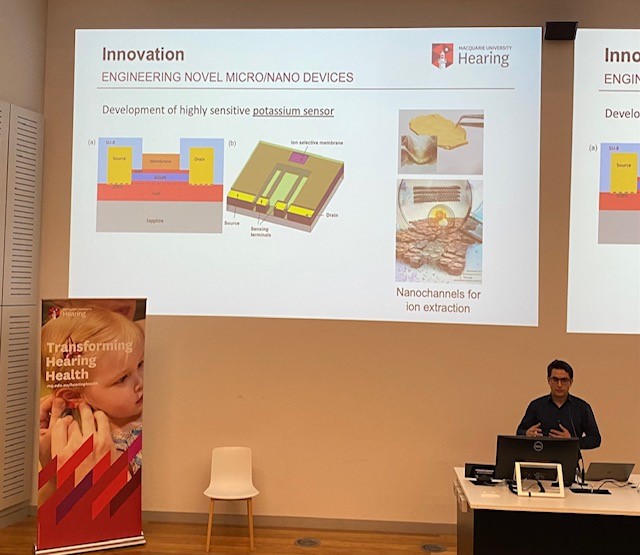
Development of highly sensitive potassium sensor
Inner ear fluid – make an implantable sensor to change the ion concentrate – potassium
Make an artificial sac to eliminate Meniere’s – has been tested and published.
They have made a membrane that only lets potassium pass through.
Professor David McAlpine thanked our presenters and we applauded. His passion for everything that had been spoken about today and about Macquarie University and their cutting edge science applied to Meniere’s was eagerly absorbed by me, and my imaginary bucket I brought along to fill with hope from today was already full. Wagging school for the day was totally worth the guilt of missing class with my students, but also knowing that they were in good hands with another teacher who would follow the plans I had left them.
11:30 AM-12:30 PM- Australian Hearing Hub’s lab visit
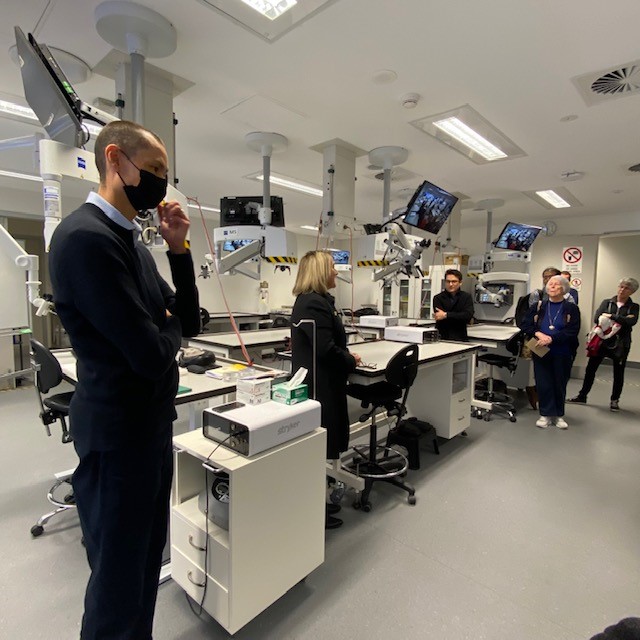
We left the lecture room and followed Professor David to our next stop on the tour. It was the Australian Hearing Hub Lab. The door opened and we entered the lab room of Cochlear Implant innovation and ground breaking research.
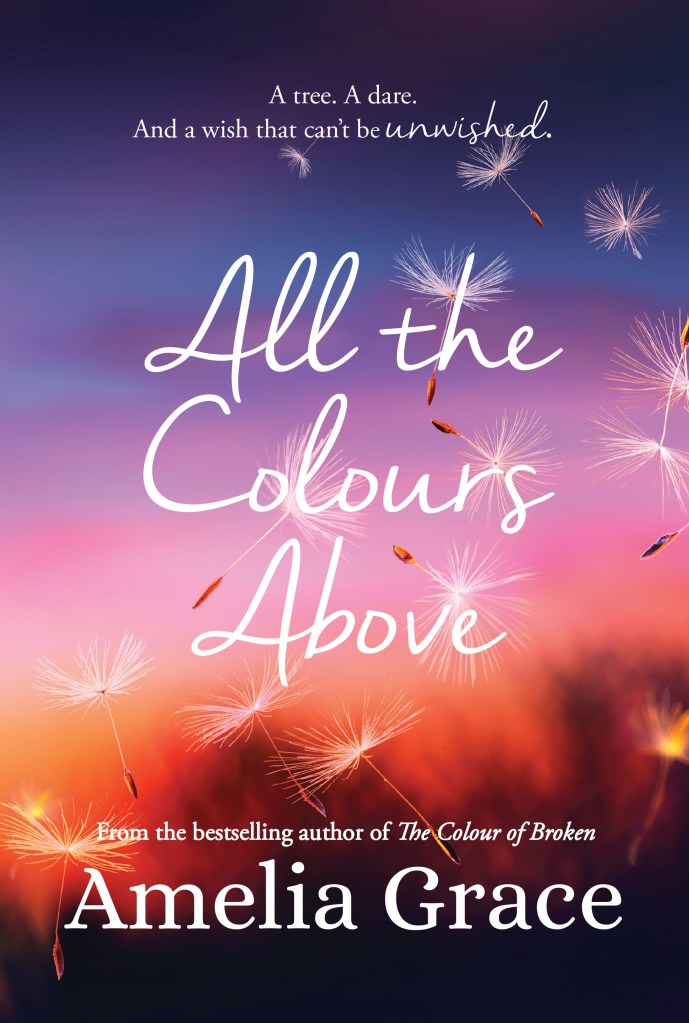
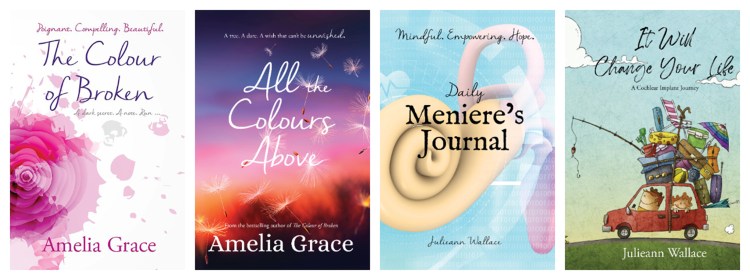
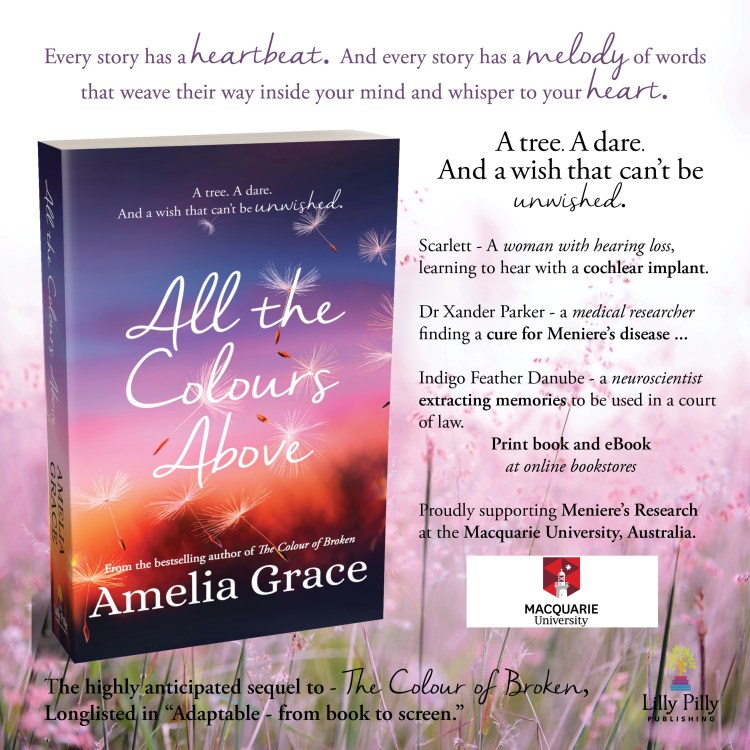
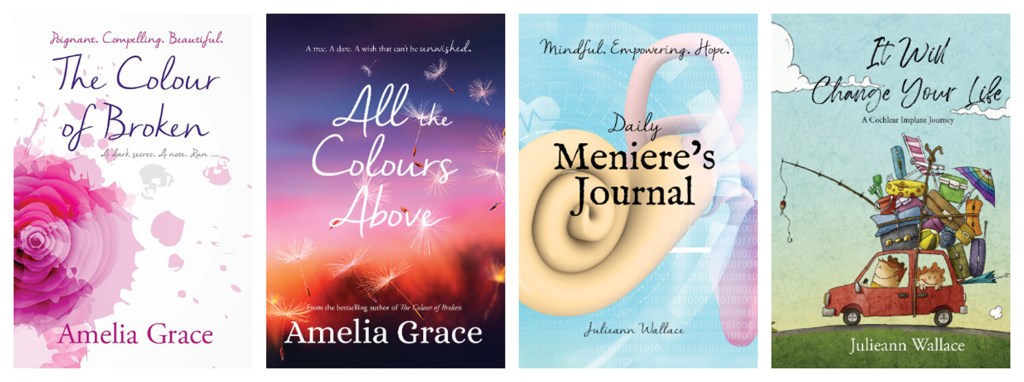
This room was named after Professor Bill Gibson who is a renowned ear, nose and throat (ENT) surgeon and world leader in cochlear implantation and Menière’s disease. My heart glowed. It was Professor Bill Gibson, whom my own ENT phoned to ask for advice before he administered my gentamicin back in 2004. It was Professor Bill Gibson, who read my Meniere’s novel, The Colour of Broken in 2018, and invited me to the Meniere’s Symposium in Sydney, 2018. It was Professor Bill Gibson, whom I emailed to apologise for curing Meniere’s in my new novel, All the Colours Above (2021), to which he replied, ‘I am interested in using nanorobotics to deliver medication to the endolymphatic sac. Mohsen Asadnia is an engineer who is very interested in Meniere’s Disease and is a leader in nanorobotics. You can google him. He is also building models to explain the cause of the vertigo.’
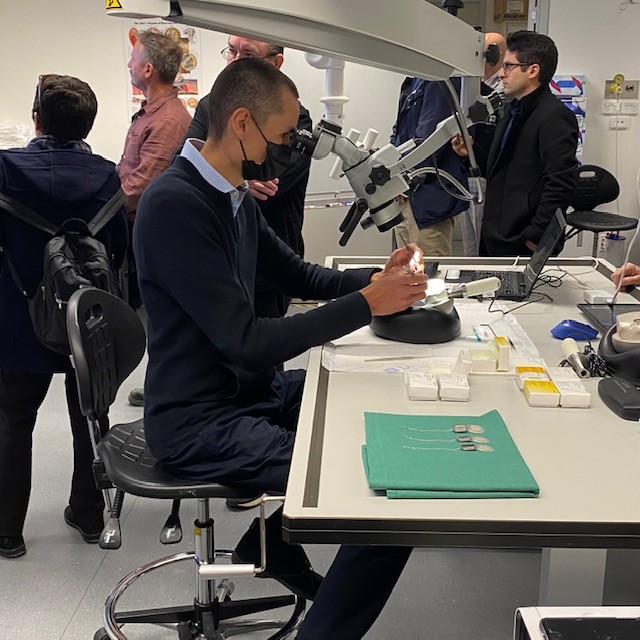
Two researchers spoke. My biggest apologies that I can’t acknowledge them by name, but I was in system overload with being present in a laboratory where the technology for my own Cochlear Implant was created once. The Cochlear Implant that changed my life. After looking around at the equipment, and the very place where Cochlear Implant Surgeons from all around the world come to learn how to perform Cochlear Implant Surgery, or where they watch live demonstrations on donated body parts from people who kindly give their physical body over to medical science after death, my eyes found the researchers again. More superheroes.
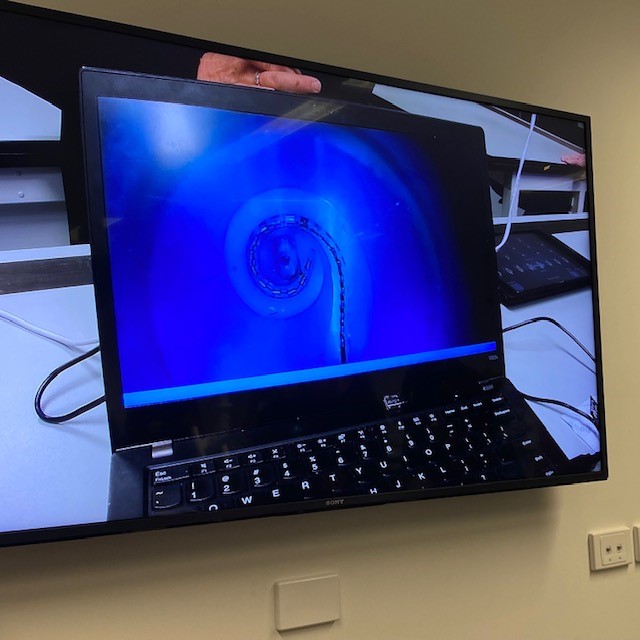
We saw the inner cochlear implant device that is placed under the skin on your scalp, and watched how the 22 electrodes were inserted via their ear prototype used for surgery instruction.
And then we were able to ask questions.
One of the people on our tour group asked about the part of the Cochlear Implant you wear on your head. The processor. I spoke up and showed them my Kanso 2, and how it attached to my head. I also told them about the year 2019, at Sports Day at school, when I saw a Year 7 boy who had cochlear implants on both ears. I spoke to him and was blown away by his perfect speech when answering my questions. He never once asked me to repeat what I was saying. He also happened to be Dux of Year Seven that year. He was the person who finally helped me to decide to get a Cochlear Implant. He’s in Year 10 now, and we always smile at each other and share CI information. He’s an amazing young man.
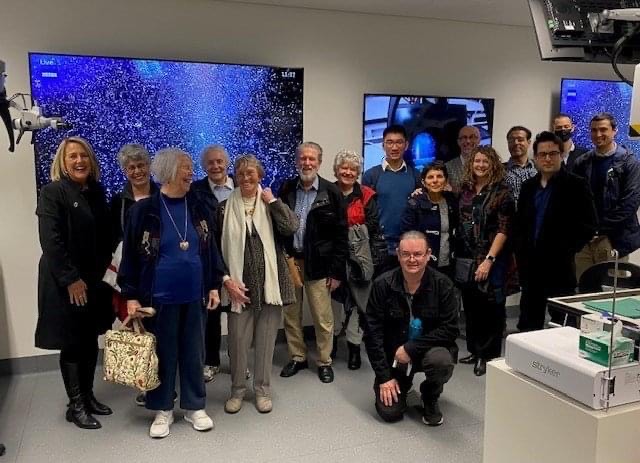
After a group photo we were lead into another room.
More Cochlear Implant research.
They are in the midst of human trials, applying hearing cell growth stimulator solution (gene therapy) into the cochlear with the electrodes at the time of the Cochlear Implant surgery. The hearing cells are stimulated to grow and attach to the electrodes to improve cochlear implant hearing even further.
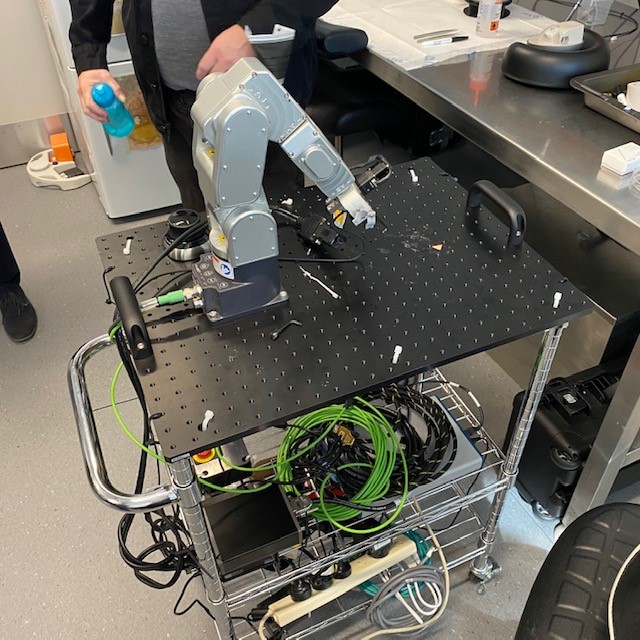
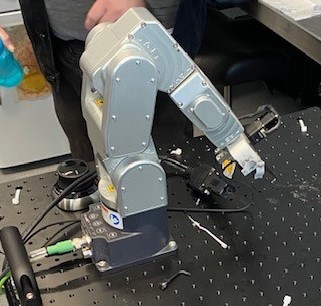
We were also shown the half a million dollar medical robot that will be used by Cochlear Implant surgeons in the near future. It’s an effective tool to overcome the surgeon’s limitations such as tremor, drift and accurate force. They joked about how good the upcoming generation of surgeons will be at controlling the joystick of the robot with all their experience in playing video games and online gaming during their youth.
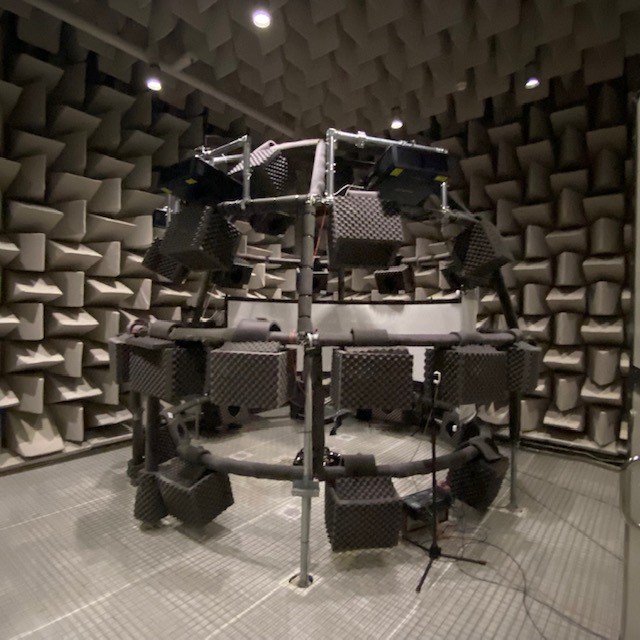
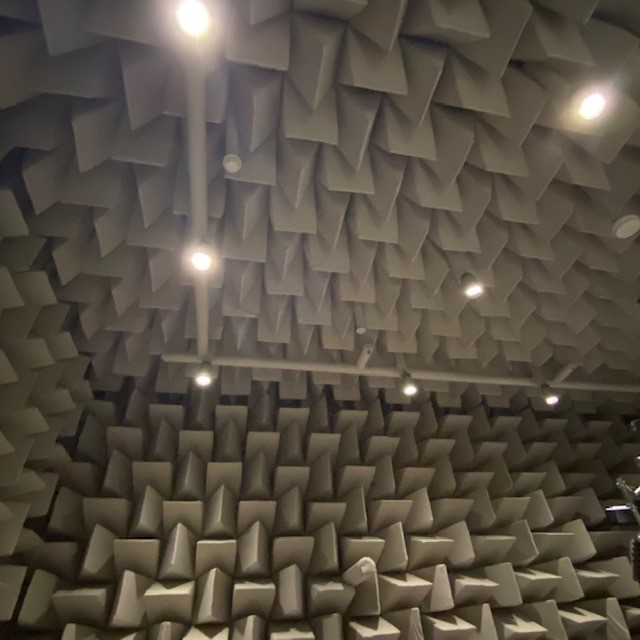
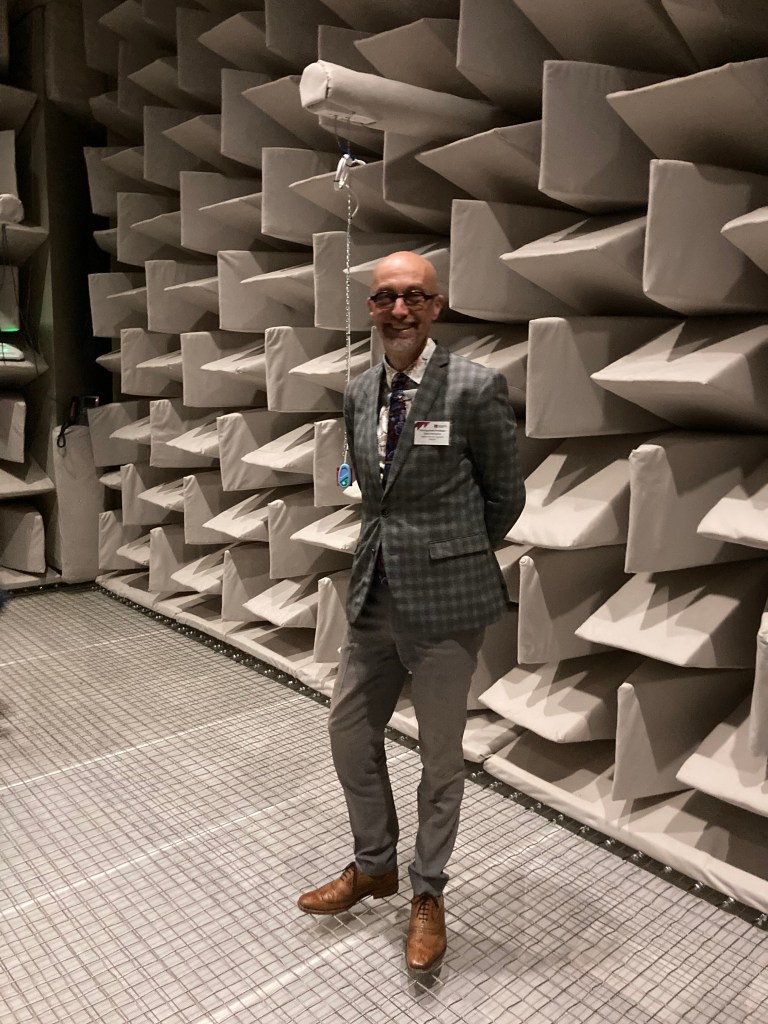
We proceeded onto the next room. On shelves were rows and rows of medical equipment and three large industrial fridges. ‘Donated totally intact vestibular systems,’ I was told. ‘We don’t want to scare you with the contents.’ I wanted to tell her that’s what I planned to do with my ears – to donate them to medical research to help people with Meniere’s disease. I also wanted to tell her that I love biology and anatomy and the sciences, and seeing body parts like that wouldn’t phase me. We moved into a long room next. If was filled with equipment for surgeons to practise Cochlear Implants. Impressive. We are in good hands. Onward bound, we entered the Anechoic Chamber – the quietest place on earth. The purpose of this room is to test sound, and to test hearing devices. The walls and ceiling was lined with fiberglass wedges. Beneath us, we stood on mesh that covered an open two floor drop below, where again the floor was covered with fibreglass wedges. This anechoic chamber at Macquarie University is the only one in the Southern Hemisphere. Explore the anechoic chamber here: https://my.matterport.com/show/?m=wPTdUHH5PNV
I was thrilled to be inside this space. I had read about these rooms. Inside the room it’s silent. So silent that noise is measured in negative decibels. It’s a challenge for people to be in the chamber. But your ears adapt. In the absence of external sounds, you will hear your heart beating, sometimes you can hear your lungs, even hear your stomach gurgling loudly. You become the sound. If you are in the room for 30 minutes, you have to be in a chair, as people have trouble orienting themselves and even standing. It is said that the longest anybody has been able to bear it is 45 minutes. I wondered about us Menierians. With our loud tinnitus, many with multiple unbearably loud tinnitus sounds, would we last longer than 45minutes? Those of us Menierians who have had their balance cells destroyed, would will still be able to orient ourselves and stand due to the fact that we have relearned to walk with the absence of our vestibular balance senses? I’d be open to the challenge to be in the chamber as a person with Meniere’s disease. Fascinating. You can read more about anechoic chambers here: https://www.scienceabc.com/innovation/anechoic-chambers-quietest-most-silent-rooms-work-made.html
12:30 PM – 1 PM Lunch
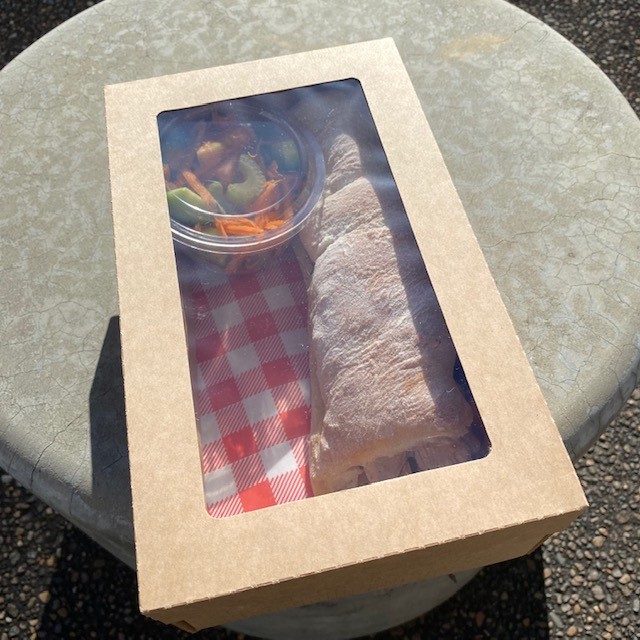
I approached the long table of prepacked lunches as a person with Meniere’s disease. You know what we do, we look at the food and categorize whether it is safe for us to eat – how much salt content would be in the foods; would it give me brain fog, ear fullness, or increase the sound level of my tinnitus, would it be enough to throw me into a vertigo episode? I wondered what would be offered for lunch by the Meniere’s specialists, knowing our reaction and limitations with salt. I was well pleased to find that the packaged lunch was well thought-out with our diet restrictions in mind, and so very thankful for their kindness once again. But still, when I opened the box of food, I deconstructed the Turkish bread (other types of bread were available as well) to see exactly what was on the roll (chicken, lettuce, tomato) with a side salad of carrot, celery etc, plus a chocolate roll. I ate what I knew wouldn’t affect me.
1 PM- 2 PM (Discussion and planning)
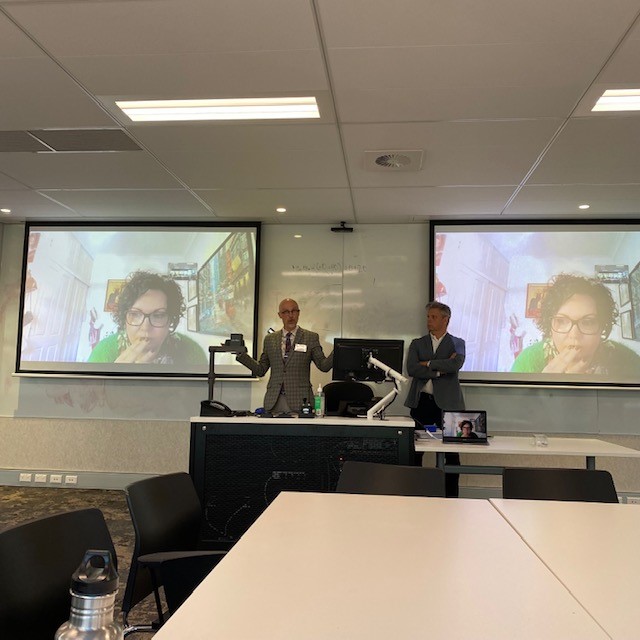
With our bellies full and Meniere’s stories shared over lunch in the glorious winter sunshine (20 degrees Celsius), we headed to another room of grouped tables and chairs for discussion and planning. This is the part of the day I was unsure about. It even made me feel a little nervous. How could we, the Meniere’s sufferers, be part of planning? What could we possibly provide the highly intelligent doctors, professors and engineers, that could help them?
That carpet – I know what you are thinking …
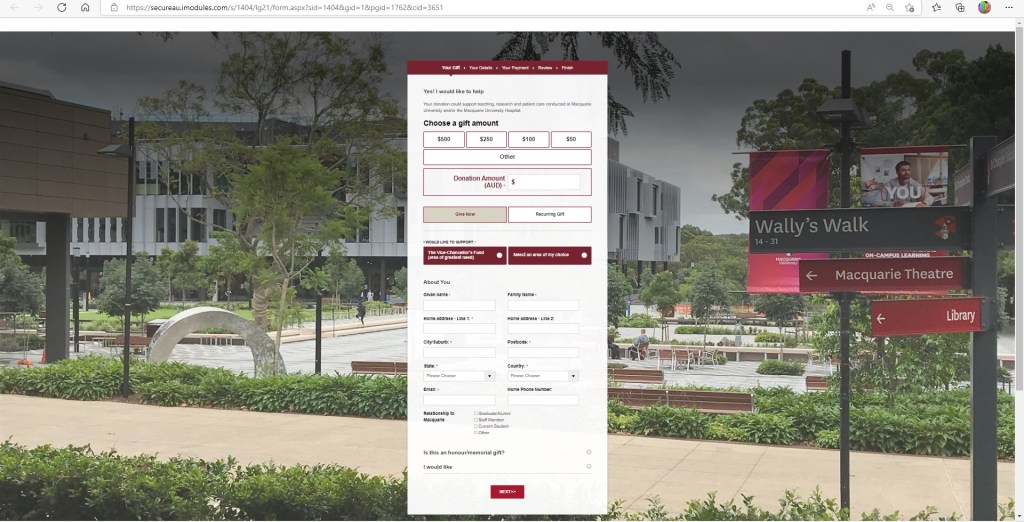
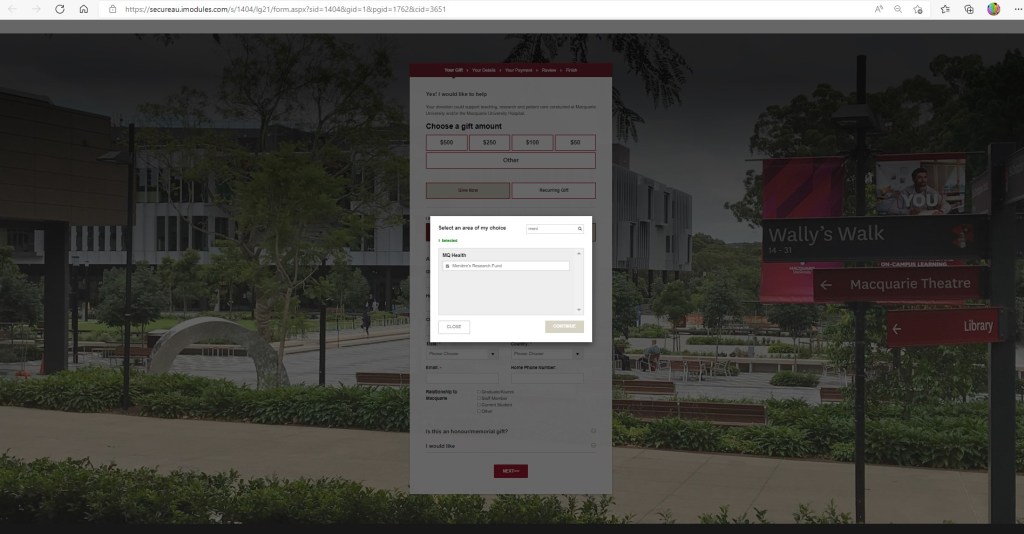
This session opened and we heard about funding for Meniere’s research. Dr Romaric Bouveret – Director of Operations and Strategies spoke, as well as another guest speaker (I apologise for not recording her name). We heard that funding for Meniere’s is hard to obtain, and they are actively applying for grants, once again. We also heard that Meniere’s comes under the umbrella of “Hearing” at the University, and so they have access to some funds through there. The sigh of relief in the room was palpable. We were also assured that any donations sent to the Macquarie University for Meniere’s (which can be chosen from the drop down menu on the donation page) would be totally committed to Meniere’s research.
And then we were given the chance to speak. At first, some of us spoke about how they may be able to find ways to donate money – this is a hard thing to do when Meniere’s has stolen your means on income.
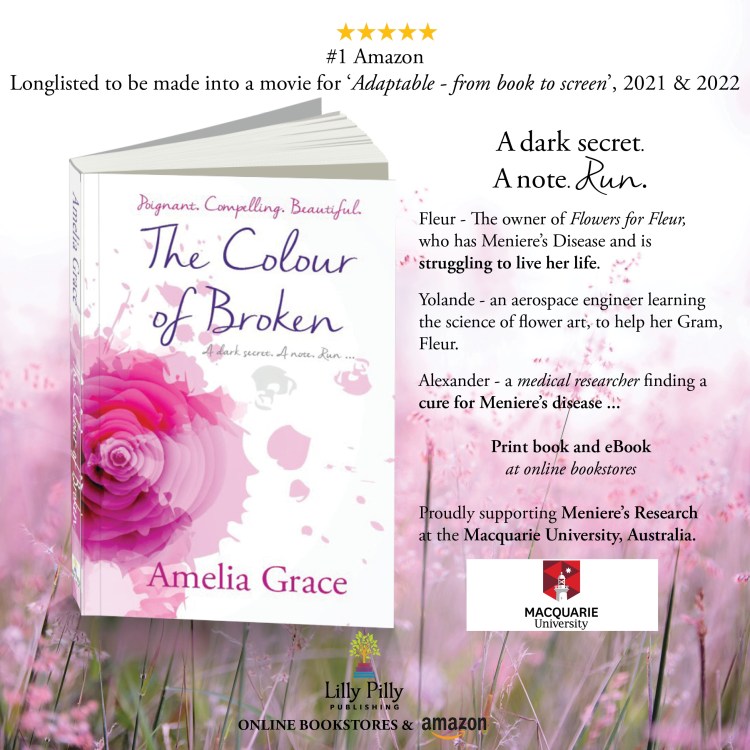
I too, joined this thread. I spoke about my two Meniere’s novels (The Colour of Broken and All the Colours Above) that I have donated a substantial amount of money to research from sales. I spoke about the impact of having a story with a main character with Meniere’s, and that a young girl in the US gave her mum a copy of The Colour of Broken … afterward, her mum came back to her begging for forgiveness, as she thought her daughter had been faking the symptoms. I also told the researchers that The Colour of Broken had been long listed, twice, to be made into a movie. Awareness for us. For Meniere’s. Professor David McAlpine stated the importance of the Arts (writing, art, drama, music, dance, movies, film and television) for helping to raise awareness and funds. And that collaboration across fields was important. That connection to people was important, and the Arts helps us to do that.
Then with tears, I spoke about how I’ve talked Meniere’s sufferers online, out of suiciding. I don’t know if they wanted to hear that. But they needed to hear that. They need to know how Meniere’s affects the lives and hearts and souls of people. They need to know how destructive it is. We want our lives back.
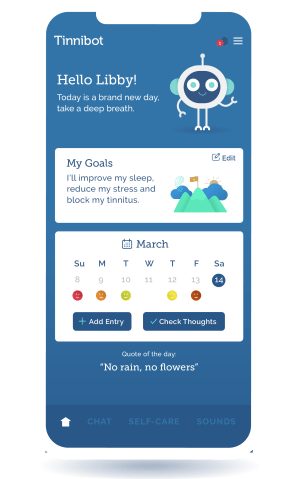
Dr Matthieu Recugnat spoke to us next. He talked about tinnitus. He talked about hearing research, and he talked about a program they have created called Tinnibot, the world’s first virtual coach (an app) that provides tinnitus support anytime, anywhere.
Professor Dave McAlpine asked, what else do we need?
I suggested they build a website that keeps people up-to-date with the latest research. I think it’s important to keep in touch with the researchers. Making connections is about hearing the stories of real people, including the Meniere’s research team stories.
2 PM -2:30 PM (Cochlear building visit)
Unfortunately we had gone overtime with the discussion and planning. And yet there was so much more to say. It was decided that the Cochlear building visit would have to be included in the next tour. I’ll definitely be attending that tour.
2:30 PM – End of the visit
I think I can speak for all of the Menierians present today – we are in awe of you, and so, so, so thankful.
My request for tours in the future: To the Macquarie University – • Record the tour sessions so they can be shared globally (with captions) – every word and every bit of added humour was precious. To Anne – • That the gathering is a day and night event, so after the tour, we can have a Meniere’s get together (and perhaps raise some money for research), and where we can share our stories, our tragedies and triumphs, and lift each other up.
As I catch my flight back to Brisbane, finally I slow down. My heart is breaking, and yet, it is full of joy. How can it be in two states at once? It’s breaking because people are still suffering terribly with Meniere’s disease. And yet it is full of joy. The future for us is looking bright. I know our cure, or resolutions of our symptoms, is coming soon.
I tuck into my ‘traditional flight home Krispy Kremes – original glazing’ and reflect on my insanely amazing day, and I hope that, while Dr David McAlpine and Dr Mohsen Asadnia are at the 2nd Inner Ear Disorders Therapeutics Summit in Boston in two weeks to share their research and findings, and to listen to other researchers on their discoveries, all the pieces of the Meniere’s jigsaw puzzle will be found.
The spark of hope can never be extinguished.
If you would like to suggest something for discussion and planning for the Meniere’s research team, please add it in the comment section, and I will pass it on to the researchers for you.
* Some names of Meniere’s people have been changed for the purpose of this blog
XX Julieann
Julieann Wallace is a multi-published author and artist. When she is not disappearing into her imaginary worlds as Julieann Wallace – children’s author, or as Amelia Grace – fiction novelist, she is working as a secondary teacher. Julieann’s 7th novel with a main character with Meniere’s disease—‘The Colour of Broken’—written under her pen name of Amelia Grace, was #1 on Amazon in its category a number of times, and was longlisted to be made into a movie or TV series by Screen Queensland, Australia. She donates profits from her books to Macquarie University, where they are researching Meniere’s disease to find a cure. Julieann is a self-confessed tea ninja and Cadbury chocoholic, has a passion for music and art, and tries not to scare her cat, Claude Monet, with her terrible cello playing.









































 My Shadow - Meniere's