They say when life gives you lemons, make lemonade.
“They” obviously don’t have Ménière’s disease, or any other incurable, debilitating, life changing disease for that matter. If they did, they would say, ‘I’m sorry about your diagnosis. I hope a cure comes soon. Let me know if you ever need help with anything.’
I want to say that I am sorry that you have Ménière’s disease.
I wouldn’t wish it on my worst enemy. I have had it since I was twenty-nine.
I woke at 5am one morning in early January, 2024, with the words Ménière’s Man stuck in my head. It’s a book written about Ménière’s disease, by a man. I’ve never read it. But I know that people are thankful for the information inside it.
Then I thought, where are the Ménière’s books written by women? There aren’t many.
How about WOMénière’s? WOménière’s? woMénière’s?
Sure, you may be able to glean lots of interesting information from books written by men, but let’s face it, they don’t deal with holding the responsibility of keeping the household going like women do (mostly) – groceries, cooking, cleaning, childcare (if you do have a partner who helps you with that, you are truly blessed!).
Men don’t deal with menstruation and everything that entails.
Men don’t have babies.
Men don’t go through perimenopause and menopause.
Men don’t have the fluctuations with hormones like women do.
We women have the rough end of the stick when it comes to Ménière’s !
Researchers have uncovered countless ways in which women’s and men’s bodies react differently to the same diseases, due to our hormones. There is A LOT that female bodies go through during a hormonal cycle, a stark contrast to the experience of the male body.
And so it began.
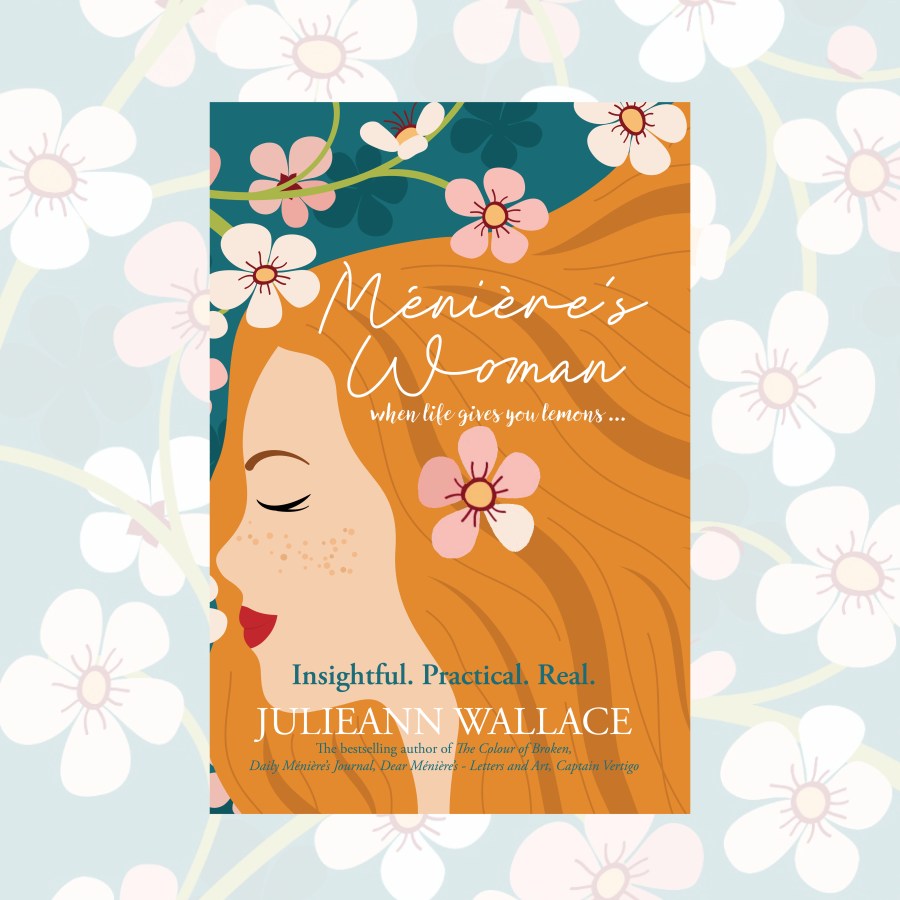
I accepted my own challenge to write a book about Ménière’s disease for women, and started on it. I figured that I was more than qualified enough to write it, Ménière’s being with me for 29 years at the time of writing this book. Exactly half of my lifetime.
Mum of three. My Ménière’s started the year before my first was born.
Wife.
Teacher.
Ménière’s Research subject at the University of Queensland’s Mind and Brain Institute.
Gentamicin to destroy the vertigo after 9 years of trying prescription medicines, herbal medicines and other alternative treatments.
It was my honour to pen this book to help others. To describe the road travelled before others going through the same things.
To encourage.
To understand.
To give insight.
To give tips on surviving the Meniere’s jungle.
To say it’s okay. We’re in this together. You’re going to make it through.
To give hope.
I have put countless hours of medical research into Meniere’s Woman, and reading anecdotal stories by women and questions they ask on social media.
Plus my own experience.
It’s time to honor us. Women with Ménière’s .
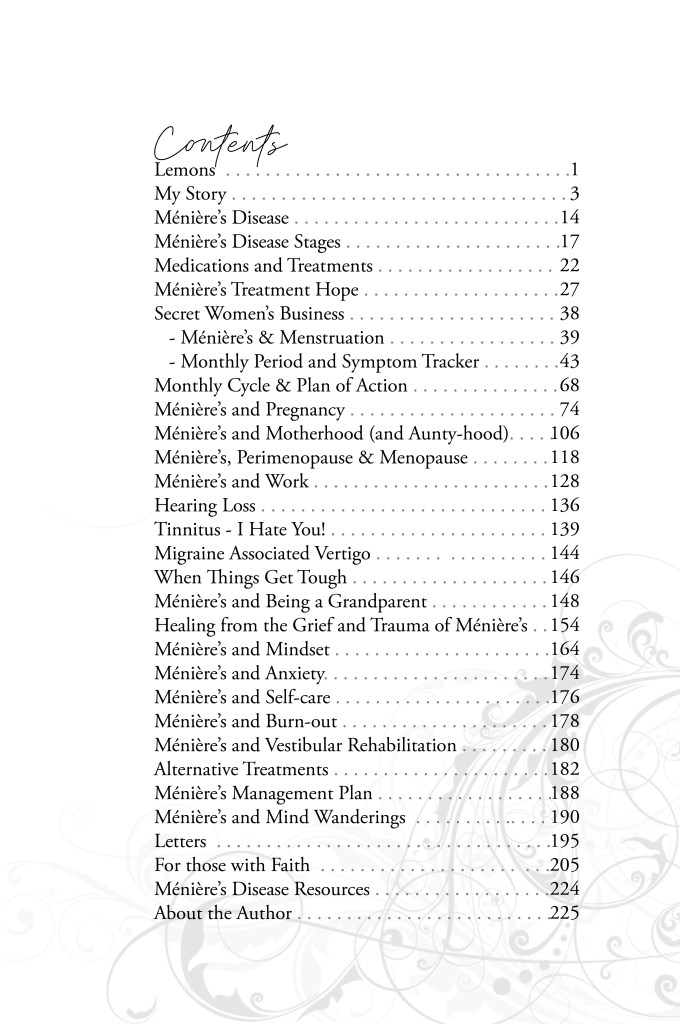
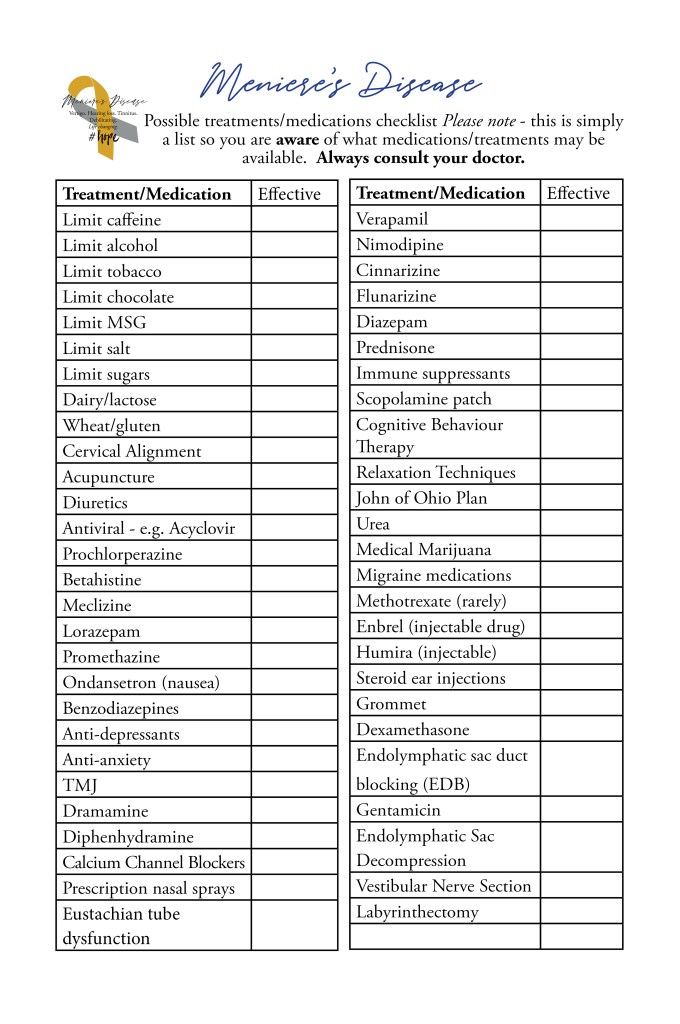
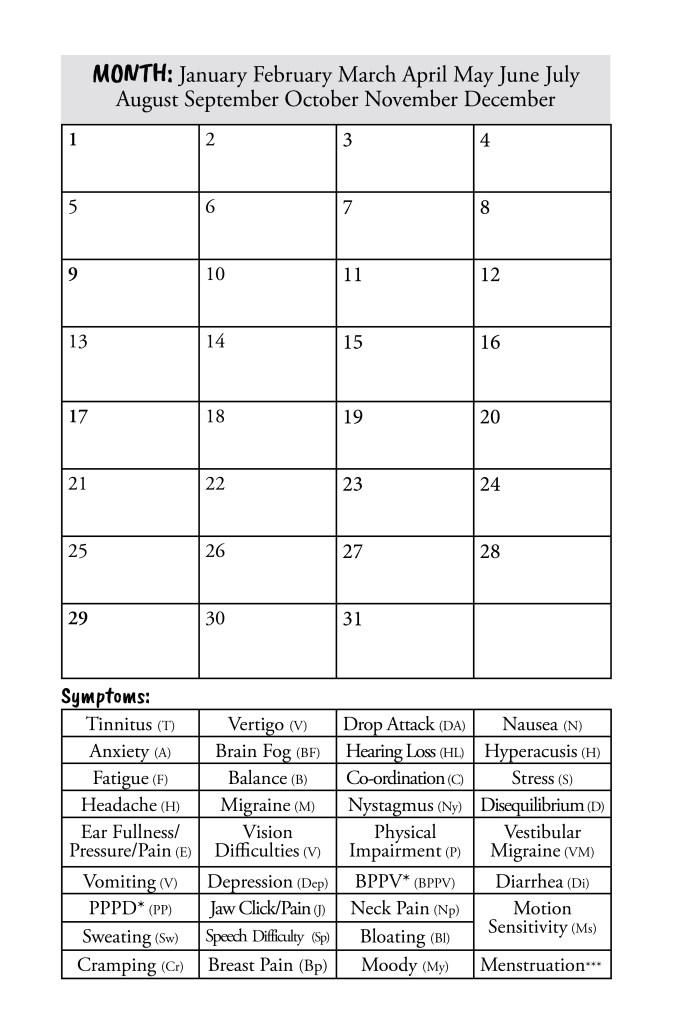
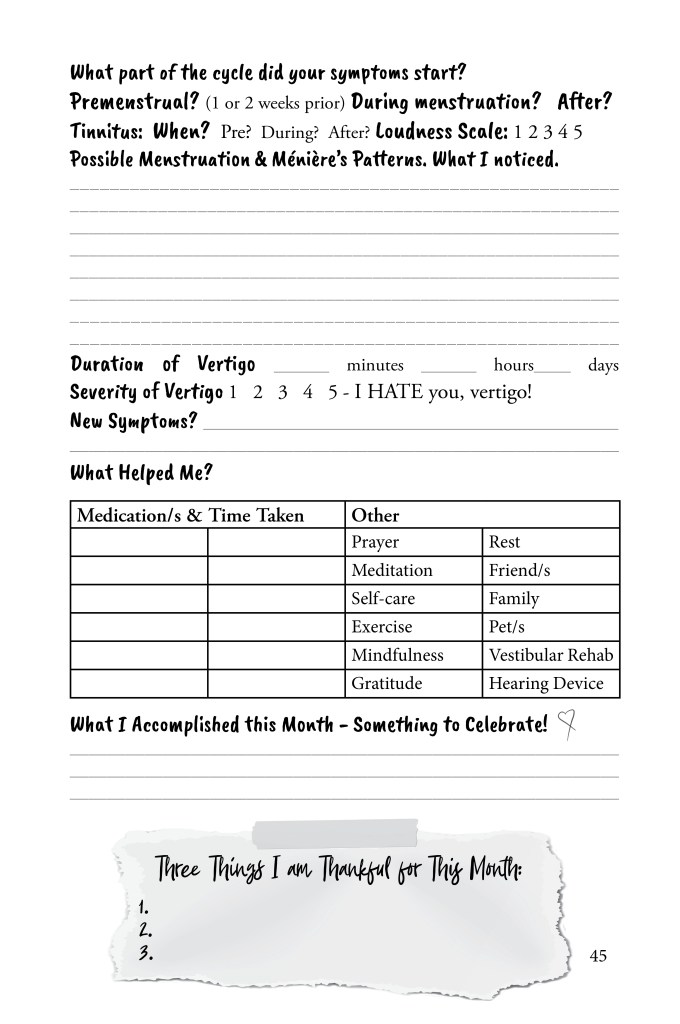
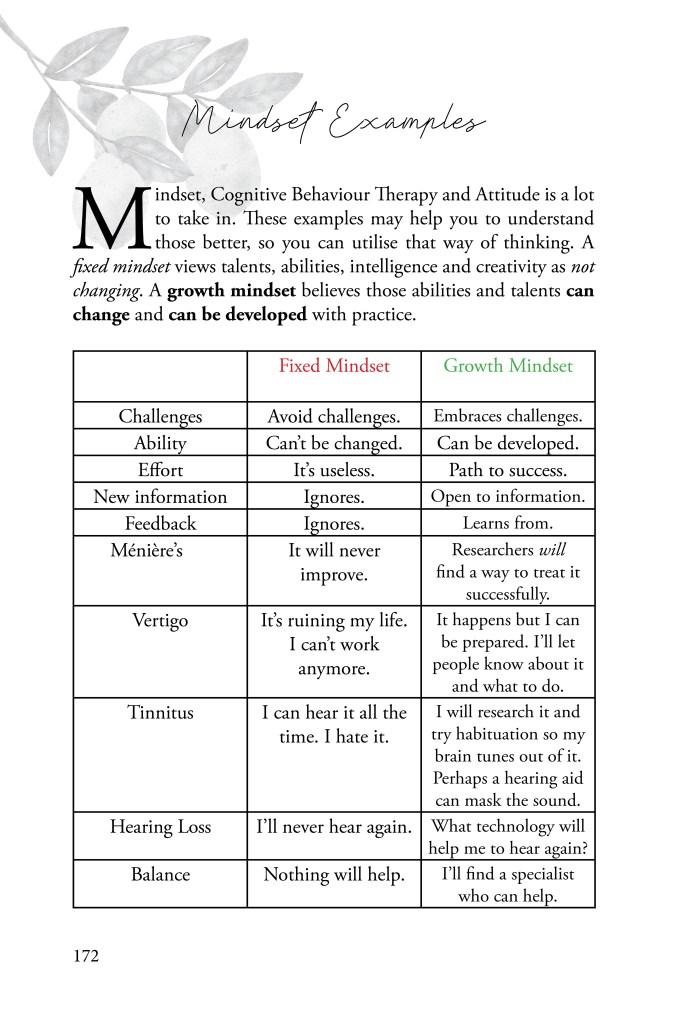
On the pages you’ll find tips, hints, research, personal anecdotes, secret women’s business, pregnancy, motherhood, grand-motherhood, understanding, inspiration and mindset, self-care, a period and Meniere’s symptoms tracker and a Ménière’s Management Plan, plus lots more.
And because this is your book, add your own stamp and style. I have left blank pages for your to glue/tape in clippings, inspirational verses or images that speak to you in some way, or write them in. Be creative. Be you.
Here’s a peek at inside the book. Ménière’s Woman. Honoring you. xx
Profits from the eBook and Print book will be donated to Ménière’s research, as all of my Ménière’s books are. I don’t publish Ménière’s books for personal gain, but to help others.
Let me know what you think of the book if you purchase a copy. And, I hope that it helps you beyond what you thought it could. xx
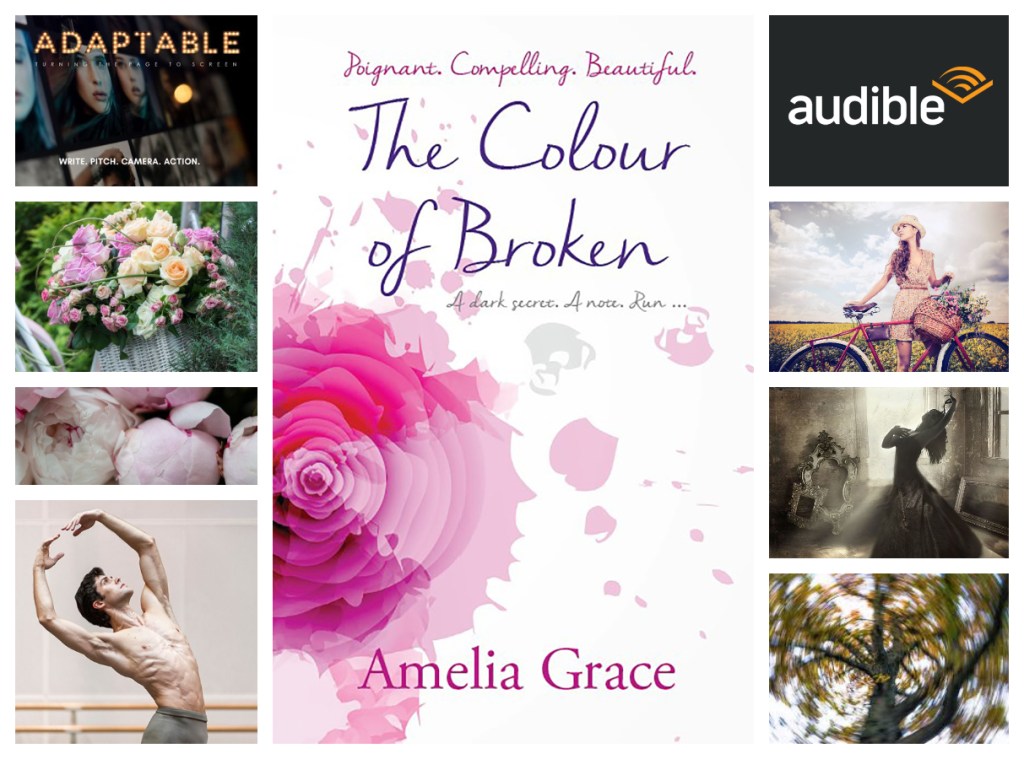
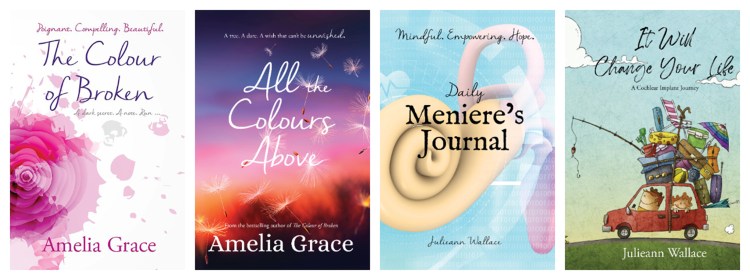
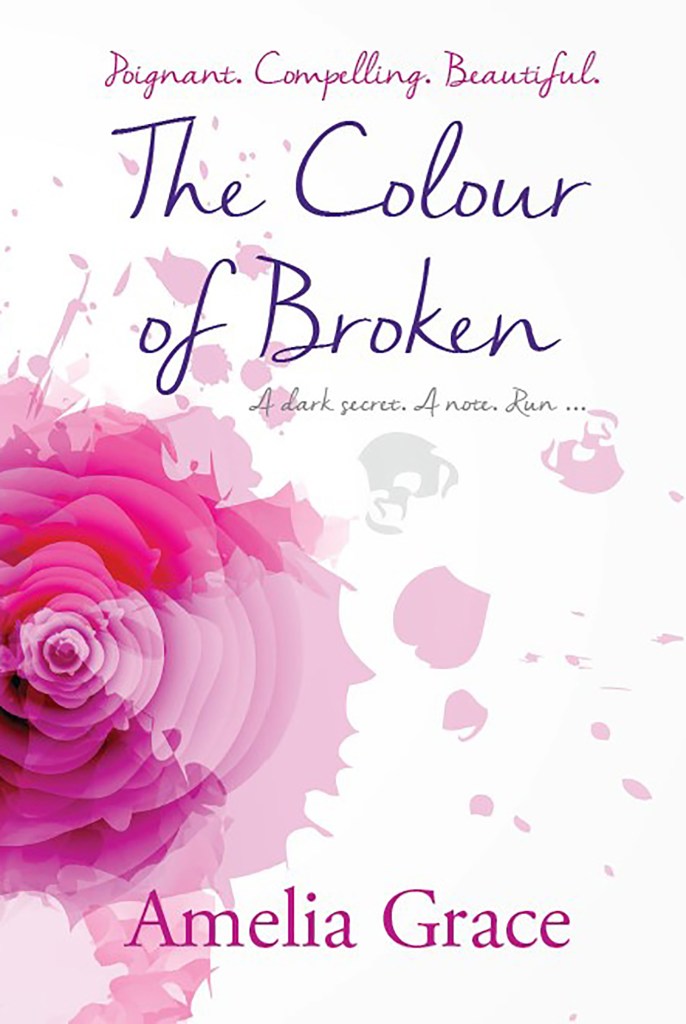
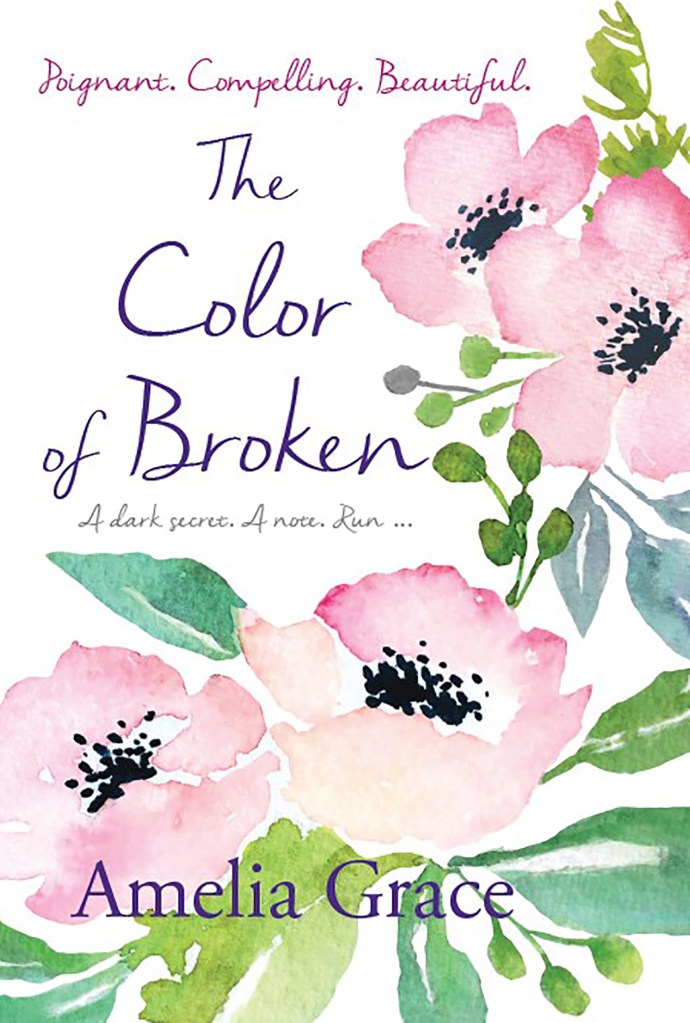
Julieann Wallace is a multi-published author and artist. When she is not disappearing into her imaginary worlds as Julieann Wallace – children’s author, or as Amelia Grace – fiction novelist, she is working as a secondary teacher. Julieann’s 7th novel with a main character with Meniere’s disease—‘The Colour of Broken’—written under her pen name of Amelia Grace, was #1 on Amazon in its category a number of times, and was longlisted in 2021 and 2022, to be made into a movie or TV series by Screen Queensland, Australia. She donates profits from her books to Meniere’s Research, to help find a cure or successful treatment for everyone. Julieann is a self-confessed tea ninja and Cadbury chocoholic, has a passion for music and art, and tries not to scare her cat, Claude Monet, with her terrible cello playing.
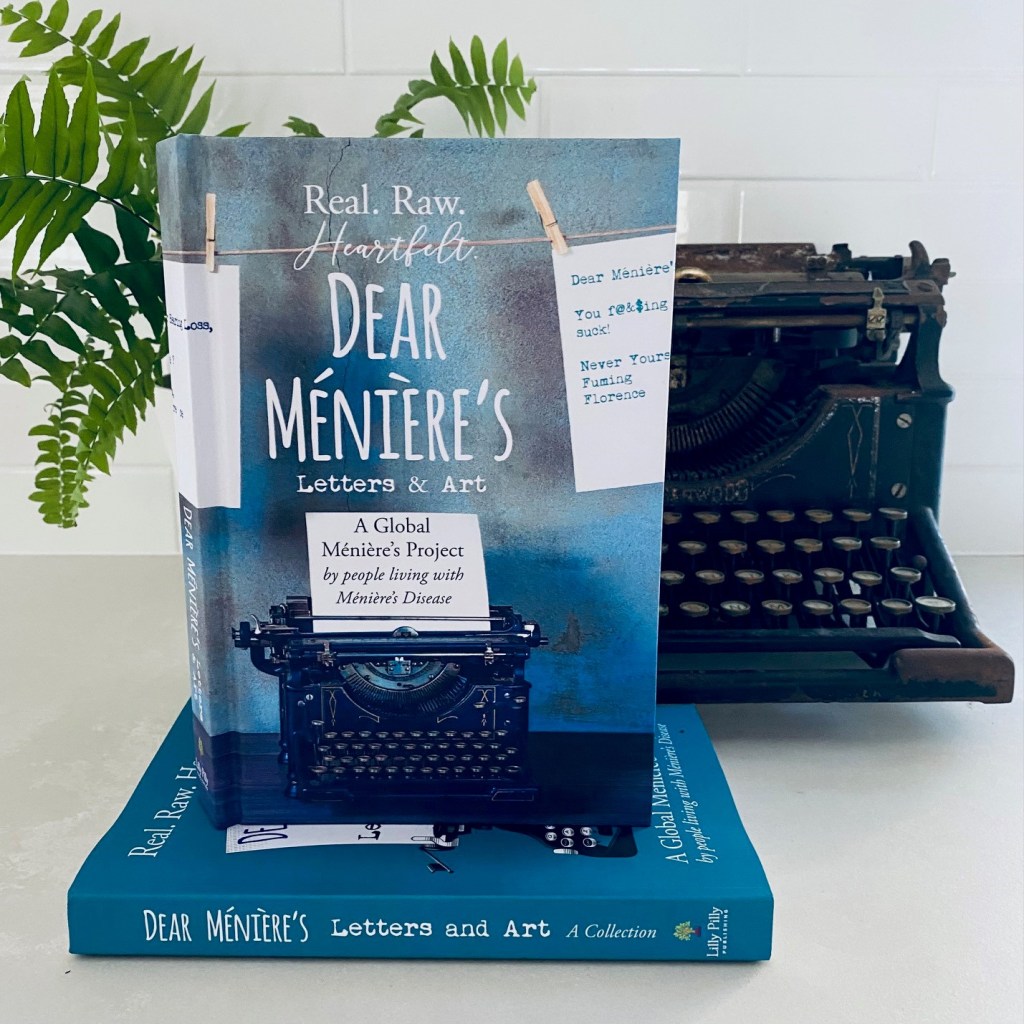
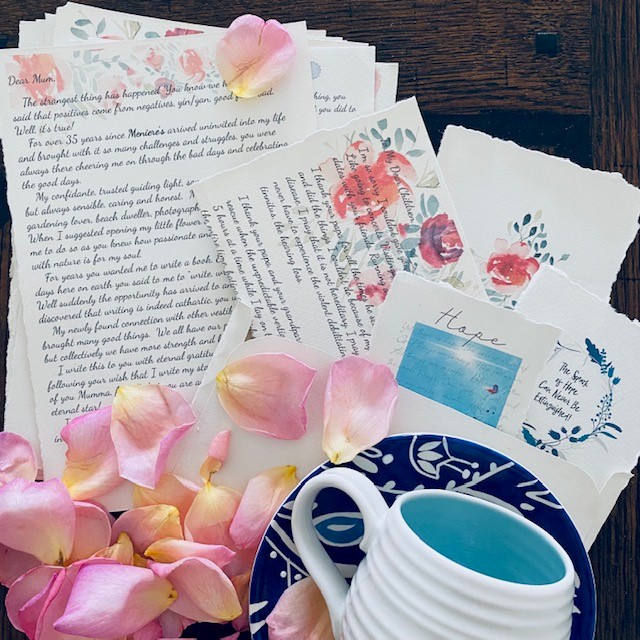
That’s you, Ménière’s. There’s a call out for submission for letters and art about you.
Apparently you’re the focus of a new book, a collection of writing and creativity.
Surely you don’t deserve such attention in this way?
What do you think they will say about you?
How kind you are?
How popular and well-liked you are?
Do you think you’ll be thanked?
We’ll see …
And the art?
What on earth would you look like on the canvas? In a photograph? Or other creative art mediums? Ha, a sculpture of you would be interesting!
Do you think you’ll be beautiful and lavished with love in each of those carefully placed paint strokes?
Will you be depicted up on a pedestal all high and mighty?
Will the capturing of your existence in visual form be so exceptional that an entire gallery will be dedicated to you?
Or will you look like the monster you are?
We’ll see …
Ménière’s, you’re finally being called out for the atrocious bully that you are.
Fingers are being pointed at you for torturing people with vile, violent vertigo, insanely loud tinnitus, nausea, hyperacusis, deafness and loss of balance. So debilitating are your attacks that some cannot find the strength to live with the symptoms anymore. How dare you?
Are you proud of the quality of life rating of 6 days from death with your repulsive, incrediblly fast room spinning vertigo that lasts for hours, sometimes days?
Fists are being shaken at you for your devious ways, hiding in the inner ear that is hard to get to.
Voices are being shouted, louder than our unremitting, loud tinnitus, to call you out from the cowardly darkness and into the light so you can be seen in all of your ugliness.
You thief. Stealing happiness, livelihoods, passions, friends, confidence, hearing, balance, joy, money, a normal quality of life, bringing us to our knees to search for the missing pieces of us.
Ménière’s disease. Debilitating. Life changing. Do you really think there is no cause, no cure?
We’ll see …
Ménière’s, research is discovering your mischievous ways. Research is planning an attack to take you down. How joyous that day will be when the doctor will say, ‘You’ve got Ménière’s disease. We can fix that!’
Never yours,
Julieann Wallace
Your turn. Here’s your invitation to write a letter or create some art to be published in the Lilly Pilly Publishing Letters to Ménière’s Global Project to raise awareness, proceeds being donated to Meniere’s research.
Julieann Wallace is a multi-published author and artist. When she is not disappearing into her imaginary worlds as Julieann Wallace – children’s author, or as Amelia Grace – fiction novelist, she is working as a secondary teacher. Julieann’s 7th novel with a main character with Meniere’s disease—‘The Colour of Broken’—written under her pen name of Amelia Grace, was #1 on Amazon in its category a number of times, and was longlisted in 2021 and 2022, to be made into a movie or TV series by Screen Queensland, Australia. She donates profits from her books to Meniere’s Research in Australia to find a cure. Julieann is a self-confessed tea ninja and Cadbury chocoholic, has a passion for music and art, and tries not to scare her cat, Claude Monet, with her terrible cello playing.
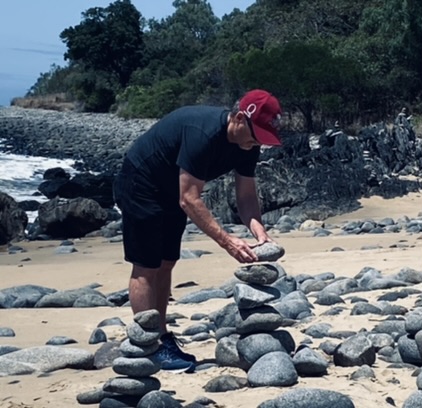
I’m sitting on a small rock beach at Wangetti, between Cairns and Port Douglas in Australia.
There’s balancing rocks everywhere. Allowed by the council. The insta-famous Gatz balancing rocks.
There’s a foreboding, for me.
Others would see it differently. I can see how it might be considered fun, and the challenge of creating your own rock stack exciting. There’s a family to my left busy creating rock stacks. Smiles litter their faces. Fingers point. Hands rest on hips once they have accomplished their mission.
But to me, the rocks are all shades of darkness, mirroring my Meniere’s journey and the destruction of my balance cells. My Meniere’s journey that has scarred my heart and mind. And my inner ear. My journey that I pray that nobody ever has to travel. Cure for Meniere’s disease, please come soon.
I study the balancing rocks with more focus.
Rocks of black.
Rocks of brown.
Grey rocks. So many grey rocks with an “e” like the rain clouds – melancholy, but an enjoyable melancholy that builds up until it releases, like petrichor, the smell of the rain after warm, dry weather. Satisfying. The grey with an “e” of deep thought, philosophy and ponderings. The grey with an “e” that helps you to discover parts of yourself that you never knew existed, and can vanish without leaving a bitter aftertaste.
Gray rocks. So many gray rocks with an “a”. Never enjoyable. A very dark gray. It’s self-judgement, doom and gloom, forever hanging around and within. It wants to drag you into the dark abyss of the colour black, that absorbs all colours … the colour of self-condemnation, the colour of depression.
The rocks first caught my gaze as my husband and I travelled to Port Douglas to catch the Quicksilver boat out to the Great Barrier Reef the day before.
‘I want to go back to the rocks tomorrow,’ I had said to him.
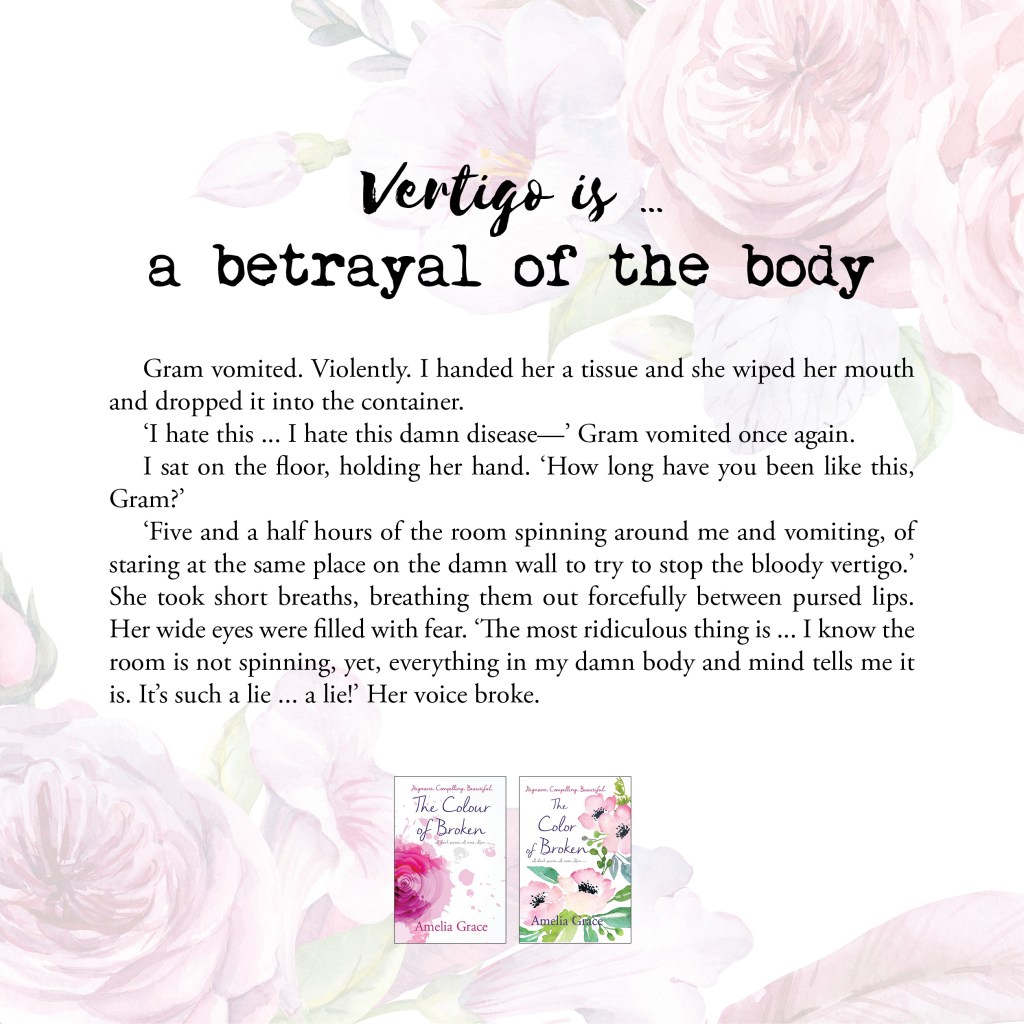
Memories of my journey with Meniere’s disease flood my mind and my throat tightens. Vertigo. I so hate vertigo! I could cope with the ear fullness, hearing loss and tinnitus. But not the abhorrent, unpredictable vertigo.
Balance. I chose to have my balance cells destroyed in 2004 to stop the violent, horrendous, soul-destroying vertigo that would last up to 4 hours at a time. I would be hit with episodes of vertigo at least 40 times a year. I was totally debilitated, unable to move. I would stare at one spot of the wall for the entire time trying to gain some sort of control over the vertigo. I never could. My husband would selflessly empty my vomit bucket numerous times, and take me to emergency at the hospital for an injection of Stemetil and a bag of IV fluids. I was exhausted for days afterward.
I looked to my right. And there was my husband creating his own rock stack.
Tears pooled in my eyes. I felt like he was making the balancing rocks for me, for the journey I have been through, relearning my new balance using my eyesight. Successfully.
In reality, I know that he is creating a rock stack because it is fun.
I wipe the tears from my eyes and place the final rock on top of my husband’s rock stack. Joy fills me and I smile.
And there it is. We have created a rock stack for my Meniere’s family, and for others who have vertigo caused by diseases and traumas.
I lift my gaze to the ocean and inhale deeply. What a journey I have been on. What an awesome family I have where I receive support, always, and who deal with my lack of balance with humour to make me laugh.
I am beyond thankful that I no longer have vertigo. An answered prayer.
I walk to my left and move amongst the balancing rocks with care. The ground is uneven and … rocky. Any normal person could easily lose their balance here. But I’d hate to be the reason some rock stacks are knocked over due to me losing my balance.
I laugh to myself at the irony.
I take one final gaze at the works of rock art. Ephemeral art. I know that researchers are working on devices and gene therapies to cure vertigo.
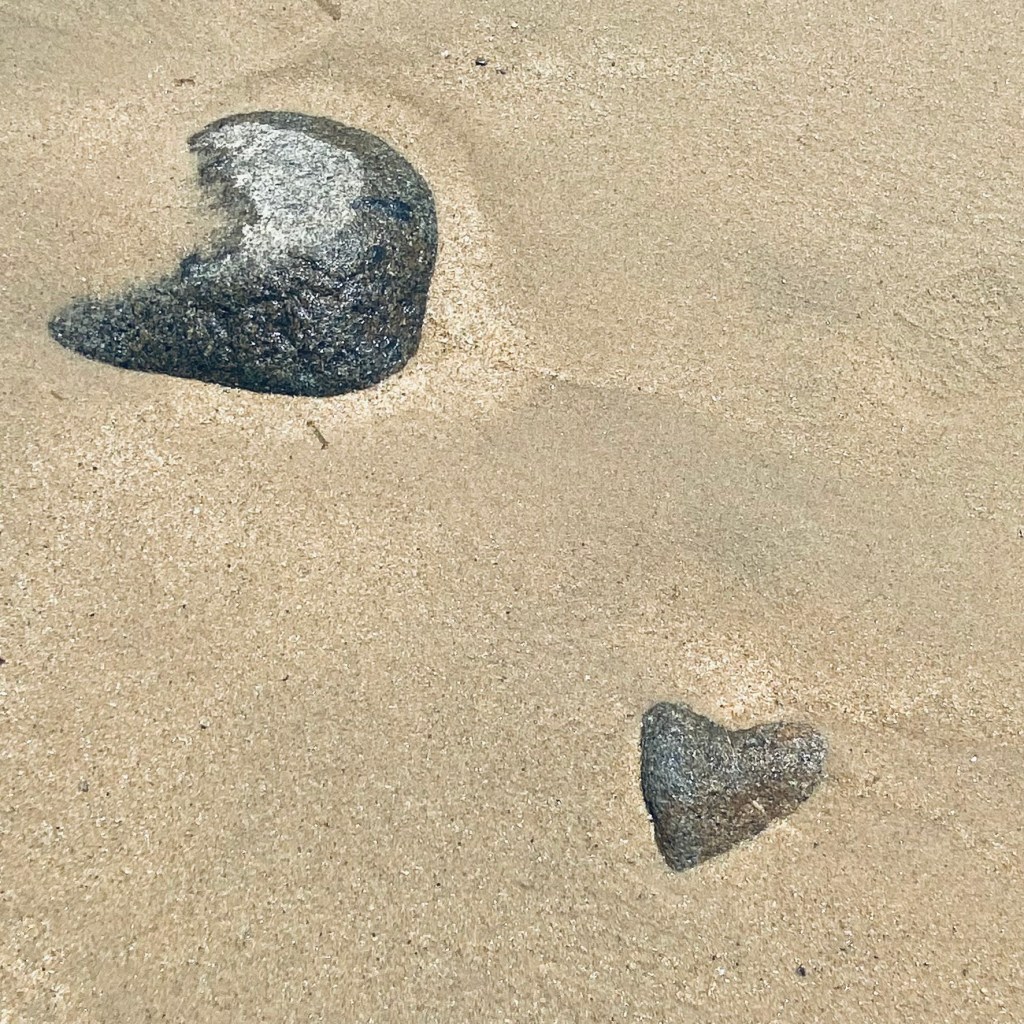
I look down and find a heart shaped rock. Good things are coming.
Julieann Wallace is a multi-published author and artist. When she is not disappearing into her imaginary worlds as Julieann Wallace – children’s author, or as Amelia Grace – fiction novelist, she is working as a secondary teacher. Julieann’s 7th novel with a main character with Meniere’s disease—‘The Colour of Broken’—written under her pen name of Amelia Grace, was #1 on Amazon in its category a number of times, and was longlisted in 2021 and 2022, to be made into a movie or TV series by Screen Queensland, Australia. She donates profits from her books to Macquarie University, where they are researching Meniere’s disease to find a cure. Julieann is a self-confessed tea ninja and Cadbury chocoholic, has a passion for music and art, and tries not to scare her cat, Claude Monet, with her terrible cello playing.
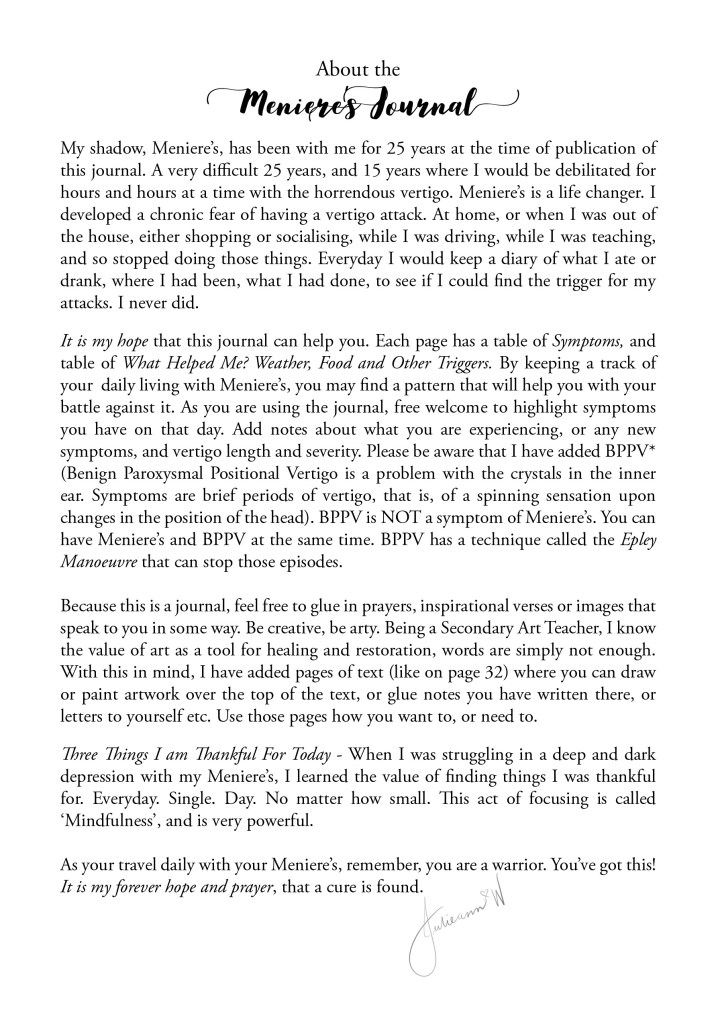
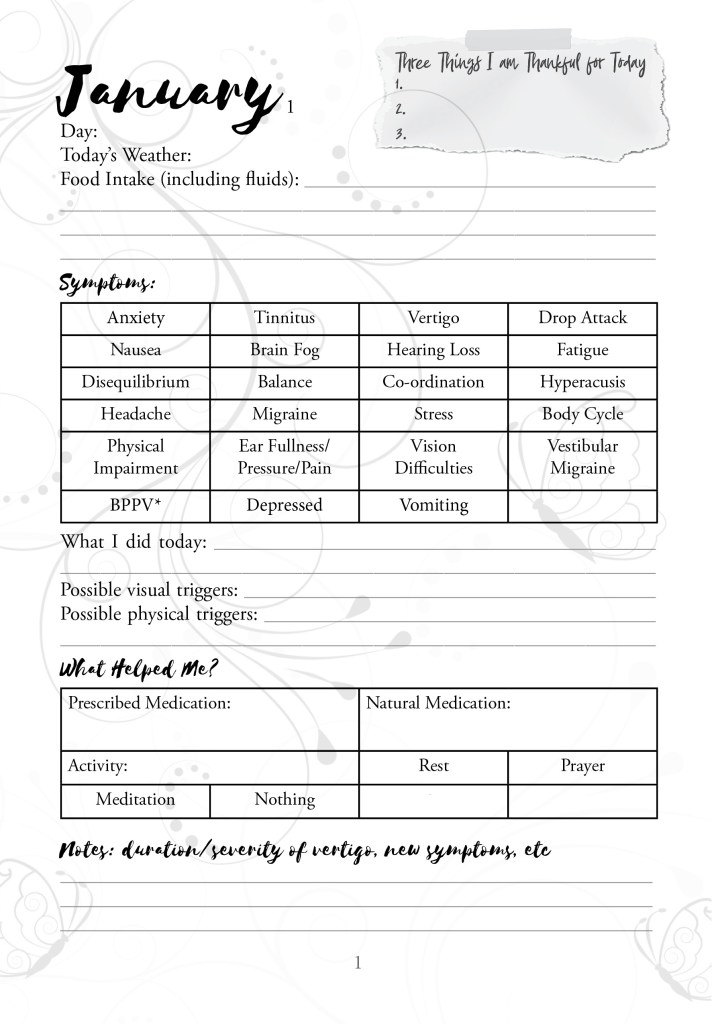
To welcome in the new year for my Meniere’s family and friends, here’s a free PDF of the Daily Meniere’s Journal I created in 2020. It’s for those who haven’t seen it before, are new to Meniere’s (i.m so sorry), or just need something like this to keep track of their day to day Meniere’s.
It’s a valuable tool to take to your doctor to show them your symptoms and how you are feeling everyday. I know there are people who bought the journal in 2020, and have already purchased another one for 2021.
Print the PDF out day by day, or month by month – however you want to use it. And you have permission to share it with others. I hope it helps you to find patterns or triggers so you can manage the horrendous Meniere’s disease a little better.
Julieann is a multi-published author and artist. When she is not disappearing into her imaginary worlds as Julieann Wallace – children’s author, or as Amelia Grace – fiction novelist, she is working as a secondary teacher, editor, book designer, and book magician for other authors. Julieann’s 7th novel with a main character with Meniere’s disease—‘The Colour of Broken’—written under her pen name of Amelia Grace, hit #1 on Amazon in its category twice. Julieann is a self-confessed tea ninja and Cadbury chocoholic, has a passion for music and art, and tries not to scare her cat, Claude Monet, with her terrible cello playing.
The birdsong of the new day wakes me. If I had been sleeping on my good ear, I would never had heard it.
I’m thankful for that precious moment. It’s been my survival mantra since battling the ferocious Meniere’s disease. Look for the small things that make me happy, no matter how small or insignificant to others. It’s been 24 years of Meniere’s disease now. And it’s been a helluva journey that had me on my knees pleading for mercy many times as I battled the violent, abhorrent vertigo that left me a shadow of myself, lost in the darkness of depression, trying to find me, my old happy, carefree, confident, successful self. Menierians know exactly what I am talking about.
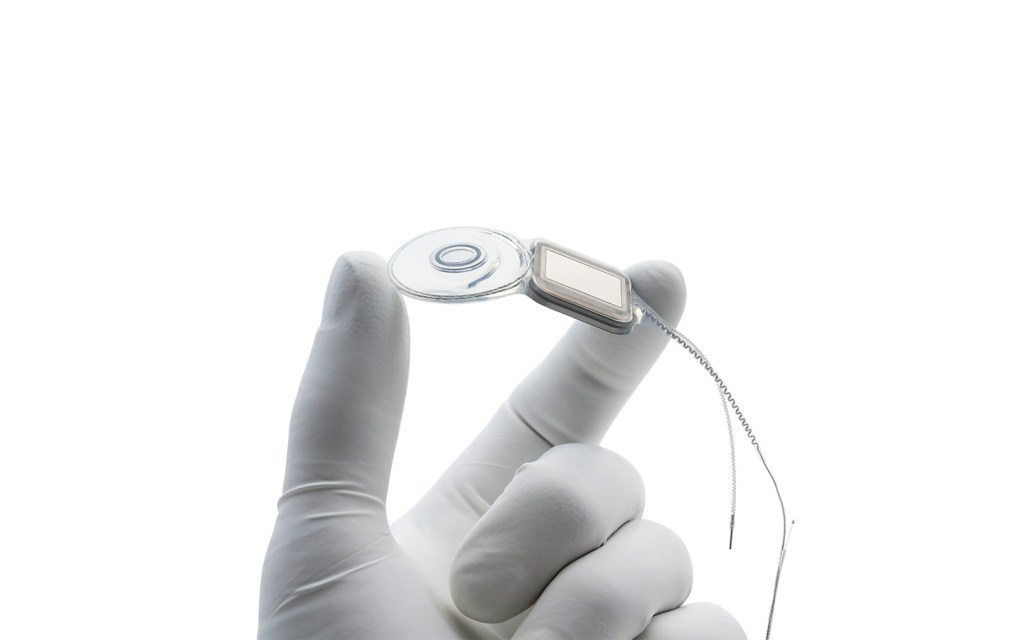
I blink away my past. Today’s the day. The surgical step in regaining my hearing, I think to myself. There’s no turning back.Yesterday was proof, more than enough, that I need the Cochlear Implant.
I climb out of bed and walk to the window and look out. There is still smoke haze hanging about from the 100s of fires that have been burning, many of them lit by people who think lighting fires is a fun thing to do. How dare they? I shake my head. We desperately need rain.
I change my focus. I need to finish breakfast by 7:30am and then fast for surgery. Mentally, I tick off what I have already done for today:
* Organised my daughter to spend the day with her father (my husband), to make sure he is okay while I am having surgery. He gets a terrible look of worry on his face, filled with sorrow, when we talk about the possibility of me having vertigo again. It breaks my heart. It’s a stark reminder that Meniere’s has a powerful impact on those who are spectators to what we go through with this horrid disease.
* Organised for my mum to catch a lift with us to the hospital.
* Organised for my two sons to pick up my dad to come and visit me after the surgery.
* Laughed at the absurdity of all the organisation I must do to ensure that the wheels turn smoothly.
Time for me.
* Breakfast before 7:30, then fasting. Toast and tea and chocolate 😊
* Pack the overnight-stay bag for hospital.
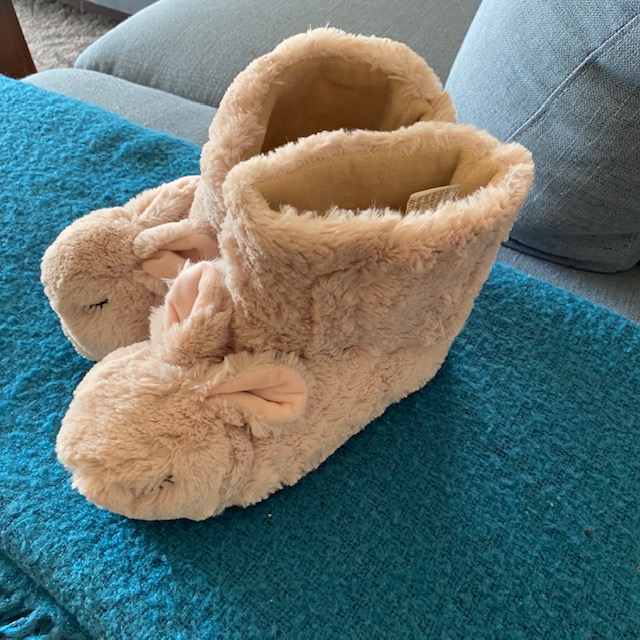
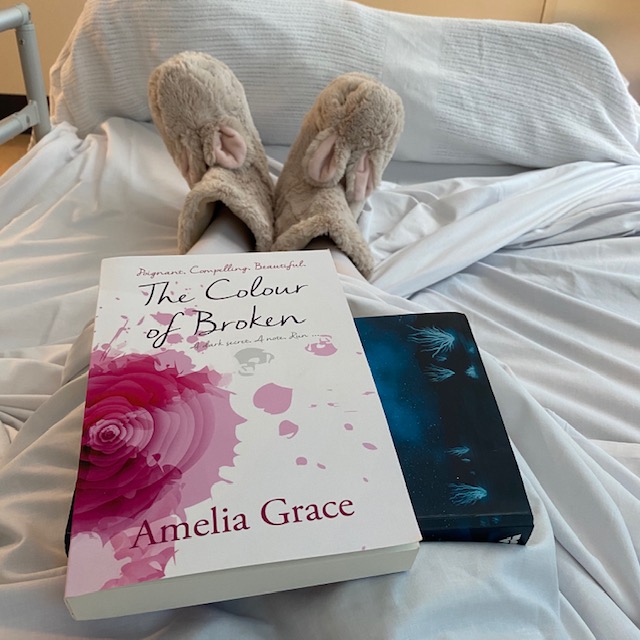
* Race to Target to buy some slippers for hospital. I have never owned any. I choose the bunny slippers because I have always wanted to have a rabbit as a pet. In Queensland, Australia, where I live, it’s a $63,000 fine if you are caught with a rabbit. This is the closest I can get.
* Double check paperwork.
I still for a moment. Vertigo. I have a terrifying fear that it would be awakened by the procedure. My shadow, Meniere’s, is dancing around me smiling. I raise an eyebrow at it and it stops.
The clock ticks over to 10am. It’s time to go. It’s time to start a new chapter in my Meniere’s journey.
I hug each of my sons and tell them that I love them. My eldest son tells me he loves me, and I hear it easily. My youngest son says something after I tell him I love him. In true Meniere’s deaf ear fashion, and one sided hearing, I can’t hear what he said and say my usual, ‘I didn’t hear you, can you say it again?’ and he says with more volume and clarity, ‘I love you, too.’ My heart melts.
I do a final swoop of the house. It is clean and tidy. Then walk to the front door.
My husband has my hospital backpack slung over his shoulder, and my daughter, her heart more beautiful than sunshine, stands beside him. They watch me, worry etched on their faces. I suck in a deep breath, controlling the deep emotion that tries to surface, not for me, but them. I don’t want them to worry.
‘I have an amazing feeling of peace. No anxiety at all,’ I tell them. And it’s the truth.
The front door closes with a feint click. It’s symbolic in a way. One door closes, another opens…
I walk to the car thinking, Anxiety, where are you? My shadow, Meniere’s, and me, are going in for surgery. Where have you gone? I can’t get over the feeling of peace that envelopes me. I decide to accept it and receive this gift from my faith, with a full and thankful heart.
Our car pulls into my parent’s house. Mum and Dad greet me with a smile. The universal language that puts you at ease.
‘Feeling nervous?’ my dad asks, making his hand shake for effect.
‘No. Not at all,’ I answer. Dad raises his eyebrows at me in disbelief.
‘I’m nervous for you,’ my mum chips in.
‘Good on you, Mum,’ I say, offering her a smile.
I hug Dad. Mum sits in the car, then me, and we are off. I’d love to listen to some music with my good ear in the car, but Mum chatters on. I’m guessing it’s her nervousness.
We arrive at the hospital and check in, then proceed to the surgery waiting lounge. Me and my family take a seat together, while my shadow, Meniere’s, bounces on the empty seats. I shake my head at it. I look for my friend, Anxiety, but he’s still not here.
It’s 11:30am. There’s quite a few adults and three children awaiting surgery, and a few of their partners and family members. I watch a man entertain his daughter with a Christmas Elf plush toy. I decide that he is more amused by what he is doing than his child. My shadow, Meniere’s, is sitting on the floor in front of him, watching.
At 12 pm, I’m called to a room by a nurse. She does the pre-op check – temperature, blood pressure, a million questions relating to my health. She tells me that my surgery is scheduled for 2pm, and I return to the waiting room.
At 1:15pm, my anaesthetist appears. I know what he looks like because I Googled his name a couple of weeks ago. My husband and I follow him to a room where we sit and wait for him to speak.
He greets me, talking loudly, over-pronouncing every word like I am totally deaf in both ears. I think of that annoyance profoundly deaf people have where normal hearing people think the person will hear better if they talk loudly.
I tell him I have one good ear and can hear him well. He smiles, and immediately his volume of voice returns to normal.
He asks me medical questions revolving around how I have reacted to anaesthetic with previous operations and takes notes, then I tell him that I have no anxiety about the surgery, and watch for his reaction, both facially and non-verbally with body movement. It still worries me that I’m so peaceful. I am an overthinker after all. I ask him if it is that a thing, like a phenomenon? Or, is there a psychological explanation for it?
He shakes his head and replies, ‘It’s good not to have anxiety.’
His last words before we exit the room are, ‘Don’t worry. I’ll look after you, I promise.’
We return to the waiting room. I keep looking at my watch, wondering when I will be called in for surgery preparation. It’s getting closer to the 2pm surgery time.
At 1:45pm, I am greeted by another nurse. It’s time to go. I hand out hugs and kisses to my husband, daughter and mother, then disappear, following the nurse to yet another room, where she asks me what my name is and my date of birth. She gives me a medical bracelet and cross checks the ID number on it with my paperwork. She shows me the change room, where I am to change into the hospital gown, including covered bare feet and a hospital robe. Once I am dressed, she places tight stockings on my lower legs to prevent blood clots during and after surgery. Then I’m led to a very comfortable recliner chair in another waiting room with a television, where she places a warm blanket over me.
And I wait. But it’s a good time for reflection. I think back to the posts from the Cochlear Implant Experiences Facebook group I joined four weeks prior. The discussions and support of other members on there and what I have learned from them has been invaluable.
It is 2:10pm, and I watch other patients come and go. I watch the television, which has closed captioning, then decide to close my eyes for a bit. I hear my name, and I follow another nurse to have a heart trace done (ECG) before returning to the waiting room. Finally, a theatre nurse calls my name, and I follow her to a hospital gurney that will take me to surgery. I don my surgery cap, hair tucked in. I listen to the nurses chatter about holidays they are taking, then my gurney is wheeled to a holding bay. The theatre nurse tells me they need to change around the operating theatre because they will be working on my left ear. She disappears.
My surgeon enters my holding bay with a smile. He approaches me on my left side, then quickly moves to my right side. ‘You will hear me better on this side,’ he says. I love him already.
‘I need to draw on you to make sure I implant the correct ear. Tell me what surgery you are having done?’ he says. It’s a question I have answered many times already, as well as my full name and date of birth. Surgery protocol.
‘I’m having a cochlear implant in my left ear,’ I answer.
He nods and smiles, then leans over and draws on the left side of my neck, just below my left ear. ‘See you soon,’ he says, and bounces out of the room with too much energy.
Five minutes later, my theatre nurse is back, and we are travelling the halls of the operating theatres. We enter the surgery room, and I gaze around, taking it all in. I see my surgeon studying my MRI, arms folded. He turns and smiles at me. The nurse lines up the gurney to the operating table, and I shuffle over to it, then lie down, ensuring that I am in the middle of the narrow table.
I am surrounded by the anaesthetist, a theatre nurse and my surgeon.
The nurse asks, ‘What is the name of your surgeon, and what is your full name and date of birth?’
As I say my surgeon’s name I look at him. He nods his head and his brown eyes show that he is smiling. I answer the rest of the question and the nurse checks my bracelet ID number to my name.
‘What procedure are you having done today?’ she asks.
‘I am having a cochlear implant in my left ear,’ I say. They all nod.
And then the movement begins. The anaesthetist straightens my right arm on positions it on a support board that juts out from the operating table, then places a tourniquet around my upper arm. He taps my lower arm a couple of times and inserts a cannular. Within 30 seconds I feel myself getting sleepy. The last words I hear are, ‘Take a deep breath,’ as the anaesthetist places the mask over my face…
I wake in recovery to the sound of my name being called. I open my eyes and become troubled by what I see. My biggest fear was waking to vertigo, and then having vertigo for days or weeks after surgery.
‘I have double vision,’ I say to the nurse, then close my eyes. This isn’t right, I think. Nowhere in my copious amounts of study and research was double vision mentioned.
I open my eyes again, and the double vision corrects itself. I feel my body relax after a small moment of panic.
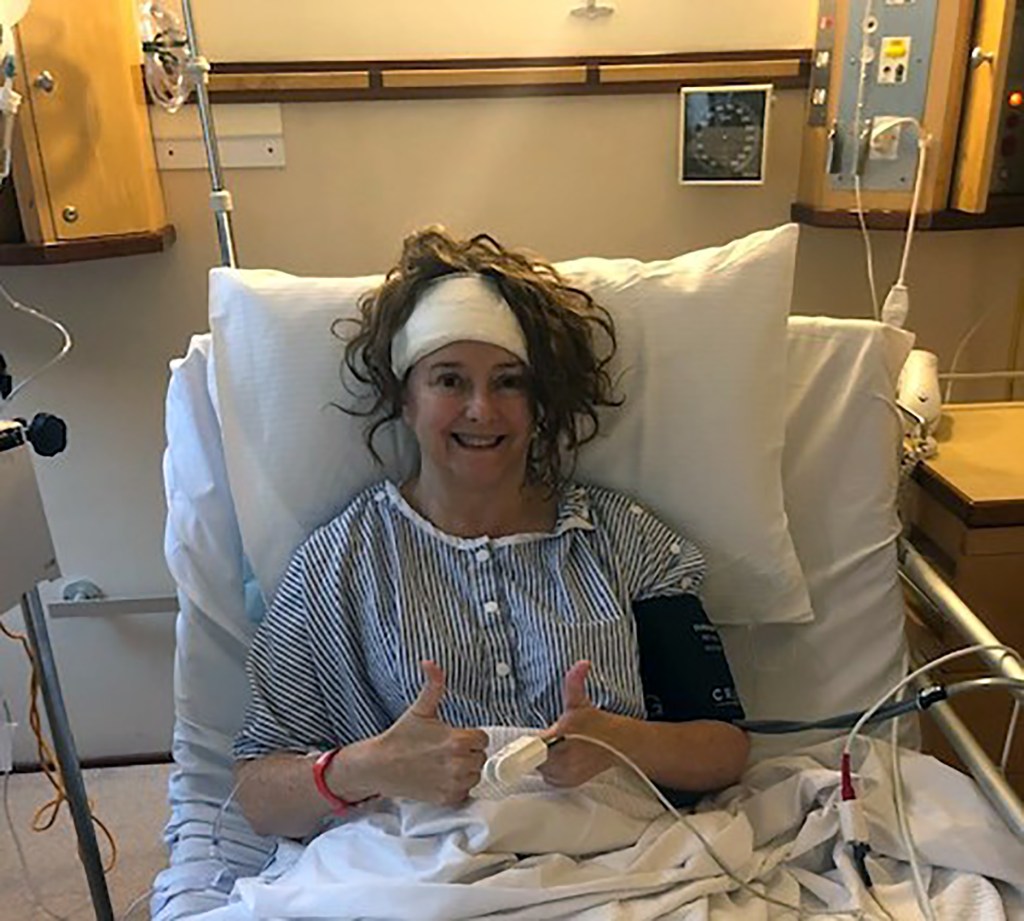
The nurse checks my temperature, blood pressure, oxygen level and heart rate. I keep my eyes open, focussing on any sign of vertigo. None. I then become aware of a tight bandage around my head, over my ear. I have no pain, which, I assume is due to any pain medication given while I was unconscious.
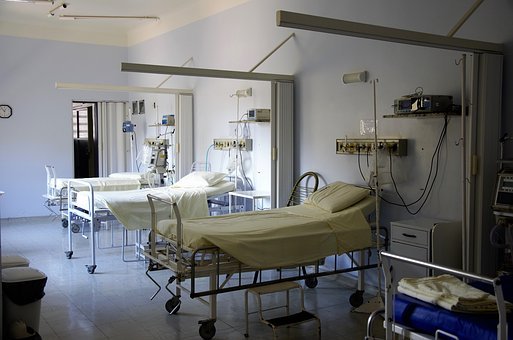
In the next moment, my hospital gurney is moving. I’m being taken to my room for the overnight stay.
As soon as the hospital bed is in position in the room, I look up to see my husband entering, worry painting his face like a fractured mirror. I smile at him, and instantly his worry vanishes, like it has evaporated into thin air.
The nurse fusses about, conducting her observations, recording everything she needs to, and asks if I have any pain, which I don’t. My heart rate is sitting at around 58 beats per minute, but that is normal for me.
Then my mum and daughter arrive. My mum smiles slowly, while Claire eyes me warily. She has seen me with too many tears in her lifetime. I smile at them to put them at ease, but I know they are worried, as their furrowed eyebrows plead for answers to unasked questions.
‘I did it,’ I say. ‘No pain at all. I woke up with double vision. But that’s all good now.’ I touch the bandage around my head.
‘Nice head band,’ my daughter says with a smirk. I grin back at her. She has a way with humour that we both understand. My husband and three children have learned to deal with my Meniere’s monster with humour to make me laugh. It’s the only way for us all to cope as they watch me fall apart in front of their eyes. They are brave. And observant. And beautiful. This humour from my incurable disease is a bond that holds us together as they gather around me to hold me up from falling in a heap.
I look up as my two sons and my father enter the room. Well done, boys, I think, Grampy would have loved spending time with you in the car.
Amongst the chatter and explanations and assuring them that I am fine, I discover a tray full of food – chicken soup, a meat dish, vegetables and mashed potato, cake, tea, milk and two bottles of water. Yay! I’m starving! I eat happily, my family tasting this and that as well. The nurse walks in for observations and tells me the surgeon was very happy with the operation. He x-rayed the position of the placement of electrodes while I will still under the general anaesthetic, and that he will be in tomorrow morning to remove the bandages.
After my family leave, I settle in for some much-needed sleep amongst the hospital alarms and beeps.
Still no pain at the surgery site.
Friday 7am…
My surgeon enters the room with a calming presence.
‘How are you?’ he asks. His gaze is focussed on my face, waiting for my answer.
‘Great,’ I say. ‘No pain. Did you give me any pain medication during surgery or after?’
He shakes his head.
‘I’ve had no vertigo. Just double vision when I woke in recovery. Are you happy with the surgery?’
‘Very,’ he says. ‘I managed to get the electrodes all the way into your cochlear.’
My eyes widen. I remember the Cochlear Audiologist telling me that sometimes the surgeon can only get the electrodes partially into the cochlear. ‘Wow,’ I say. I can’t believe it.
He walks to the basin and washes his hands, and takes some scissors from a tray, then walks around to the right side of my bed. ‘Let’s take the bandage off and see how it looks. I’ll have to ruin your great hair style,’ he jokes. He uses the surgical scissors and cuts through the bandage and studies the incision site. ‘Looks good. Sleep sitting up for a few days and don’t wash your hair. No heavy lifting or sneezing. I’ll see you on Monday at 10:45am. Any questions?’
‘Aaah – no. Just … thank you for looking after me.’
He gives me a nod and a smile. ‘Take is easy, and I’ll see you Monday.’
10am
My husband arrives. He hands me a copy of my own novel that has a main character with Meniere’s disease. It’s a gift to the nursing staff. And a gift for those with Meniere’s disease. It will help the nursing staff understand what Meniere’s is really like – physically, socially, emotionally, psychologically. We need to find a cure! I sign it for them.
After final observations and cannula removal, I am discharged from the hospital. I am in disbelief at how good I feel. And I am soooo thankful, with a heart overflowing with gratitude – my faith, my medical specialists, the nurses, my family – it takes a village.
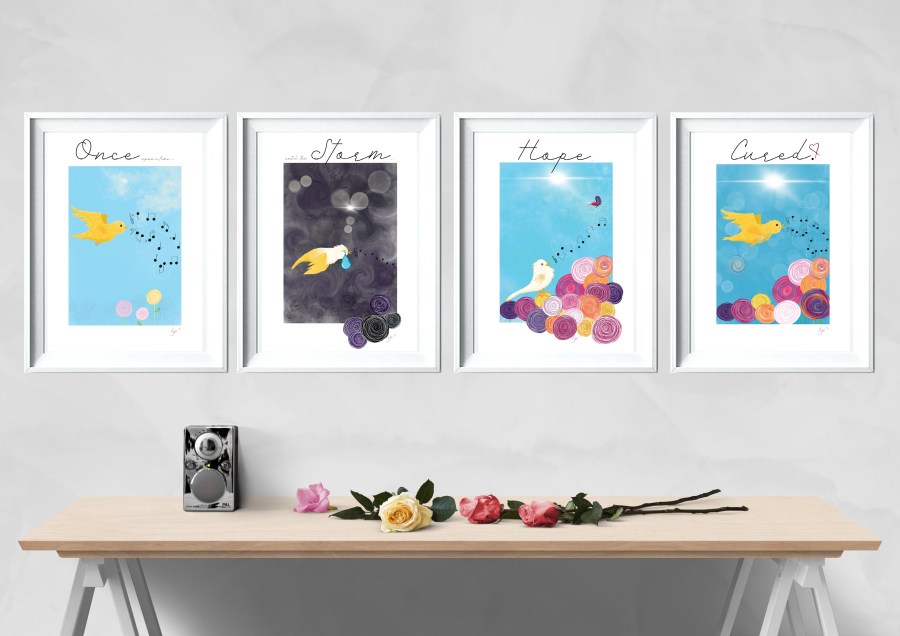
Life is good. The light shines more brightly when you have struggled through the darkest of dark storms.
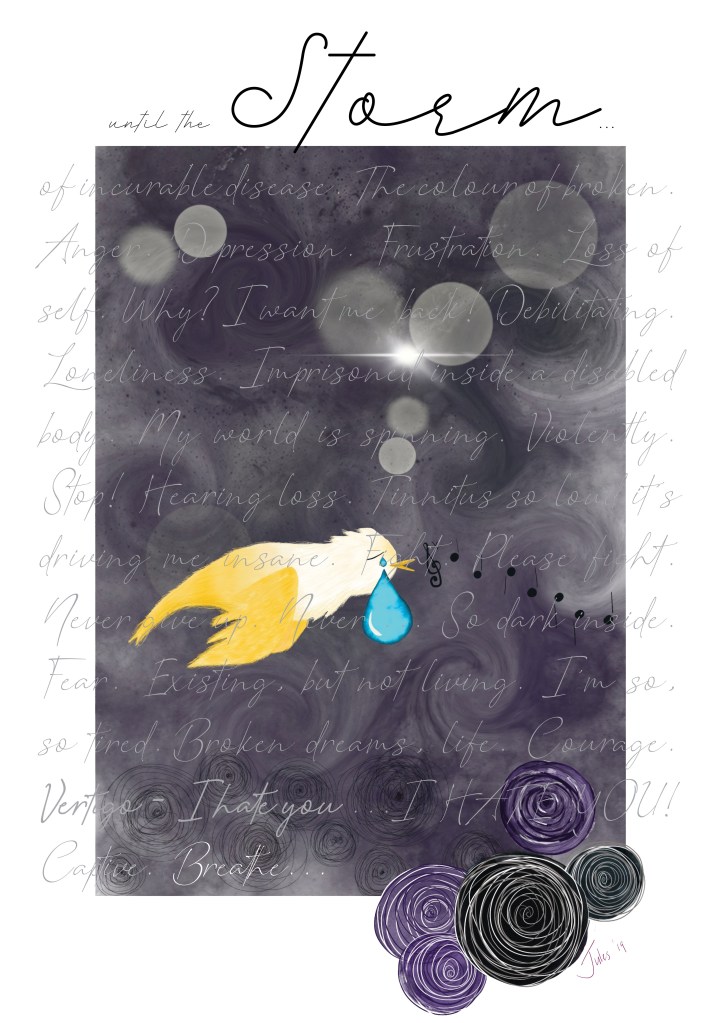
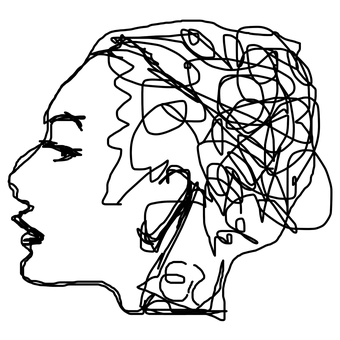
Art work by Julieann Wallace 2019
There is always hope.
Art work by Julieann Wallace 2019
Next blog. Happy New Ear! Cochlear Implant activation …
About this blog …
My Shadow, Meniere’s, is not just about the physical aspect of a Cochlear Implant – you can research about them online. I am sharing the human side of the journey towards a Cochlear Implant – feelings, appointments, the process, apprehensions, successes, highs and lows as I step into the next chapter of my Meniere’s journey.
I am mindful of those who also have incurable diseases or are walking the path of a diagnosis that is life changing. My blog never aims to undermine the severity of anyone else’s illness, disability or journey. We all deal with life with different tolerances, attitudes and thresholds. ‘My Shadow -Meniere’s’ is my journey. It is my hope that it can help others with Meniere’s disease, or hearing loss, or simply when life has a plot twist.
I also acknowledge those before me, who have already had a Cochlear Implant. Your experiences, advice and suggestions are welcome.
Life with an invisible illness is an interesting voyage.
People cannot see what you are going through, what you suffer- physically,
emotionally, psychologically, socially – your invisible scars – so it’s hard for
others to empathize.
People would often say to me, ‘Your life has been so easy. Everything just falls into place. Good things always happen to you. You’re always smiling.’ It used to frustrate me. They had no idea what I was going through. They had no idea I worked hard to be where I was in my career, my family, my three children. Nothing ever “fell into place”. It was earned.
During the hardest time of my Meniere’s disease, I was in
very deep and dark depression that I couldn’t climb out of. Yet, I kept
smiling. It was easier that way. I would patch up the cracks in my mask before
I put it on and met with others. If I could meet others … if my
shadow, Meniere’s, hadn’t imprisoned me for five hours of violent, debilitating
spinning that would land me in hospital at times.
In hindsight, I’m glad my illness is invisible. It makes it
easier to pretend that I am okay. I don’t have people avoiding me like I have a
contagious condition. I don’t have people looking at me with well-meaning
concern, or that “pity” look. I hate the pity look. I don’t have people
devaluing the severity of my symptoms, like:
‘It’s okay, dear, we all get dizzy sometimes.’
‘Oh, I have tinnitus too. It’s so common. When it’s really quiet, I can hear a little “sssssssssss”. You’ll be fine!’
‘My friend had Meniere’s disease – he got a bit faint sometimes. He went to the doctor and is cured.’
Meniere’s disease. No cause. No cure. Yet.
Good things are coming. I know it. I follow the research.
My Cochlear Surgeon is younger than me, as my ENT had said.
I follow the surgeon into his office, my shadow, Meniere’s,
behind me, then my husband, and anxiety far behind. The more I know about the
Cochlear Implant the less anxious I feel. And I am so thankful to hundreds of
people with Cochlear Implants who have reached out to me. The world is a
wonderful place.
The surgeon tells me that my ENT believes my Meniere’s
disease has “burnt out”.
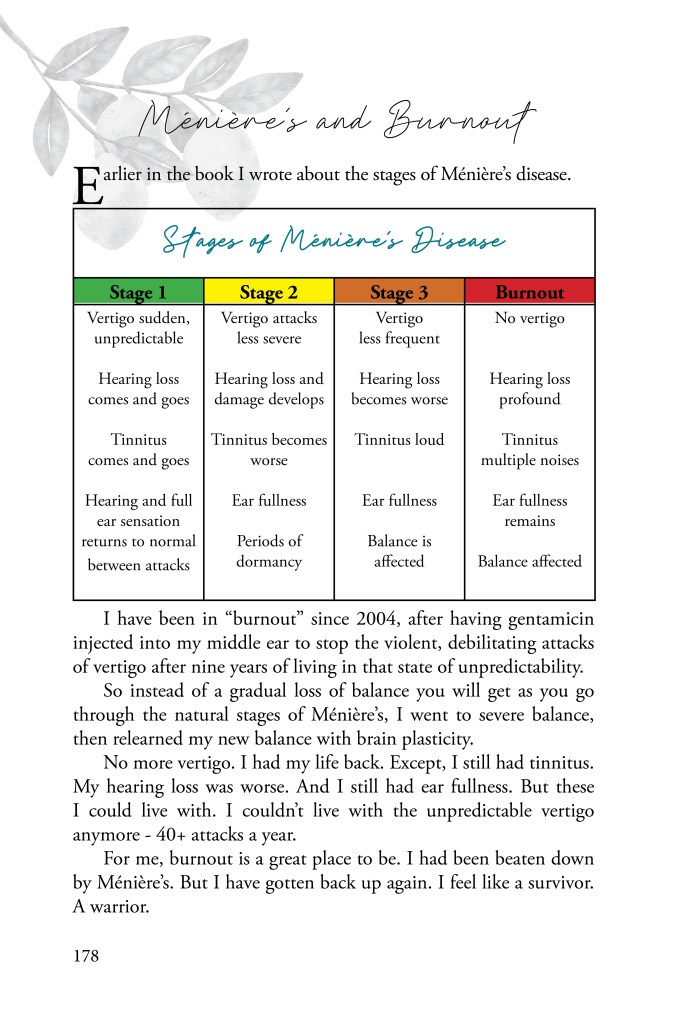
“Burnt out”. There’s those two words that float around in Meniere’s groups.
According to menieres-disease.co.uk, “the term ‘burn out’ is
frequently used to describe Meniere’s as though it is the end of the line, that
it has finished. However, it really means that the vertigo attacks have
disappeared as the vestibular function has now been destroyed. The disease
continues to progress as hearing is completely lost, tinnitus and fullness will
continue even after burn out.”
‘Hmmm … I’m not so sure that it has burned out. I still get little mini spins at times,’ I say. And it’s definitely not BPPV.
I am questioned about the history of my Meniere’s, then the surgeon asks me to sit on a stool so he can look inside my ears.
‘Spin to your left,’ he says.
‘Spin?’ I say with a smirk, referring to the spinning of
vertigo, then swivel the chair to the left, slowly.
‘Turn to your left,’ he says, smiling. Ah – he has
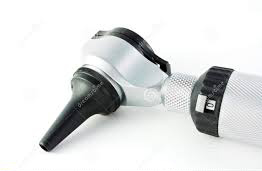
a sense of humour. Good. He uses the auriscope to look inside my ear canal.
‘Turn … to your right,’ he says with a smile in his
voice. I swivel the chair to the right, slowly, and he checks inside my ear
canal.
The remainder of the appointment flows with quick
succession:
Surgery date: 19 December. Overnight stay. $25, 000 Cochlear
Implant cost covered by the health fund. Any questions?
I take a deep breath. ‘Will my vertigo return?’
He considers my question, then says, ‘I don’t expect it to,
but there are no guarantees. For Meniere’s patients who still have some balance
cells left, I usually wash out the inner ear with gentamicin while I am in
there as an insurance that they will not have vertigo anymore, but since you
have been so good for quite a while without vertigo, I won’t do that, in case
it upsets anything.’
I nod, feeling a little numb. There is still no certainty that my vertigo will not return. How can it be burnt out if the vertigo returns? My shadow, Meniere’s, crosses its arms and grins.
Before I leave, the surgeon gives me a form for an MRI and CT Scan, and tells me I need balance rehabilitation before I have surgery, and to continue afterward. I raise my eyebrows and nod. I have never had balance rehabilitation; I just relearned my balance to walk by myself after the gentamicin was injected into my middle ear in 2004.
I leave the surgeon’s office. Anxiety is waiting.
Next – MRI and CT SCAN
About this blog …
My Shadow, Meniere’s, is not just about the physical aspect of a Cochlear Implant – you can research about them online. I am sharing the human side of the journey towards a Cochlear Implant – feelings, appointments, the process, apprehensions, successes, highs and lows as I step into the next chapter of my Meniere’s journey.
I am mindful of those who also have incurable diseases or are walking the path of a diagnosis that is life changing. My blog never aims to undermine the severity of anyone else’s illness, disability or journey. We all deal with life with different tolerances, attitudes and thresholds. ‘My Shadow -Meniere’s’ is my journey. It is my hope that it can help others with Meniere’s disease, or hearing loss, or simply when life has a plot twist.
I also acknowledge those before me, who have already had a Cochlear Implant. Your experiences, advice and suggestions are welcome.




























 My Shadow - Meniere's