It Will Change Your Life #7
Monday 18th November – Psychology Appointment
I see the psychologist today.
How does that make me feel?
When I first started the Cochlear Implant process, I was informed of the CI ‘Team’:
* ENT. done
* Audiologist. done
* Surgeon. done
* Psychologist …
* Cochlear Audiologist …
Balance Rehabilitation – an added one just for me –– only because I have had all my balance cells destroyed.
I’m working my way through the list.
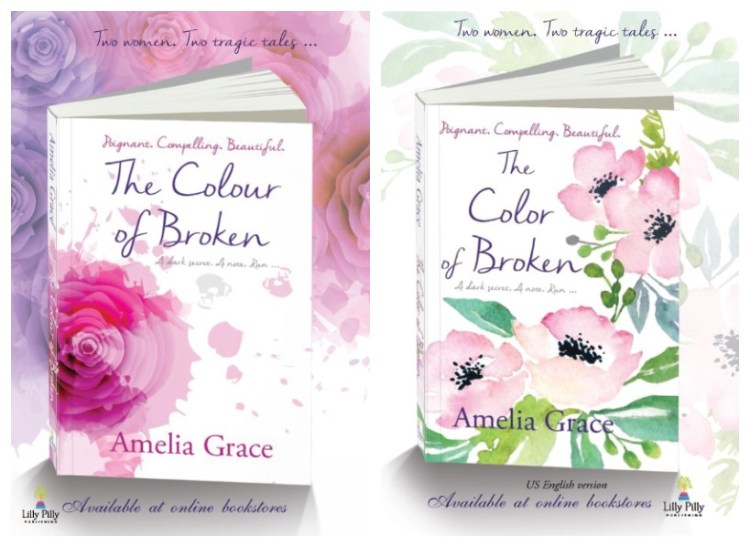
I arrive for my appointment ten minutes early, laughing on the inside. My weird sense of humour is getting the better of me. In my best-selling novel, ‘The Colour of Broken’, the main character, Andi, visits her psychologist regularly. I did a considerable amount of research to ensure the psychologist in my novel was asking the right questions. I already know what to expect.
I open the door and scan the waiting room. I have never seen so many artworks on medical walls. I’m in an artists’ paradise.
I’m asked to fill out some paperwork, and I promptly complete it.
Then I have a moment of downtime and the realisation hits me – the psychologist holds a power over me. He is a cog in the wheel of the cochlear implant team who can allow or deny my access to the hearing technology. He will make a judgement call by the end of the session. I sigh, and remind myself, ‘it’s part of the journey’, and the Cochlear Team want to ensure my mental wellness.
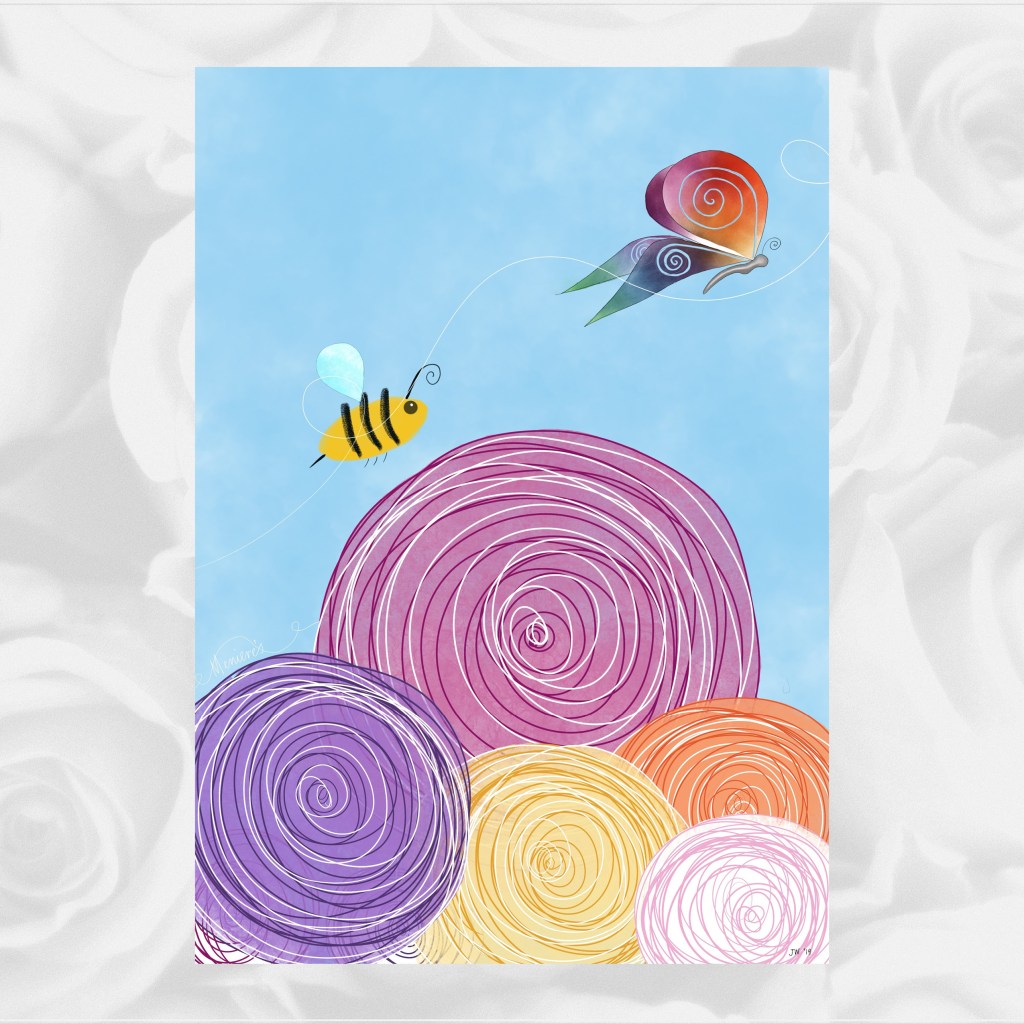
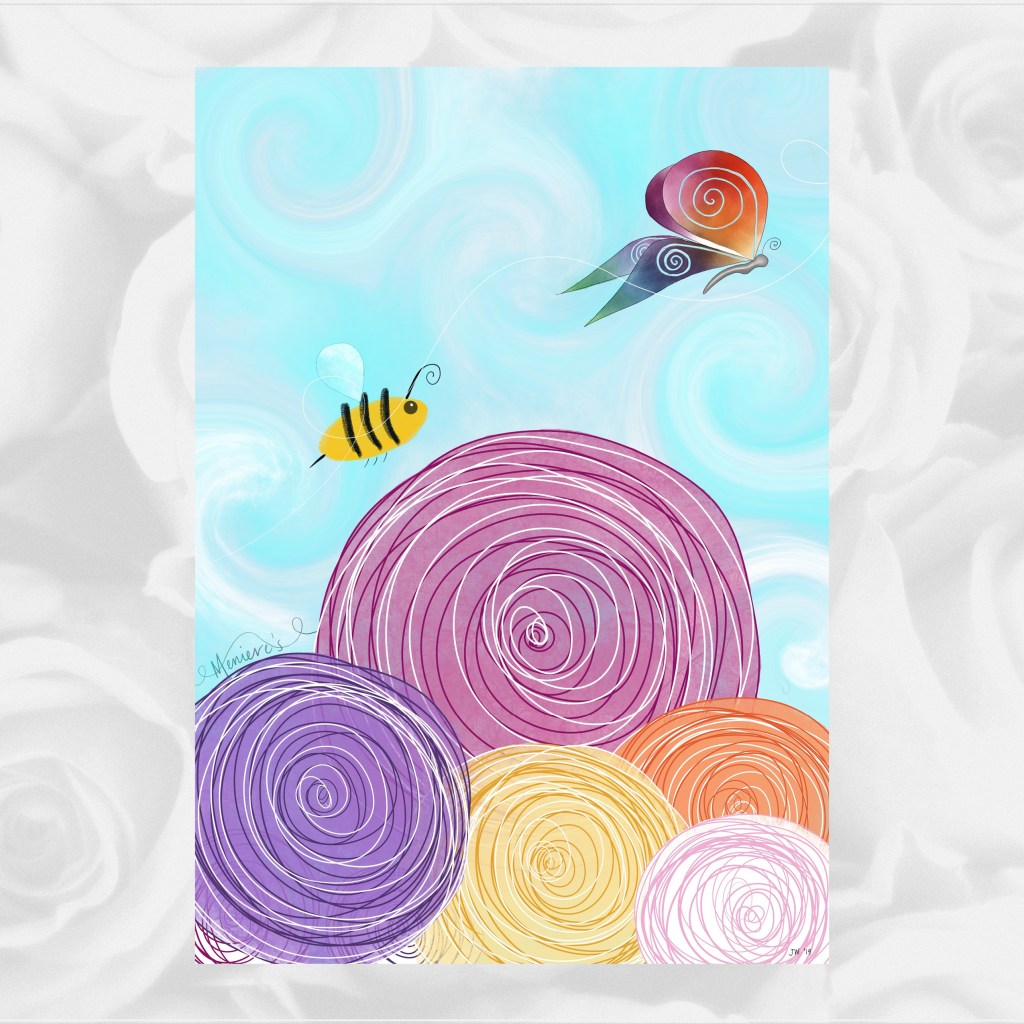
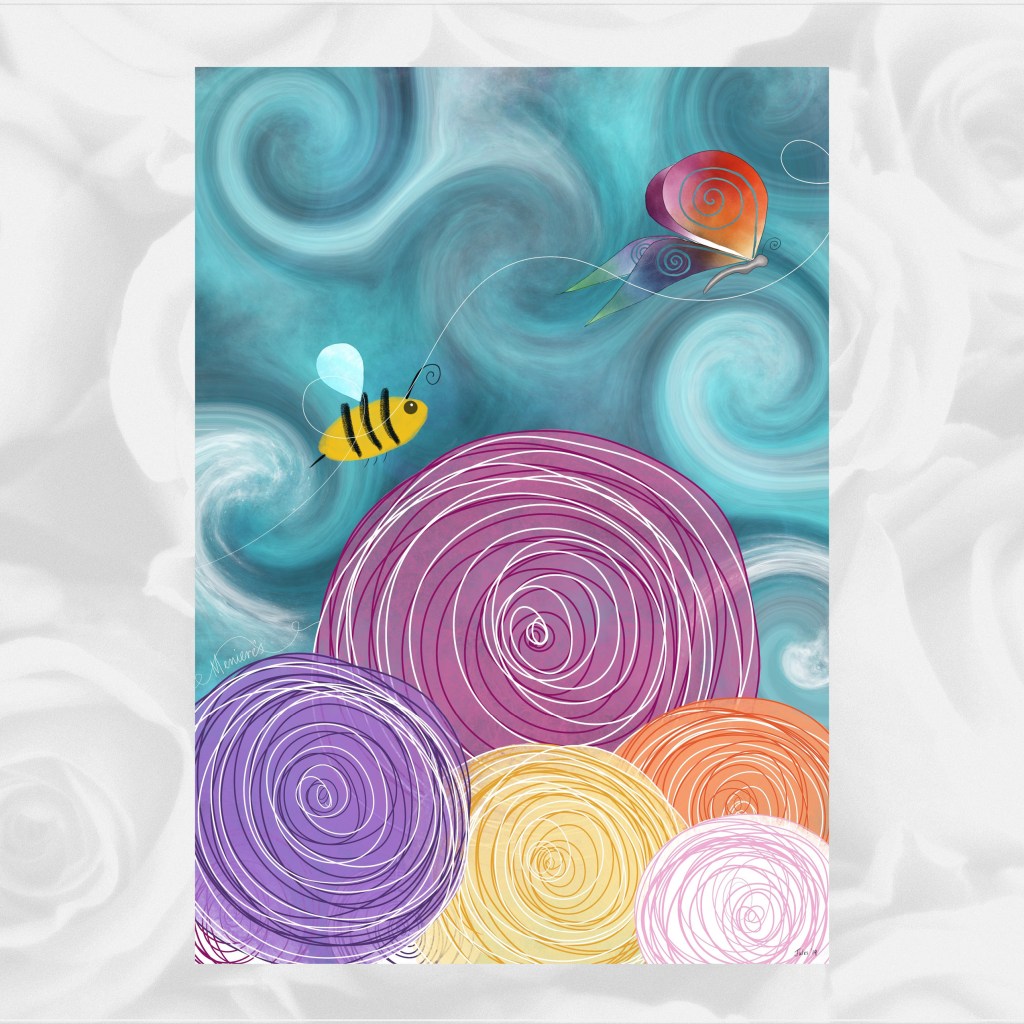
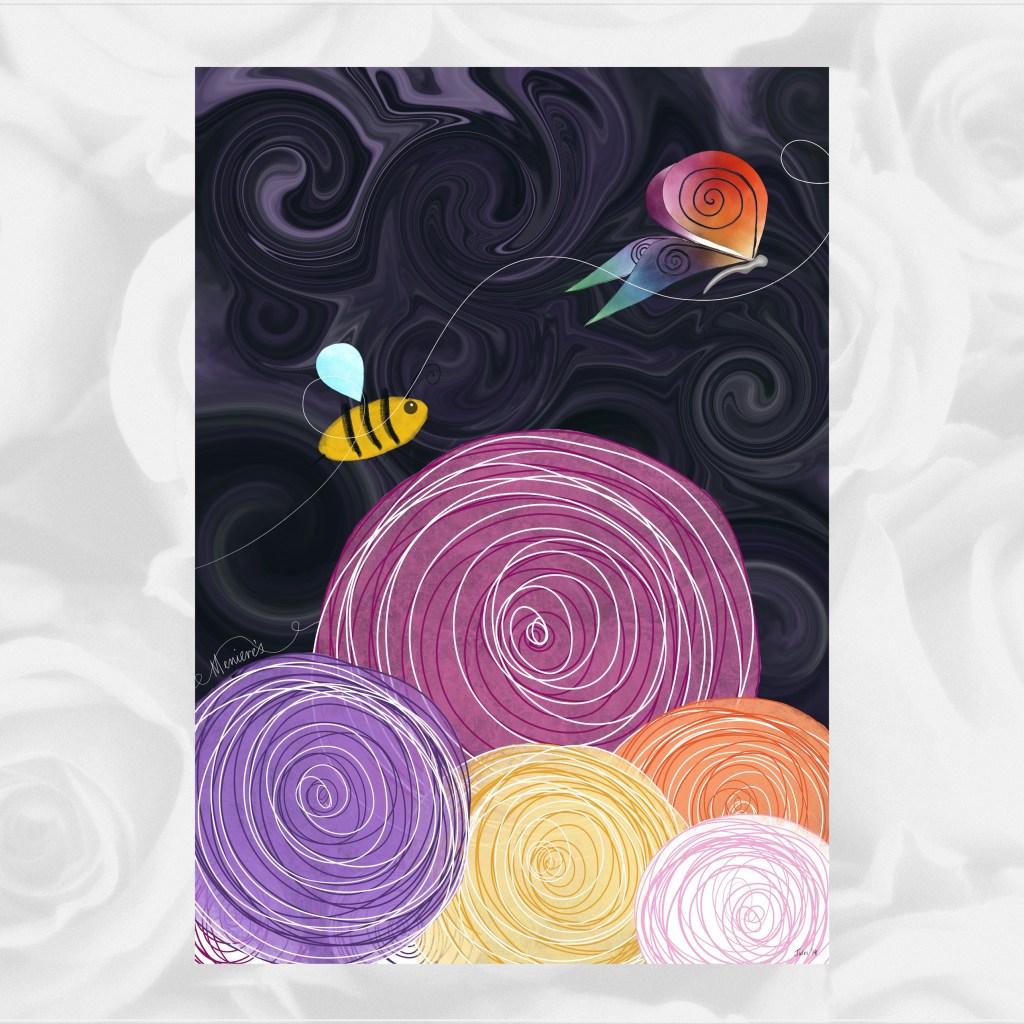
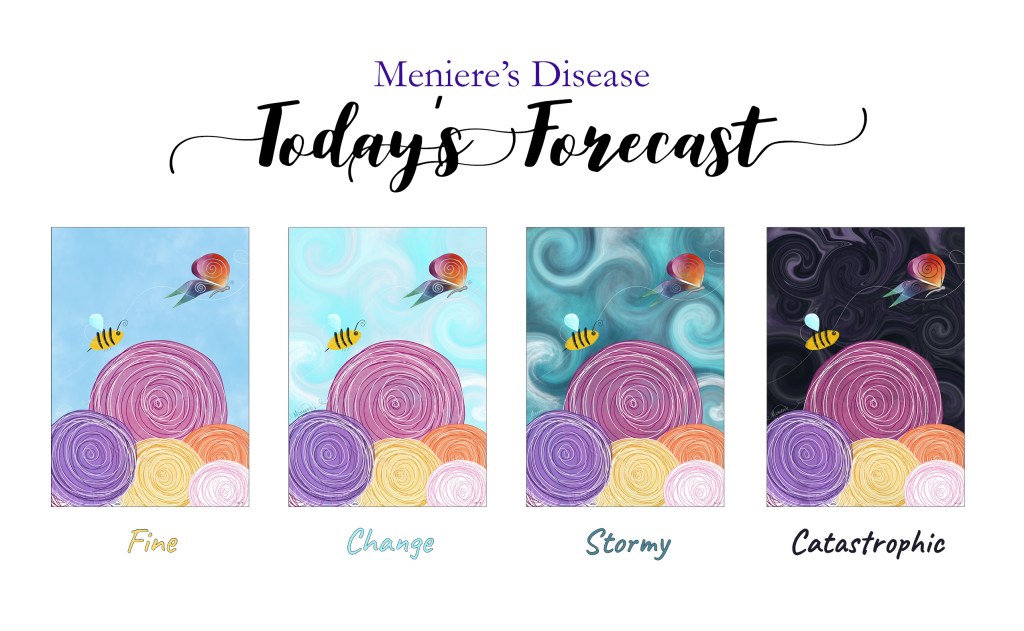
I open my iPad and work on a Meniere’s illustration I have been creating. It is full of symbolism. The buzzing bee for tinnitus. The vertigo flowers for vertigo, and the butterfly for loss of hearing, as most butterflies are deaf. The blue sky is a good coping day.
I change the backgrounds to add an oncoming vertigo attack.
I close my iPad. I soak in time like I have slowed it down. It feels like I have been here before, all because of my novel. It feels like a book paralleling real life.
(from “The Colour of Broken”)
I sat in the chair outside the psychologist’s office. I’m sure it had a permanent imprint of my butt on it. My mother’s hand was around my upper arm like a vice so I couldn’t run. She knew me well. Thank God. I didn’t want to be here, but I did. I needed to be here. Darkness had reached up to pull me under, yet again.
(me)
I sat in the chair outside the psychologist’s office. The seat was really comfy and I wiggled down into it. I was here by myself. I didn’t want to be here, but I had to. I needed to be here to prove that I was a suitable candidate for a Cochlear Implant.
(from “The Colour of Broken”)
‘Yolande.’ Dr Jones’s voice was comforting, like a warm childhood blankie and a mug of hot chocolate by the fireplace. My mother’s grip loosened on my arm and I stood, eyes focussed on the floor. I took slow steps into the office. The familiar office. I’d been here so often I was wondering when she’d ask me to pay rent.
Dr Jones put a light hand on my shoulder and led me to the couch. Usually she asked me whether I wanted to sit on the chair or lie on the couch. Today there was no such question. She knew me well. For a moment I wondered if psychologists ever saw a psychiatrist or psychologist themselves? Who did they go to when they had a problem?
(me)
‘Julieann.’ The psychologist’s voice was hard to hear, like listening to a voice through a wall. I stood, dropping my jacket and pen onto the floor, as per usual, picked them up, then took slow steps into the office. The unfamiliar office. It was smaller than I had imagined. The psychologist gestured to the black sofa with red and blue cushions, and told me to take a seat. I briefly wonder if he has already analysed my conscious choice about where to sit on the sofa. My shadow, Meniere’s, sits beside me, and looks the psychologist up and down. I gaze up at the artwork on the wall behind him and comment on the castle sitting on top of a mountain. It has dark undertones. I like it.

(from “The Colour of Broken”)
‘What brings you here today, Andi?’ Dr Jones asked, sitting beside me, so we weren’t facing each other.
‘The darkness within,’ I said, and sipped on some more tea. ‘And fear.’
‘Ah … good old Darius Darkness. Your friend. What is he trying to tell you?’
‘I deserve everything that happened. I almost believed him.But Darius is such a liar. He’s relentless at times.’
‘Well done, Andi. So, I’m assuming fear has jumped on board to weigh you down?’
‘Yes.’ I sipped on my tea. It warmed my throat and my stomach. I welcomed its warmth.
‘Fear of?’
‘Gram wants me to go to a garden party with a stranger to protect her bicycle. She told me not to wear my steel-capped boots.’
‘How does that make you feel?’
(me)
‘What brings you here today, Julieann?’ The psychologist asks, sitting opposite me, so we were facing each other.
I stop a smirk from appearing on my face, and think, he knows exactly why I am here. ‘The Cochlear Audiologist, the surgeon and the ENT,’ I rattle off, feeling like I am telling an accumulative story. I wished I had some tea to sip.
‘Ah, yes,’ he says. ‘Getting a cochlear implant will change your life. It’s my role is to make sure that you will be able to cope with the change.’
I nod.
‘How does getting a Cochlear Implant make you feel?’ he asks.
‘I … it …’ I look to the floor trying to find the right words. ‘I think it will make me feel like I have been released from the Meniere’s prison. Having an incurable disease – for anyone – is like feeling captive. You can’t leave. You’re never free.’

He nods his head as he writes furiously on his paper with a hot pink inked pen.

‘I think … it feels like … I might get a bit of the old me back, the me before I had Meniere’s disease,’ I add.
He nods and writes.
‘How does that make you feel?’
Silence. I don’t want to think back to before I was 30. I finally answer, ‘Scared.’
‘Why is that?’
‘It will push me out of my comfort zone. Sometimes I think people can get comfortable sitting within their disease, and use it as a type of crutch.’
He nods and writes.
His next questions are about my cochlear implant expectations, support people, then he encourages me to describe my life after I get a cochlear implant.
He talks about the importance of resilience, and wants to know what my strategies will be to help me get through it, and if somehow, the cochlear implantation isn’t what I think it will be.
His next question stops me in my tracks. ‘Tell me about your life before Meniere’s, and then during Meniere’s. I want to know what strategies you used to cope when you had active Meniere’s.
My voice trembles as I recount my life before Meniere’s. I never like reminiscing about what is was like being free of the beast. And I hate reminiscing about the very dark time in my life with active Meniere’s.
Tears. Stop.
I manage to keep them balancing on my eyelids.
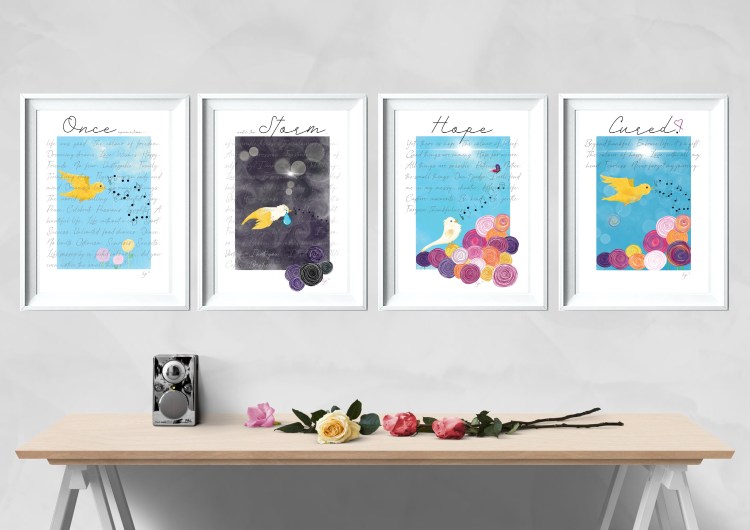
I take a deep breath then I tell him I would wake up each day and look for the positives. Even the very small positives, like the colour of flowers and nature. Patting my dog. I tell him I write, and it helps me. It’s the only time I don’t hear the loud tinnitus. I tell him I have a published novel with a main character with Meniere’s to raise awareness and help others that has sold around 2000 copies. I tell him that I volunteer as a research subject when the Mind and Brain Centre at the University puts a call out for Meniere’s people. I tell him that I love art, and recently exhibited a series of 4 artworks for Meniere’s awareness, called ‘Captive’.
The psychologist is writing at a phenomenal rate. I wonder if he has his own shorthand. Then I wonder if he can always read his words afterward.
For a split second in time I want to say, ‘You’re using a pink pen. How does that make you feel?’ But I don’t. Instead I search my mind for the meaning of pink – “the colour pink is the colour of universal love of oneself and of others”. He is in the right profession.
He stops writing and looks at me. ‘You would make an interesting research subject with something psychologists have recently termed “post-traumatic growth”, where you can use all the negativity of what has happened to you and use in in a positive way.’

I half smile. I would have preferred not having an incurable disease in the first place. I want to tell him that I discovered “post-traumatic growth” myself, and didn’t need a psychologist to give me the strategy or the label. I want to say that realistically, humans have been “post-traumatic growth-ing” since the beginning of trauma. It’s one way we bring light back into our dark world.
The psychologist leans back in his chair. ‘My job now is to write a report and send it to the cochlear implant team. I will recommend that you are a suitable candidate for a cochlear implant, and that you have strategies that will help you cope with the change that is coming.’
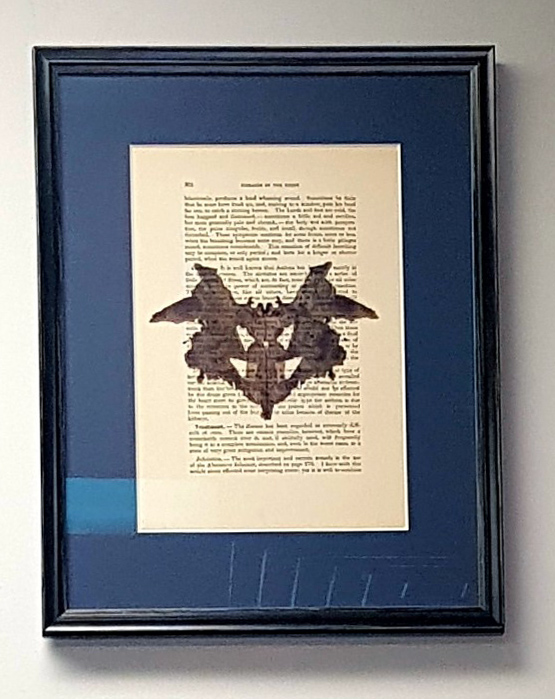
I smile. ‘Thank you,’ I say, then pluck up the courage to comment on a piece of artwork the room. I know it is part of the ink blot test.
He smiles back. ‘It’s from Rorschach’s Ink Blot test. Then he takes me to the reception area and proudly shows me the Rorschach’s Ink Blot Test Collection – on a background of typed text, mounted and framed.
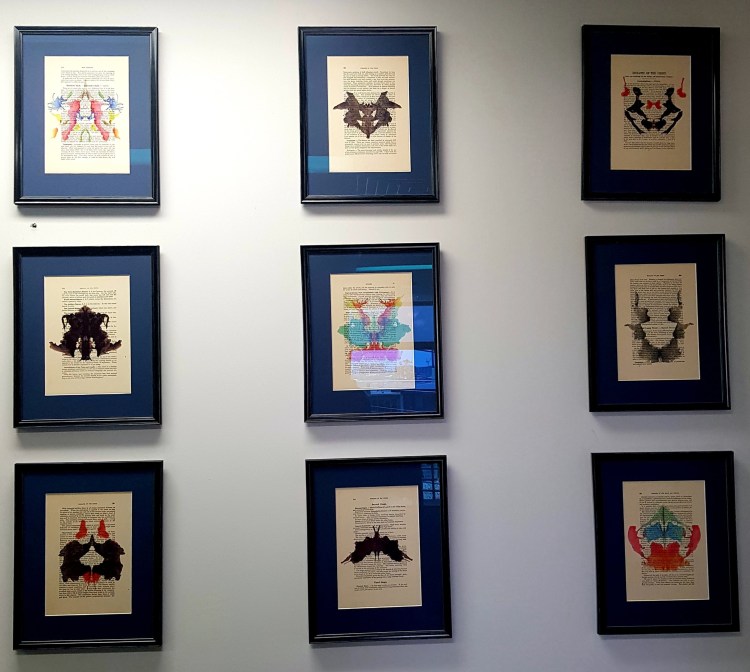
If Meniere’s disease was one of those ink blots, it would definitely be:
I leave the psychology appointment with a bounce in my step. The Cochlear Implant is getting closer to becoming a reality.
I have also finalised the design of my Meniere’s artwork in my mind that I was working on before the meeting:
Next appointment – Wednesday 20th November – final expectations with the cochlear audiologist.
If you would like to read the full excerpt from Chapter 12 of “The Colour of Broken” click here. Scroll down the new page to find Chapter 12.
About this blog …
My Shadow, Meniere’s, is not just about the physical aspect of a Cochlear Implant – you can research about them online. I am sharing the human side of the journey towards a Cochlear Implant – feelings, appointments, the process, apprehensions, successes, highs and lows as I step into the next chapter of my Meniere’s journey.
I am mindful of those who also have incurable diseases or are walking the path of a diagnosis that is life changing. My blog never aims to undermine the severity of anyone else’s illness, disability or journey. We all deal with life with different tolerances, attitudes and thresholds. ‘My Shadow -Meniere’s’ is my journey. It is my hope that it can help others with Meniere’s disease, or hearing loss, or simply when life has a plot twist.
I also acknowledge those before me, who have already had a Cochlear Implant. Your experiences, advice and suggestions are welcome.

 My Shadow - Meniere's